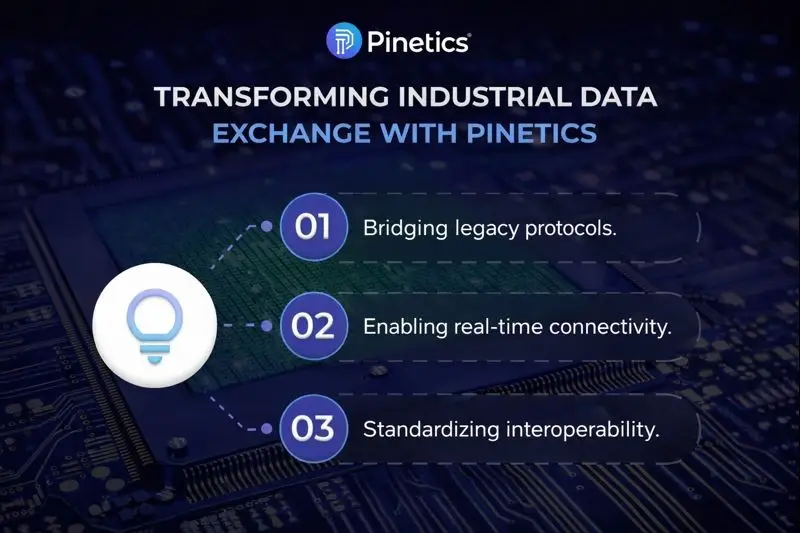
You bridge legacy and modern industrial protocols with a translation layer, usually an embedded gateway, between machines that speak Modbus, PROFIBUS, CAN or RS-485 and platforms that expect OPC UA, MQTT or REST, so that integrating legacy industrial protocols with IoT analytics platforms does not mean replacing machines. Pinetics bridges legacy and modern industrial protocols with gateways it designs.
If you are connecting a plant built up over twenty years to an analytics platform now: list which protocols are on the floor; what data each machine must deliver and how fast; who may reach each machine; and what must keep running when the network drops. Those four answers size the gateway, the timing design, the security design and the edge-versus-cloud split before any hardware is chosen.
Industrial automation today depends on continuous, real-time data exchange across machines, devices, and control systems. Yet many industrial plants still operate communication protocols designed decades ago, long before IIoT, AI, cybersecurity threats, and cloud connectivity existed.
Legacy protocols were never built for:
- High-speed data streaming
- Cross-vendor interoperability
- Large-scale device connectivity
- Modern security requirements
The result is predictable: integration complexity, latency problems, system inefficiencies, and increasing cybersecurity risk.
Factories are modernising equipment, but the underlying communication fabric still reflects the past. In heterogeneous environments with PLCs from different vendors, mixed-age machines, and hybrid cloud-edge architectures, protocol compatibility becomes one of the largest barriers to digital transformation.
At Pinetics, we focus on eliminating those barriers.
We simplify complex industrial communication by bridging legacy and modern industrial protocols, delivering seamless protocol translation, real-time data flow, and secure connectivity across diverse industrial infrastructures.
Our solutions are closely tied to our expertise in:
- Embedded Product Development Services
- Hardware Design and Development
- Electronic Product Design Services
- Medical Device Hardware Design
As industrial systems evolve, the communication layer must evolve with them, and that is exactly where Pinetics delivers value.
Why does bridging legacy and modern industrial protocols matter?
Bridging legacy and modern industrial protocols matters because almost no plant is greenfield: it holds PLCs on serial links, CAN instrumentation, fieldbus machinery, Ethernet controllers, IIoT gateways and cloud dashboards bought over decades, each speaking its own language. Until they are translated, the plant’s data sits in silos and modernisation stalls at the communication layer, not the equipment.
Most industrial ecosystems are not greenfield digital factories. They have evolved over the years. As a result, they contain a mix of technologies:
- Old PLCs communicating via serial links
- CAN bus instrumentation
- Fieldbus-based machinery
- Ethernet-enabled controllers
- Modern IIoT gateways
- Cloud dashboards and analytics systems
Each speaks a different “language.”
Why do legacy industrial protocols not talk to modern IoT platforms?
Legacy industrial protocols do not talk to modern IoT platforms because they were designed for isolated, closed-loop systems: a Modbus, PROFIBUS, CAN or RS-485 link assumes a fixed device set on one wire and no outside network. OPC UA, MQTT and REST assume many clients, structured data models, authentication and the internet. Without a bridge, the two become silos.
Legacy protocols such as:
- Modbus
- PROFIBUS
- CAN Bus
- RS-485
were designed for isolated, closed-loop systems.
Modern environments demand protocols such as:
- OPC UA
- MQTT
- RESTful APIs
- IIoT platforms
Without translation bridges, these networks become information silos.
Manual workarounds emerge:
- CSV exports
- Offline data logging
- Middleware patches
- Vendor-locked proprietary tools
These increase costs, create operational risk, and slow digital transformation.
Six protocols the bridge has to handle, what each was built for and the primary source for each
| Protocol | Built for | Primary source |
|---|---|---|
| Modbus | Client-server messaging structure, since 1979 | Modbus Organization |
| PROFIBUS | Factory and process automation fieldbus, IEC 61158 | PROFIBUS and PROFINET International |
| CAN | Multi-master control bus; data link layer ISO 11898-1:2024 | ISO 11898-1 page |
| RS-485 | Serial physical layer under many Modbus and PROFIBUS links | Modbus FAQ, physical layers |
| OPC UA | Platform-independent data exchange with information models | OPC Foundation |
| MQTT | Lightweight publish and subscribe messaging, OASIS standard | MQTT.org |
The gap between the legacy protocols and the modern ones is not only syntax. A Modbus register arrives as a raw value with no unit, no timestamp and no name; an OPC UA node is expected to carry all three, and an MQTT payload carries them only if somebody designs it to. The bridge therefore does more than repackage bytes: someone has to decide, machine by machine, what each register means, how often it is read and what happens when a read fails. That mapping is engineering work with an owner, not a configuration screen.
Can legacy machines connect to IoT analytics platforms without being replaced?
Yes. Legacy machines connect to IoT analytics platforms through an embedded gateway that reads RS-485, CAN and fieldbus traffic on one side and publishes into MES, SCADA, ERP, predictive maintenance and cloud systems on the other, so integrating legacy industrial protocols with IoT analytics platforms needs no rip-and-replace. The machine keeps its controller; the gateway carries the translation.
Pinetics builds intelligent communication frameworks that allow machines, irrespective of age or vendor, to communicate effortlessly.
Many manufacturers fear modernisation because they assume it requires full equipment replacement. That is unnecessary and economically unrealistic.
We translate legacy protocols such as:
- RS-485
- CAN Bus
- Fieldbus variants
into modern IIoT frameworks.
This allows existing machines to integrate with:
- Analytics dashboards
- MES and SCADA
- ERP platforms
- Predictive maintenance engines
- Cloud data lakes
- Without hardware rip-and-replace.
This is where our experience in embedded product development services and electronic product design services becomes essential. We build intelligent protocol converters and embedded gateways that sit between legacy machinery and modern IT infrastructure.
Choosing the gateway is a decision in its own right, covered in our post on choosing an IoT gateway for an edge computing project: processor, protocol stack, security hardware and update path. What matters here is that the gateway is a product, with a schematic, a layout and firmware that will run unattended beside the machine for years, so the decisions that settle whether it survives, the power design, the heat it has to shed and the update path, belong in the schematic review and not in the pilot.
How does real-time industrial connectivity work over standard Ethernet?
Real-time industrial connectivity over standard Ethernet uses Time-Sensitive Networking, the IEEE 802.1 TSN standards that add scheduled transmission, time synchronisation and bounded latency to ordinary Ethernet, so that motion control, robotics and process control traffic arrives when expected rather than when the network gets round to it. Legacy fieldbuses gave that determinism on proprietary wiring; TSN gives it on Ethernet.
Real-time data is essential for:
- Motion control
- Robotics
- Automated material handling
- Precision manufacturing
- Chemical process control
Pinetics leverages Time-Sensitive Networking (TSN) to ensure deterministic, low-latency communication.
TSN supports:
- predictable network scheduling
- synchronised device communication
- strict timing guarantees
- reduced packet jitter
This transforms standard Ethernet infrastructure into real-time industrial communication backbones without requiring proprietary networks.
The IEEE 802.1 TSN task group states its aim as “guaranteed packet transport with bounded latency, low packet delay variation, and low packet loss”. The practical question for a plant is narrower: which loops need that guarantee. Most analytics traffic does not; a motion axis or a safety interlock does, and separating the two on the design drawing is what keeps the deterministic part of the network small enough to verify.
How do OPC UA, MQTT and REST make a multi-vendor plant interoperable?
OPC UA, MQTT and REST make a multi-vendor plant interoperable by giving every device one way to describe and publish its data. OPC UA carries a structured information model with security built in; MQTT brokers fan lightweight messages out to many subscribers; REST gateways expose the same data to enterprise systems. An industrial gateway typically speaks all three northbound.
Industrial automation is increasingly multi-vendor, and interoperability is critical.
We simplify communication via:
- OPC UA integration
- MQTT brokers
- RESTful API gateways
This allows seamless communication between:
- OT devices in plants
- Edge compute nodes
- Cloud platforms like AWS, Azure, GCP
- Enterprise business systems
Our hardware design and development teams design smart edge devices that perform protocol conversion, device management, security, and analytics at the network edge, reducing dependence on centralised systems.
The OPC Foundation describes OPC UA as “a platform independent service-oriented architecture” that runs on hardware from PCs and cloud servers down to PLCs and microcontrollers, and MQTT is an OASIS standard. The choice between them is not either-or: OPC UA is where the plant’s data model lives and MQTT is how that data reaches the cloud cheaply, so a gateway that speaks only one of them narrows what the plant can add later.
What does AI-driven adaptive protocol management do?
AI-driven adaptive protocol management watches industrial traffic and changes how it is handled as conditions change: it prioritises control packets ahead of bulk data when congestion is predicted, compresses data streams where bandwidth is scarce and converts protocols at the edge so a plant runs through a cloud outage. It sits above the protocol bridge, not in place of it.
Industrial environments are not just complex; they are noisy, high-interference environments where communication reliability cannot be assumed.
Pinetics employs AI-driven adaptive communication frameworks that intelligently manage industrial traffic.
Intelligent Packet Prioritisation
AI analyses network load patterns and predicts congestion before it happens. Data packets are dynamically prioritised so that mission-critical control traffic always moves first, preventing production delays and communication failures.
Real-time Data Compression
In remote plants and offshore facilities, bandwidth is limited. Our AI algorithms compress data streams while maintaining data integrity, enabling efficient communication in low-connectivity environments.
Edge-processed Protocol Conversion
Rather than routing all traffic through centralised cloud servers, protocol conversion happens at the edge.
Benefits include:
- Lower network latency
- Offline functionality during outages
- Reduced bandwidth consumption
- Improved data security
This aligns directly with our embedded product development services, where we design intelligent gateways capable of edge analytics, hardware security modules, and remote management.
Before any traffic management described as adaptive goes near a control network, ask one question of whoever proposes it: what happens when the model is wrong? A prediction of congestion that lowers the priority of a safety interlock is worse than no prediction at all, so the control path needs a fixed priority floor that no algorithm can lower. That floor is set in the gateway’s firmware and, where the network supports it, in the IEEE 802.1 TSN transmission schedule, not learnt.
How is industrial communication secured from edge to cloud?
Industrial communication is secured from edge to cloud by encrypting every link with TLS 1.3 and AES, authenticating every device and user instead of trusting the network they sit on and watching protocol traffic for command sequences and rates a real machine would never produce. IEC 62443 is the standard series that frames this for industrial automation and control systems.
Industrial networks are now prime cybersecurity targets. Once isolated, OT systems are now connected to cloud applications, creating new attack surfaces.
At Pinetics, security is architected into every protocol handling layer.
Our approach includes:
End-to-end Encryption
We implement encryption standards such as:
- AES-256
- TLS 1.3
Ensuring data remains protected from device to cloud.
Zero-Trust Authentication
No endpoint is trusted by default.
We implement:
- Multi-factor authentication (MFA)
- Role-based access control
- Certificate-based device authentication
This protects against spoofing, unauthorised devices, and insider risk.
AI-based Intrusion Detection
Our anomaly detection engines continuously monitor protocol traffic.
They identify:
- Unexpected command sequences
- Communication rate deviations
- Abnormal device responses
and automatically isolate suspicious nodes in real time.
Security is especially critical in regulated sectors such as healthcare and medical device hardware design, where communication integrity is directly linked to patient safety.
Four security controls on the path from device to cloud, what each protects and the primary source
| Security control | What it protects | Source |
|---|---|---|
| TLS 1.3 | The link between device, gateway and cloud | RFC 8446 |
| AES-256 | Data inside the encrypted link and at rest | FIPS 197 |
| Zero trust | Every request checked; no trusted network zone | NIST SP 800-207 |
| IEC 62443 | The whole control system lifecycle, component to plant | IEC on 62443 |
IEC 62443 “was developed to secure industrial automation and control systems (IACS) throughout their lifecycle”, and NIST’s SP 800-207 defines zero trust as moving “defenses from static, network-based perimeters to focus on users, assets, and resources”. A twenty-year-old PLC cannot run TLS itself, so the gateway is where those controls begin, which is why the gateway’s own key storage and firmware update path are the first two questions to put to any supplier. How the device-to-cloud link is designed is the subject of our post on securing IoT communication.
How do you future-proof industrial connectivity?
You future-proof industrial connectivity by designing the architecture so that computation can move between on-premises controllers, edge gateways and cloud platforms as needs change, a new wireless link can be added without redesigning the data model and a new device can be onboarded without a vendor’s proprietary tool. The protocol bridge is where that flexibility is won or lost.
Industrial automation strategies must prepare for rapidly shifting technology standards. Pinetics designs communication architectures that evolve with future infrastructure, not against it.
Hybrid Cloud and Edge Connectivity
We engineer solutions that intelligently distribute computation between:
- On-premises control systems
- Edge gateways near production equipment
- Cloud analytics platforms
This ensures resilience, scalability, and regulatory flexibility.
Readiness for 5G and Private Industrial Networks
Low latency 5G enables:
- Mobile robots and AGVs
- Remote operations
- Wireless factory networks
- Ultra-reliable low-latency communication (URLLC)
Next-generation Protocol Standardisation
We actively engage in emerging industrial IoT frameworks, enabling:
- Plug-and-play device onboarding
- Interoperable vendor ecosystems
- Unified machine identity models
This reduces vendor lock-in and increases enterprise agility.
The test of a future-proof design is a dull one. Can a device bought from a different vendor next year be added by editing a configuration and an OPC UA information model, or does it need new firmware on the gateway? If the answer is firmware, the architecture is tied to today’s device list, however modern the protocols on the drawing.
Why does protocol bridging need product engineering rather than IT networking alone?
Protocol bridging needs product engineering because the bridge is a physical device on the plant floor: an embedded gateway with its own electronics, firmware, hardware security and compliance obligations, running unattended beside machines for years. IT networking configures switches and brokers; product engineering designs, tests and supports the box that turns RS-485 or CAN traffic into OPC UA or MQTT.
Bridging industrial protocols is not just an IT networking problem; it intersects deeply with:
- Embedded systems
- Device electronics
- Hardware security
- Compliance engineering
That is why Pinetics integrates protocol engineering with:
- Embedded Product Development Services
- Hardware Design and Development
- Electronic Product Design Services
- Medical Device Hardware Design
This multidisciplinary capability allows us to deliver complete industrial connectivity solutions, not just standalone software.
We design:
- Custom embedded gateways
- Protocol bridges
- Edge analytics modules
- Secure hardware communication modules
tailored to specific industry environments such as manufacturing, energy, transportation, and healthcare.
That is also why the gateway is built like any other product. On an industrial IoT gateway programme Pinetics ran, every design stage was paired with its own review and rework step: schematic design, schematic review, schematic rework, component placement, layout, layout review, layout rework, output files and then order, with design change notices prepared and reviewed as tracked work. It is also why a machine that is already running and already earning is as likely a starting point as a blank sheet. Pinetics is asked to take over engineering on products in the field, sustaining them, reducing their cost or revising a part that works but costs too much, as often as it is asked to design something new, and a protocol bridge on an ageing line is work of that kind. How a hardware and firmware programme runs from architecture to design transfer is set out on our page on how we run a product development programme.
Do you need to replace everything to modernise industrial communication?
No. You do not need to replace everything to modernise industrial communication; you need to connect everything intelligently, through a bridge that translates legacy protocols, secures the data flow, keeps control traffic real-time and lets analytics platforms read machine data they could not reach. Replacing working machines to fix a communication problem is the expensive answer to the wrong question.
Most organisations are still stuck with fragmented legacy communication systems. They know modernisation is necessary but fear the disruption and cost of replacing entire infrastructures.
The reality is more encouraging:
You do not need to replace everything; you need to connect everything intelligently.
Pinetics enables industries to:
- bridge old and new communication systems
- secure industrial data flows
- operate in real time
- unlock actionable insights from machine data
- prepare for IIoT, AI, and autonomous operations
Industrial communication is becoming the backbone of digital transformation. The right strategy determines whether connectivity becomes a barrier or a competitive advantage.
Pinetics designs and builds the bridge itself: the embedded gateway that sits between the machines and the platform, its firmware, its security hardware and its update path, for manufacturing, energy, transportation and healthcare plants. That work rests on 100,000+ engineering hours and a leadership team with 20+ years of experience, and it starts with the same four questions every time: which protocols are on the floor; what data each machine must deliver and how fast; who may reach each machine; and what must keep running when the network drops. If your plant’s data is stuck behind protocols older than your analytics platform, talk to Pinetics about the bridge before you price the replacement.
With Pinetics, it becomes your advantage.
Sanjay Barewar, Director, Co-Founder and Global Chief Delivery Officer, Pinetics. 22+ years in electronic product development. BE Electrical, Pune University. LinkedIn