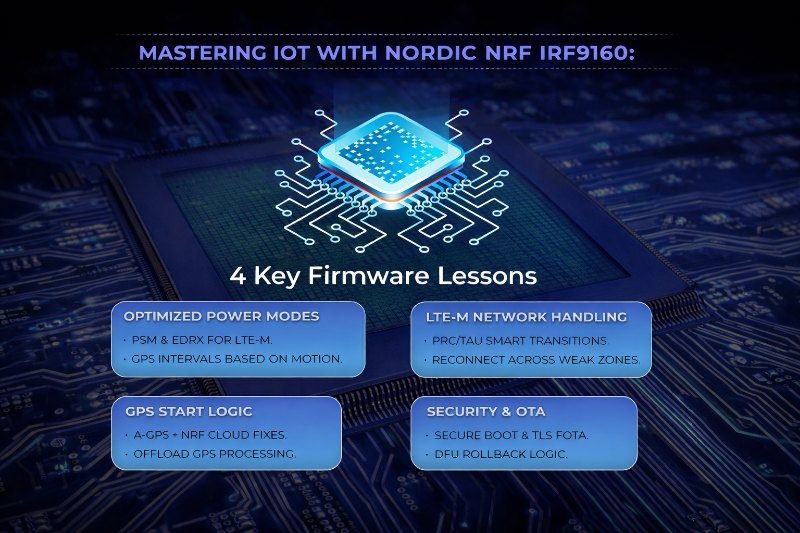
Firmware is the backbone of the Internet of Things. It is more than just low-level device software; it is the intelligence layer that determines how secure a device is, how efficiently it performs, how long it lasts in the field, and how easily it adapts to new requirements.
Without robust firmware, even the most advanced hardware becomes unreliable. Poorly designed firmware leads to sluggish performance, battery drain, unstable connectivity, insecure communication channels, and, in the worst cases, complete device failure. In large IoT deployments, these problems multiply rapidly and become operational risks.
At Pinetics, we approach firmware as a strategic engineering discipline. Through advanced Firmware Development Services partnered with IoT Product Development Services, we engineer firmware ecosystems designed for performance, resilience, and long-term scalability, not just short-term functionality.
Firmware is where connectivity meets intelligence. Done right, it becomes the foundation for smarter devices, autonomous decision-making at the edge, and secure cloud-integrated operations.
Why Traditional Firmware Architectures Fail Modern IoT Systems
Many IoT devices today are still built using monolithic firmware architecture. Initially, this approach seems simple: one block of tightly coupled firmware controlling all device functions. Over time, however, this creates severe problems:
- Upgrades are risky and complicated.
- Fixing one bug risks impacting multiple subsystems
- Adding new features requires rewriting large sections.
- Performance tuning is difficult.
- Security patches are slow to roll out.
Monolithic firmware is rigid in a world that demands continuous evolution.
IoT is inherently dynamic. Devices are deployed in varying environments, interact with unpredictable network conditions, require over-the-air updates, and must support new functionality of post-deployment. This environment demands highly modular, testable, adaptable firmware frameworks.
Modular Microservices-Based Firmware Architecture
To solve the limitations of monolithic systems, Pinetics designs firmware based on microservices principles.
Instead of one large code block, functionality is broken into independent modules handling:
- Connectivity
- Data processing
- Security
- Analytics
- Hardware abstraction
- Cloud communication
This modern approach ensures:
Faster Updates with Minimal Downtime
Firmware modules can be updated individually without replacing the entire codebase. This dramatically reduces deployment risk and increases the pace of product improvement.
Fault Isolation and Resilience
If one service crashes, the device keeps functioning. Critical safety services continue running while non-essential modules restart autonomously.
Easier Scalability
New capabilities such as advanced diagnostics, additional sensors, or AI-based features can be added without reworking the core architecture.
This framework also aligns directly with enterprise-grade IoT Product Development Services, where product lines evolve continuously and need a long-term software foundation.
AI-Driven Predictive Testing and Self-Healing Firmware
Most testing strategies validate behavior only before deployment. But IoT ecosystems evolve dynamically; firmware must adapt continuously after devices are already in the field.
Pinetics integrates AI-powered validation and self-healing mechanisms, enabling firmware to detect faults before they become failures.
Automated Regression Testing
AI-driven testing scripts execute thousands of functional and stress test cases automatically, identifying edge-case failures long before deployment. This increases confidence and greatly reduces post-release defects.
Digital Twins for Real-world Simulation
Digital twins replicate real-world device conditions in a virtual model, allowing firmware to be stress-tested under extreme temperature, connectivity instability, packet loss, and voltage variation scenarios.
Edge AI-Based Self-Healing Mechanisms
Firmware independently monitors its own performance. When degradation is detected, it:
- Resets affected modules
- Reallocates resources
- Adjusts operating parameters
- Prevents complete device failure
This moves firmware from passive control logic to active autonomous resilience.
Secure and Future-Ready OTA Firmware Updates
Firmware is the most common point of attack in IoT security breaches. Insecure update mechanisms allow attackers to:
- Inject malicious code
- Hijack devices
- Shut down critical services
- Access sensitive data
Pinetics builds security into OTA from the ground up using:
End-to-end Encrypted Updates
Data remains encrypted during transfer and installation, preventing tampering and reverse engineering.
Delta Patch Mechanisms
Only changed blocks of the firmware are downloaded, lowering bandwidth consumption by up to 75%, especially critical for LPWAN and cellular IoT deployments.
Rollback Protection and Version Control
If an update fails, devices revert automatically to the last stable firmware build. This prevents outages, bricked devices, and costly field replacements.
OTA becomes not just a feature but a strategic operational capability.
Building Firmware for Scale, Security, and Performance
Enterprise IoT deployments include thousands to millions of devices. Firmware must therefore be built for scale from day one.
Pinetics focuses on:
Lightweight RTOS Frameworks
Real-Time Operating Systems optimized for deterministic performance ensure ultra-low-latency responses for:
- Industrial controls
- Automotive electronics
- Smart medical systems
- Home automation
- Security monitoring
Edge Processing and Security Layers
Processing data locally reduces latency and cloud dependency, while layered security models protect:
- Device identity
- Communication channels
- Stored data
Zero-Downtime Rolling Updates
Fleet-wide firmware updates are rolled out gradually across devices to ensure uninterrupted service delivery.
Firmware Is Central to Product Strategy, Not Just Engineering
Modern digital products are no longer defined only by physical hardware. Their real differentiation comes from:
- Connectivity capabilities
- Device intelligence
- Cloud integration
- Update capability
- Data analytics
Firmware sits at the core of each of these functions.
Organizations that treat firmware merely as an afterthought risk delivering products that:
- Become obsolete faster
- Cannot evolve post-deployment
- They are difficult to secure.
- Fail regulatory expectations
Those that make firmware a core strategic competency build long-life products capable of evolving with markets.
The Link Between Firmware and Full IoT Product Lifecycle Success
Effective firmware engineering directly impacts every stage of IoT Product Development Services, including:
- Device prototyping
- MVP rollout
- Pilot deployment
- Mass manufacturing
- Lifecycle support
- Feature evolution
Firmware is also critical for domains requiring reliability and compliance, such as:
- Smart healthcare
- Automotive electronics
- Industrial automation
- Energy management
- Consumer smart devices
Strong firmware means strong systems.
Final Thoughts
Firmware defines how IoT devices think, communicate, secure themselves, and evolve. In a connected world where devices must operate continuously, update dynamically, and defend themselves intelligently, firmware quality determines product success.
Most firmware failures are not technical inevitabilities; they result from outdated development models, weak testing frameworks, or insecure update practices. The future belongs to devices designed around modular, test-driven, AI-assisted, resilient firmware architecture.
Pinetics delivers advanced Firmware Development Services integrated with holistic IoT Product Development Services to help organizations build future-ready connected devices. We engineer firmware ecosystems designed for reliability, adaptability, field-upgradability, and security from day one, ensuring your IoT products perform flawlessly today and continue evolving tomorrow.
If you are building connected products and need firmware designed for the future, Pinetics is ready to partner with you.