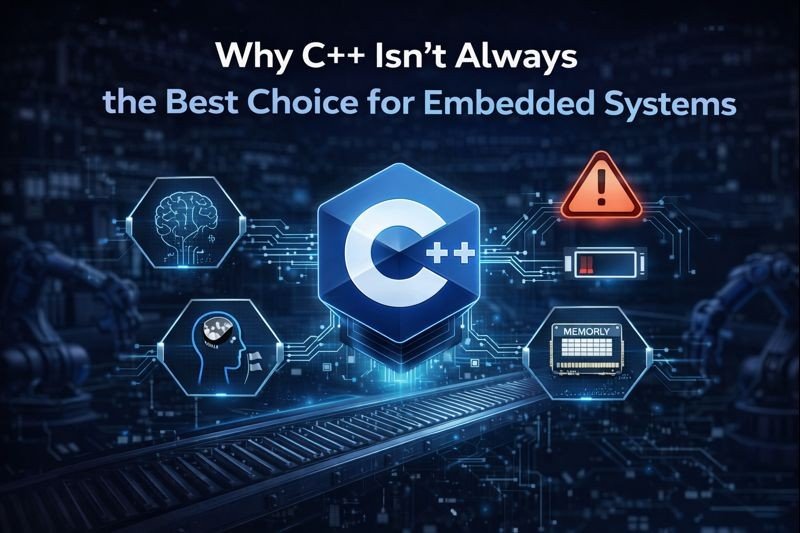
C++ gives software engineers power, but in embedded systems, power without restraint is often a liability. On a recent firmware project, our team made what seemed like the obvious decision: we chose C++.
The reasoning was sound. C++ offers cleaner syntax, strong modularity, object-oriented design, and modern tooling. For complex systems, it provides structure and scalability, qualities every engineering team values. Yet within weeks, cracks began to show. Memory usage became unpredictable. Debugging template-heavy logic felt like archaeology.
Critical behavior was abstracted to such an extent that it was nearly invisible. Real-time guarantees began to erode.
What we encountered is a lesson many teams learn the hard way: embedded systems do not reward elegance; they reward control.
This realization reshaped our approach to Embedded Systems Development and continues to inform how we deliver robust, production-grade Firmware Development Services.
The Embedded Reality: Constraints Are the Architecture
Embedded systems live under constraints that traditional software rarely encounters.
They operate with:
- Limited memory and storage
- Strict real-time deadlines
- Deterministic execution requirements
- Direct hardware interaction
- Long product lifecycles
- Minimal tolerance for failure
In this environment, every abstraction carries a cost. While C++ abstractions can improve code readability and reuse, they can also introduce:
- Hidden dynamic memory allocations
- Unpredictable execution paths
- Complex call stacks
- Compiler-dependent behavior
In general-purpose computing, these trade-offs are acceptable. In embedded systems, they are often not.
When Abstraction Becomes the Enemy
C++ shines when managing complexity in large systems. But in embedded firmware, complexity must often be explicit rather than hidden.
During our project, we encountered several common pitfalls:
Unpredictable Memory Behavior
Templates, STL containers, and object lifetimes can introduce memory fragmentation or unexpected heap usage. Even when dynamic allocation is intentionally avoided, the compiler may still allocate memory behind the scenes.
In systems with tight RAM budgets, this unpredictability is dangerous.
Debugging Opacity
Template-heavy C++ code produces long, cryptic stack traces and error messages. When something goes wrong in a real-time system, engineers need clarity, not layers of indirection.
Time spent deciphering abstractions is time not spent fixing the problem.
Hidden Execution Paths
Object-oriented designs can obscure when and how code executes. Virtual functions, inheritance hierarchies, and implicit constructors make it harder to reason about timing behavior.
For real-time systems, knowing precisely what runs, when, and how long it takes is essential.
Real-Time Systems Demand Determinism
- Industrial control systems
- Automotive electronics
- Medical devices
- Robotics and motion control
The Hard Call: Choosing Control Over Convenience
After weeks of instability, our team made a difficult but necessary decision.
We re-evaluated every assumption.
- Core modules were moved back to C.
- Time-critical paths were rewritten to eliminate hidden allocations.
- All assumptions were documented explicitly rather than abstracted away.
- Interfaces were simplified to expose behavior clearly.
The result was immediate and measurable.
- Performance stabilized.
- Memory usage became predictable.
- Bugs were easier to trace and reproduce.
Developers stopped feeling like archaeologists digging through layers of abstraction.
This wasn’t a step backward. It was a step toward engineering maturity.
This Is Not an Anti-C++ Argument
C++ is not the enemy. It has a valuable place in embedded systems, particularly in higher-level modules where:
- Memory usage is controlled.
- Timing is less critical.
- Complexity benefits from abstraction.
User interfaces, configuration layers, diagnostic tools, and non-real-time logic can often benefit from C++’s expressiveness.
The problem arises when C++ is applied indiscriminately, without considering the system’s constraints and priorities.
In Firmware Development Services, the right question is never “Which language is better?” It is “Which tool gives us the most control here?”
Simplicity as an Engineering Discipline
There is a misconception that simplicity reflects a lack of sophistication. In embedded systems, the opposite is true.
Simplicity is often the result of:
- Deep understanding of hardware behavior
- Respect for system constraints
- Intentional design choices
- Disciplined trade-off analysis
Explicit state machines are often better than implicit object hierarchies. Clear data structures are often safer than clever abstractions.
Documented assumptions are more valuable than reusable patterns that hide intent.
Simplicity makes systems easier to test, validate, certify, and maintain over long lifecycles.
Language Choice Is a System-Level Decision
Choosing a programming language for embedded systems is not a matter of style. It is a system-level architectural decision that affects:
- Memory layout
- Execution timing
- Debuggability
- Maintainability
- Certification readiness
The best embedded engineers do not default to one language. They choose deliberately, module by module, based on risk, constraints, and system behavior.
This is the mindset that defines successful Embedded Systems Development.
Do We Need Better Languages?
Perhaps, there is growing interest in safer systems languages, better static analysis tools, and stricter subsets of existing languages. These trends are promising, but better tools alone will not solve the fundamental challenge.
What embedded systems need most is better judgment.
- Judgment to know when abstraction helps and when it hurts.
- Judgment to value control over convenience.
- Judgment to prioritize predictability over elegance.
Lessons That Last
Our experience with C++ reinforced a core principle:
- Embedded systems reward engineers who are willing to be explicit, disciplined, and intentional.
- Not every problem needs a powerful abstraction. Some issues need a clear loop, a fixed buffer, and a well-documented assumption.
- In embedded environments, restraint is a feature.
Final Thoughts
C++ remains a powerful tool, but power must be applied with care in embedded systems. When abstraction obscures behavior, compromises timing, or introduces unpredictability, it becomes a liability rather than an advantage.
At Pinetics, we approach language choice as part of a broader system-design philosophy. With deep expertise in Embedded Systems Development and Firmware Development Services, we help organizations build firmware that is deterministic, maintainable, and ready to handle real-world constraints. Our focus is not on trends or preferences, but on engineering decisions that stand the test of time.
In embedded systems, simplicity is not a lack of innovation. It is a mark of engineering maturity. If you have faced this trade-off in your own projects, you are not alone, and we are always ready to have that conversation.