A hardware startup approached us with a familiar but urgent problem. They had a game-changing product idea, one that could redefine their market. Investor’s interest was strong, early customer validation was promising, and the opportunity window was clear.
Yet every development cycle kept slipping.
Weeks turned into months. Deadlines have moved. Cost climbing. Their biggest threat wasn’t competition; it was time.
This is a challenge many electronics innovators face. The issue is rarely a lack of vision or technical capability. More often, its execution is fragmented across disconnected teams and vendors.
At Pinetics, we see this pattern repeatedly and how quickly it can be fixed when organizations adopt an integrated, end-to-end engineering approach.
When Innovation Outpaces Execution
For this startup, delays surfaced at every stage of development. Prototyping stretched into months because hardware design, PCB layout, enclosure design, and sourcing were handled by different vendors with limited coordination. Each iteration required handoffs, clarification of cycles, and rework.
Compliance testing became an afterthought. Regulatory and certification requirements were addressed late, triggering last-minute redesigns when products failed to meet standards.
Firmware development stalled because hardware and software teams worked in silos. Firmware engineers were forced to adapt to late hardware changes, while hardware teams lacked feedback on real-world firmware constraints.
None of these issues were catastrophic on its own. Together, they created a development drag that threatened the company’s first-mover advantage.
They didn’t just need to move faster. They needed a fundamentally different way of building products.
Why Fragmented Development Slows Hardware Innovation
Unlike pure software products, hardware systems have physical, regulatory, and manufacturing realities that compound delays when teams are misaligned.
In fragmented models:
- Hardware design decisions are made without input from firmware.
- Firmware is developed against unstable or evolving hardware.
- Compliance is treated as a gate instead of a design constraint.
- Manufacturing considerations surface only after prototypes are built.
This results in avoidable redesigns, duplicated effort, and schedule risk.
True speed in hardware innovation does not come from rushing. It comes from alignment.
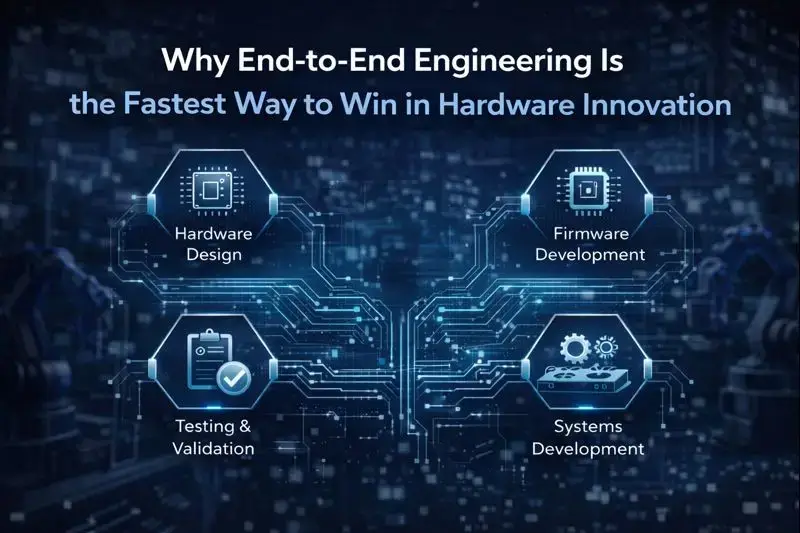
This is where Embedded Systems Development, Firmware Development Services, and Electronic Product Design Services must operate as a single, synchronized workflow rather than isolated disciplines.
The Power of an Integrated, End-to-End Engineering Model
The turning point for this startup came when they shifted to an end-to-end engineering strategy, aligning concept, design, firmware, compliance, and manufacturing from day one.
Instead of asking, “How fast can we build?” the focus became, “How do we build once, correctly?”
This approach changes everything.
Design for Manufacturability from the Start
A structured Design for Manufacturability (DFM) process was introduced early in the product lifecycle. Component selection, PCB layout, enclosure design, and assembly processes were evaluated not only for functionality but also for manufacturability at scale.
This eliminated entire classes of redesigns that typically occur when prototypes transition to production.
Firmware and Hardware Co-Development
Rather than working sequentially, firmware and hardware teams collaborated continuously. Hardware interfaces were designed with firmware constraints in mind, while firmware development progressed in parallel using stable architectural assumptions.
This tight integration is a cornerstone of effective Embedded Systems Development. It ensures that performance, power management, timing, and reliability are engineered holistically.
Compliance as a Design Input, not a Final Checkpoint
Regulatory and compliance requirements were embedded into the development process from the beginning. Instead of retrofitting fixes after testing failures, design decisions were made with certification standards already in mind.
This dramatically reduced risk and removed the “surprise factor” that often derails schedules late in development.
From Months to Weeks: Accelerating Prototyping Cycles
One of the most tangible benefits of this integrated approach was the acceleration of prototyping.
By synchronizing Electronic Product Design Services with firmware and manufacturing considerations, the team significantly reduced iteration loops.
What once took months, with multiple prototype spins, redesigns, and revalidations, was compressed into weeks.
Each prototype was closer to production ready. Each iteration delivered learning without introducing new uncertainty.
Speed, in this context, was not about cutting corners. It was about eliminating waste.
Firmware Development as a Strategic Enabler
In many hardware startups, firmware is treated as a downstream activity, something that adapts to decisions already made about hardware.
This mindset limits innovation.
Through tightly aligned Firmware Development Services, firmware became a strategic enabler rather than a bottleneck. Power optimization, boot sequences, communication stacks, and error handling were designed in concert with hardware capabilities.
This co-design approach improved:
- System stability
- Performance predictability
- Power efficiency
- Long-term maintainability
The firmware was no longer responding to hardware changes. It was shaping the system architecture.
Market Readiness Without Compromise
The result of this transformation was measurable and immediate.
- Redesign cycles were eliminated through DFM discipline.
- Compliance risks were mitigated early.
- Firmware and hardware progressed in lockstep.
- Prototyping timelines were dramatically shortened.
The most important outcome?
The product reached the market 40 percent faster than originally projected.
For a startup operating in a competitive electronics market, this difference was existential. Faster launch meant earlier customer feedback, stronger investor confidence, and a defensible market position.
Time Is Competitive Survival in Electronics Innovation
In hardware, delays compound quickly. Every missed milestone impacts funding, partnerships, and market relevance. Unlike software, hardware timelines cannot be infinitely compressed once manufacturing and compliance are involved.
That’s why time is not just money in electronics; it is competitive survival.
Companies that succeed are rarely the ones with the boldest ideas alone. They are the ones who execute precision, alignment, and foresight.
End-to-End Engineering Is a Strategic Advantage
An integrated product development approach is not just an operational improvement; it is a strategic differentiator.
When Embedded Systems Development, Firmware Development Services, and Electronic Product Design Services are aligned:
- risks are surfaced early
- decisions are informed by system-level impact
- development becomes predictable
- innovation scales sustainably
Instead of firefighting delays, teams focus on building differentiated products.
Final Thoughts
Hardware innovation does not fail because of a lack of ideas. It fails when execution cannot keep pace with opportunity.
This startup journey illustrates a broader truth: speed in hardware development comes from integration, not acceleration. When design, firmware, compliance, and manufacturing are synchronized from the start, teams move faster precisely because they move smarter.
At Pinetics, we specialize in delivering end-to-end engineering excellence. Through deep expertise in Embedded Systems Development, Firmware Development Services, and Electronic Product Design Services, we help electronics innovators turn ambitious ideas into market-ready products without unnecessary delays or compromises.
If your product roadmap is slowing under the weight of fragmented development, it may be time to rethink how your engineering ecosystem is structured.
What’s slowing your product down, and how fast could you move with the right integration in place?