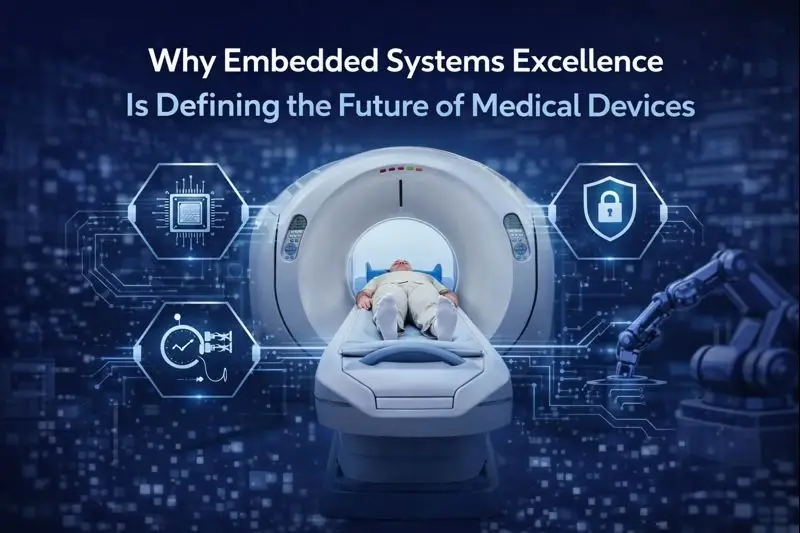
Embedded systems excellence drives medical device innovation because every modern medical device is a tightly integrated hardware and firmware system, and the device is only as reliable, safe and approvable as that integration. Embedded systems excellence in medical device innovation means the hardware, the firmware, the safety case and the compliance evidence are designed together from the first architecture decision.
If you are about to fund a new medical device or rescue a late one: ask who owns the boundary between hardware and firmware, which document records that boundary and at which design review the evidence for the regulator is first produced. The answers tell you whether you are buying a system or a set of parts.
Medical technology is evolving faster than ever, but innovation alone is no longer enough. In today’s healthcare ecosystem, success depends on reliability, safety, regulatory compliance, and long-term performance, all delivered within shrinking development timelines.
At the centre of this transformation lies one critical discipline: embedded systems development.
Every modern medical device, whether a wearable monitor, imaging system, infusion pump, or implantable solution, relies on tightly integrated hardware and firmware working as a single, dependable system. When that integration fails, the consequences are not just technical; they are clinical, regulatory, and reputational.
This is why embedded engineering excellence has become a defining factor in the next generation of medical innovation.
Why are medical devices no longer standalone products?
Medical devices are no longer standalone products because the fixed-function hardware and deterministic software that stayed unchanged for years after approval have given way to devices that are continuously connected, firmware-updatable, data-driven and algorithm-assisted. That shift moves the reliability burden onto the embedded system, where uptime, accuracy and predictability are decided in firmware and on the board.
Traditional medical devices were largely static systems. Hardware performed a fixed function. Software followed deterministic rules. Once approved, products remained unchanged for years.
That model no longer applies.
Today’s medical devices are:
- Continuously connected
- Firmware-updatable
- Data-driven
- Algorithm-assisted
- Increasingly intelligent
They operate in real-world clinical environments where uptime, accuracy, and predictability are non-negotiable.
This shift places unprecedented demands on medical device hardware design and firmware architecture.
Firmware-updatable is also the property that makes the firmware itself a target after approval. NIST SP 800-193, a US federal guideline rather than a standard, “provides technical guidelines and recommendations supporting resiliency of platform firmware and data against potentially destructive attacks”, and a buyer can ask whether the update path was designed with that guideline in view.
Where does medical device engineering break down?
Medical device engineering breaks down at the seams between hardware, firmware and system requirements, not for want of innovation: hardware designed ignoring firmware timing, memory or power, firmware written against a moving hardware specification, compliance addressed too late and performance tested under ideal rather than worst-case conditions. In a regulated programme each seam becomes delay, redesign or field risk.
Many MedTech programmes struggle not because of a lack of innovation, but because of misalignment between hardware, firmware, and system-level requirements.
Common failure points include:
- Hardware designed without sufficient consideration for firmware timing, memory, or power constraints
- Firmware developed against unstable or evolving hardware specifications.
- Compliance and safety requirements are addressed too late in the development cycle.
- Performance tested under ideal conditions rather than worst-case clinical scenarios
In regulated environments, these gaps result in:
- Delayed certifications
- Expensive redesigns
- Extended validation cycles
- Post-market reliability risks
This is why embedded systems development in MedTech must be approached as a co-design discipline rather than a sequence of handoffs.
Four common failure points in medical device programmes, and the consequence each one produces first
| Failure point | First consequence in a regulated programme |
|---|---|
| Hardware designed ignoring firmware timing, memory or power | Expensive redesign |
| Firmware developed against an unstable hardware specification | Extended validation cycles |
| Compliance and safety addressed too late | Delayed certification |
| Performance tested under ideal, not worst-case, conditions | Post-market reliability risk |
The first consequence of each failure point is the one a programme manager sees on the schedule, and each of them is avoidable at the architecture stage. Compliance addressed too late has a named counterpart: IEC 62304 “defines the life cycle requirements for medical device software”, and in our reading compliance picked up after the code is written is a life cycle requirement met out of order, with the delayed certification following from it.
What makes medical device embedded development a system discipline?
Embedded systems development is a system discipline in MedTech because the device must behave deterministically in the face of uncertainty: real-time response guarantees, predictable power behaviour, controlled failure modes, secure data handling and traceable decisions cannot be added to a board or firmware image afterwards. They are properties of the system, engineered before the first line of application code.
In medical devices, embedded systems are not just about writing code or designing boards. They are about engineering deterministic behaviour in the face of uncertainty.
That includes:
- Real-time response guarantees
- Predictable power behaviour
- Controlled failure modes
- Secure data handling
- Traceable system decisions
A well-designed embedded system anticipates variability in inputs, environments, and usage and remains safe and reliable under all conditions.
This mindset fundamentally changes how systems are built.
A system discipline shows in the shape of the plan before it shows in the code. Every Pinetics programme runs to an eleven-phase plan, Phase 0 to Phase 10, from kick-off and QMS setup through architecture and feasibility, schematic design, PCB layout and DFM, firmware, prototype bring-up and EVT, verification and EMC pre-compliance, medical device documentation, pilot production and regulatory certification to design transfer. The certification phase is the customer’s device being certified inside the customer’s quality system; Pinetics holds no certification of its own. The firmware phase runs in parallel with the schematic and PCB layout phases rather than after them, and that parallel is what “co-design” means on a calendar. Our page on how a medical device development programme is phased and gated sets out each phase and its gate.
Why is firmware the control layer of patient safety?
Firmware is the control layer of patient safety in a medical device because it governs what hardware alone cannot guarantee: deterministic task scheduling, controlled interrupt handling, error detection and recovery, secure boot and update, predictable memory use and long-term maintainability. Well-designed hardware becomes unsafe or unreliable under poorly architected firmware, so constraints hardware cannot hold alone are enforced in firmware.
Firmware is often underestimated in medical devices. It is the layer that directly governs safety, performance, and compliance.
High-quality firmware development services focus on far more than feature implementation. They ensure:
- Deterministic task scheduling
- Controlled interrupt handling
- Robust error detection and recovery
- Secure boot and update mechanisms
- Predictable memory usage
- Long-term maintainability
In regulated devices, firmware is also responsible for enforcing system constraints that hardware alone cannot guarantee.
When firmware is poorly architected, even well-designed hardware can become unsafe or unreliable.
Medical device firmware is medical device software, and IEC 62304 defines the life cycle requirements for medical device software. The engineering consequence, ours rather than the standard’s wording, is that each of those firmware properties, from deterministic task scheduling to long-term maintainability, is a requirement to be written down, verified and traced, not a habit of a good engineer. The buyer’s question is whether the firmware plan names those requirements or assumes them.
How must hardware design anticipate clinical reality?
Hardware design must anticipate clinical reality by designing the medical device for the extremes it will meet, not the nominal conditions of demonstrations: unstable power, hospital electrical noise, thermal constraints in compact enclosures, component ageing over long service lives and mechanical stress in transport and use. Each extreme is a hardware decision taken alongside firmware behaviour, not in isolation.
Effective medical device hardware design starts with understanding real-world clinical usage, not just functional requirements.
Hardware must account for:
- Electrical noise in hospital environments
- Thermal constraints in compact enclosures
- Component ageing over long service lives
- Mechanical stress during transport and use
- Power instability and backup scenarios
Designing only for nominal conditions is insufficient. Medical devices must perform safely at extremes.
This is why hardware design decisions must be made alongside firmware behaviour analysis, not in isolation.
Two of those extremes have published IEC test methods a buyer can ask to see the device tested to. Electrical noise in a hospital is tested as immunity, two of the test methods being IEC 61000-4-2 for electrostatic discharge and IEC 61000-4-3 for radiated radio-frequency fields. Thermal constraints in a compact enclosure are tested in part by temperature-change testing: IEC 60068-2-14 “provides tests with specified ambient temperature changes to analyse their impacts on specimens”. The question to ask is at which phase those tests are scheduled, because a test first run at certification is a redesign waiting to be found.
Why are security and compliance embedded concerns in a medical device?
Security and compliance are embedded concerns in a medical device because a connected device’s vulnerabilities are patient safety issues, not IT problems, and the controls live in hardware and firmware: a hardware root of trust, secure boot and key storage, encrypted communication, authenticated firmware updates and runtime integrity checks. Regulators expect those controls architected in, not added later.
Medical devices are now part of connected healthcare ecosystems. With this connectivity comes risk. Cybersecurity vulnerabilities are no longer IT problems; they are patient safety issues.
Modern embedded systems development must embed security at multiple layers:
- Hardware root of trust
- Secure boot and key storage
- Encrypted communication
- Authenticated firmware updates
- Runtime integrity checks
Regulators increasingly expect these controls to be architected into the system rather than added later.
Security is no longer optional. It is a baseline requirement for market approval.
Two of those layers, authenticated firmware updates and runtime integrity checks, are framed by NIST SP 800-193, Platform Firmware Resiliency Guidelines, which “provides technical guidelines and recommendations supporting resiliency of platform firmware and data against potentially destructive attacks”. It is a US federal guideline rather than a standard, and its value to a buyer is its framing: protection, detection and recovery of firmware are one problem, so a device that can authenticate an update but cannot detect or recover from a corrupted firmware image has answered the first of three questions.
How do you design a medical device for regulatory reality?
You design a medical device for regulatory reality by building the evidence the regulator will ask for into the architecture: deterministic system behaviour, traceability from requirements to implementation, controlled firmware update mechanisms, post-market monitoring readiness and risk mitigation by design. Compliance treated as an afterthought slows development; compliance that shapes the embedded architecture makes approval smoother and more predictable.
Medical device regulations are evolving rapidly, particularly as software and firmware play larger roles in clinical decision-making.
Regulatory bodies expect manufacturers to demonstrate:
- Deterministic system behaviour
- Traceability from requirements to implementation
- Controlled firmware update mechanisms
- Post-market monitoring readiness
- Risk mitigation by design
This makes embedded systems development a regulatory discipline as much as a technical one.
When compliance is treated as an afterthought, development slows dramatically. When it is built into the system architecture, approvals become smoother and more predictable.
“Built into the system architecture” has a project-plan meaning. On a Pinetics programme, medical device documentation and regulatory certification are named phases of the eleven-phase plan, after verification and EMC pre-compliance and before design transfer, rather than a document sprint at the end. Pinetics holds no certification of its own and works inside the customer’s quality system, so the certification phase is the customer’s device being certified, with the evidence produced in the customer’s design records. What a firmware engineer needs to know about the regulations that gate that phase is the subject of our post on what firmware engineers must know about medical device regulations.
Why does long-term reliability matter more than initial performance?
Long-term reliability matters more than initial performance in a medical device because the device is expected to operate for years in mission-critical environments, and a short-term performance gain means little if the system degrades: component selection, power management, firmware robustness and fault tolerance decide whether the embedded system is still stable, maintainable and secure at the end of its life.
Medical devices are expected to operate reliably for years, often in mission-critical environments.
This places unique demands on:
- Component selection
- Power management strategies
- Firmware robustness
- Fault-tolerance mechanisms
Short-term performance gains mean little if systems degrade over time.
True engineering maturity in firmware development services is demonstrated by products that remain stable, maintainable, and secure throughout their lifecycle.
Component selection carries a risk the datasheet does not show: the part going end-of-life before the device does. IEC 62402 “provides requirements and guidance for obsolescence management applicable to any organization that is dependent on another organization to obtain value from the usefulness of the items that it provides”, and a buyer can ask whether the bill of materials has been reviewed against it. How hardware and firmware are designed so that a chip change does not become a redesign is the subject of our post on designing hardware and firmware against semiconductor obsolescence.
What does poor embedded integration cost a medical device programme?
Poor embedded integration costs a medical device programme in a cascade: delayed regulatory submissions, repeated validation cycles, more field failures, higher support costs and reduced clinician trust, each magnified by regulatory scrutiny and patient risk. The cost falls late, after the hardware is tooled and the firmware is in the field, when every fix is most expensive.
When embedded systems are poorly integrated, the consequences cascade:
- Delayed regulatory submissions
- Repeated validation cycles
- Increased field failures
- Higher support costs
- Reduced clinician trust
In MedTech, these issues are magnified by regulatory scrutiny and the implications for patient safety.
This cascade is why we hold that end-to-end embedded engineering beats a fragmented vendor model, and the control that stops it is a gate, not a status call. On a Pinetics programme, design progress is gated by formal reviews on a dated schedule: a Preliminary Design Review, a Critical Design Review, then a Test Readiness Review, each with acceptance criteria and each passed on a written sign-off rather than a verbal nod. A buyer who wants to know how integration risk is controlled on a programme can ask for the review schedule and the criteria at each gate, because a programme that has neither will discover its integration problems at validation.
What does a unified engineering mindset look like for medical devices?
A unified engineering mindset for medical devices co-creates hardware and firmware, engineers safety rather than assuming it, lets compliance shape the architecture, makes performance deterministic and prioritises long-term reliability, which reduces risk while accelerating innovation. In embedded engineering for MedTech, these five commitments are decided on the programme plan, at architecture and at the review gates, not recovered at validation.
Successful medical device development requires a unified mindset where:
- Hardware and firmware are co-created
- Safety is engineered, not assumed
- Compliance shapes architecture
- Performance is deterministic
- Long-term reliability is prioritised
This approach reduces risk while accelerating innovation.
Five commitments of a unified engineering mindset, and where each one is decided on a medical device programme
| Commitment | Where it is decided on the plan |
|---|---|
| Hardware and firmware are co-created | Firmware phased in parallel with schematic and layout |
| Safety is engineered, not assumed | Firmware constraints written as traced requirements |
| Compliance shapes architecture | Device documentation and certification as named phases |
| Performance is deterministic | Real-time guarantees set at architecture |
| Long-term reliability is prioritised | Component selection reviewed for obsolescence |
The future of healthcare innovation will be defined not just by smarter algorithms or smaller devices, but by how well embedded systems are engineered to operate safely, predictably, and sustainably in real-world clinical environments.
Excellence in embedded systems development, disciplined firmware development services, and thoughtful medical device hardware design are no longer differentiators; they are prerequisites.
At Pinetics, we specialise in helping MedTech innovators build embedded systems that meet these demands from day one, with an engineering approach that integrates hardware, firmware, safety and compliance into a single, cohesive development strategy: the firmware phase in parallel with the board phases, the review gates on a dated schedule with written sign-off, and the documentation and certification phases named on the plan from kick-off. What a buyer can inspect is the plan itself: the phase list, the gate dates, the acceptance criteria and the sign-off record, produced inside the customer’s quality system rather than under a certification of our own, for a device that stays reliable, secure and regulator-ready throughout its lifecycle. That work rests on 100,000+ engineering hours and a leadership team with 20+ years of experience. If you are deciding how to structure a device programme or which parts of one to bring to a partner, we are happy to talk it through.
As medical technology continues to evolve, the companies that succeed will be those that treat embedded engineering not as an implementation task, but as a foundation for long-term clinical and commercial success. At Pinetics, that foundation is what we help build.
Alankar Dhobale, Co-Founder and Global CTO, Pinetics. 21+ years in electronic product development. BE Electronics, Shivaji University. LinkedIn