Every great product begins with a spark, an idea. It may start as a notepad sketch, a rough lab prototype, or a hypothesis from a late-night discussion. Ideas are plentiful. Transforming them into real, reliable, certified, and scalable electronic products is rare.
The difference is execution. Not partial or fragmented execution. End-to-end execution. We have guided electronic products from concept to certified, production-ready devices. In every industry, one takeaway is clear: successful products result from strategically integrating every stage of development rather than working in silos.
Why Siloed Development Breaks Promising Products
Electronic products often fail not because of flawed concepts but because of fragmented development processes.
Common patterns include:
- Hardware designed without firmware input.
- Firmware developed against unstable hardware assumptions.
- Compliance is considered late in the process.
- Manufacturing constraints discovered after design freeze.
- Business goals are misaligned with technical decisions.
Each silo may optimize locally, but the system as a whole suffers. Delays compound. Costs rise. Redesigns become inevitable.
This is where Electronic Product Design Services must extend beyond schematics and layouts to encompass the product’s full lifecycle.
End-to-End Execution Starts with the Right Questions
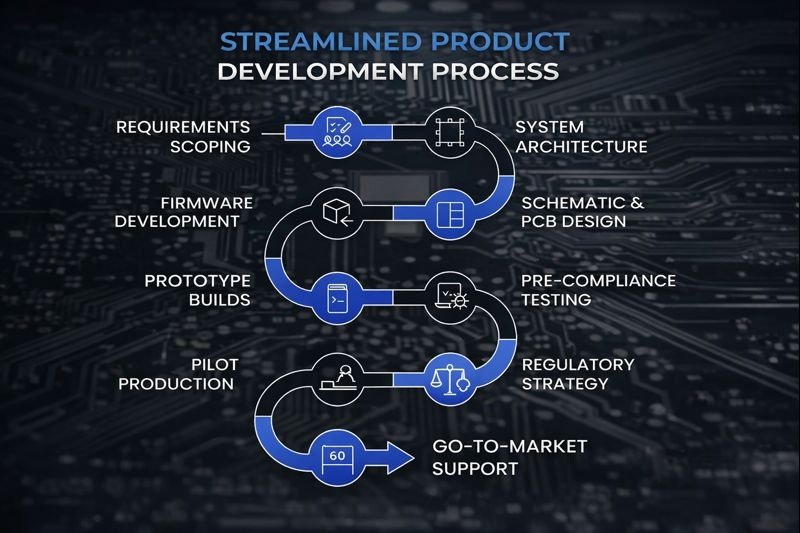
The foundation of any successful product lies in the requirements of scoping.
Before a single component is selected or a line of firmware is written, the most important questions must be answered:
- What problem are we truly solving?
- Who is the end user, and under what conditions will the product be used?
- What constraints are non-negotiable: power, cost, size, latency, safety?
- What regulatory or certification paths apply?
- What does “success” look like in the market?
Providing clear answers up front helps prevent costly rework. Requirements are dynamic constraints that inform each decision and drive strategic outcomes.
System Architecture: Where Hardware and Software Meet
One of the most critical and often underestimated phases is system architecture.
This is where hardware-software co-design must begin, not as afterthoughts layered on top of each other.
Effective architecture defines:
- Processing responsibilities
- Memory and power budgets
- Communication interfaces
- Real-time behavior
- Security boundaries
With strong architecture, Hardware Firmware Development becomes predictable rather than reactive. Firmware isn’t forced to cope with hardware issues, and hardware isn’t overbuilt for vague software needs.
Schematic and PCB Design with Manufacturing in Mind
Designing a function is not enough; scalability to production determines real-world success.
Modern Electronic Product Design Services must embed DFM (Design for Manufacturability) principles directly into schematic and PCB layout stages.
This includes:
- Component availability and lifecycle planning
- Layout strategies for signal integrity and EMI/EMC
- Thermal management considerations
- Testability and probe access
- Yield optimization
Ignoring these early issues almost always leads to costly redesigns as prototypes near production.
Firmware Development Is the Product’s Nervous System
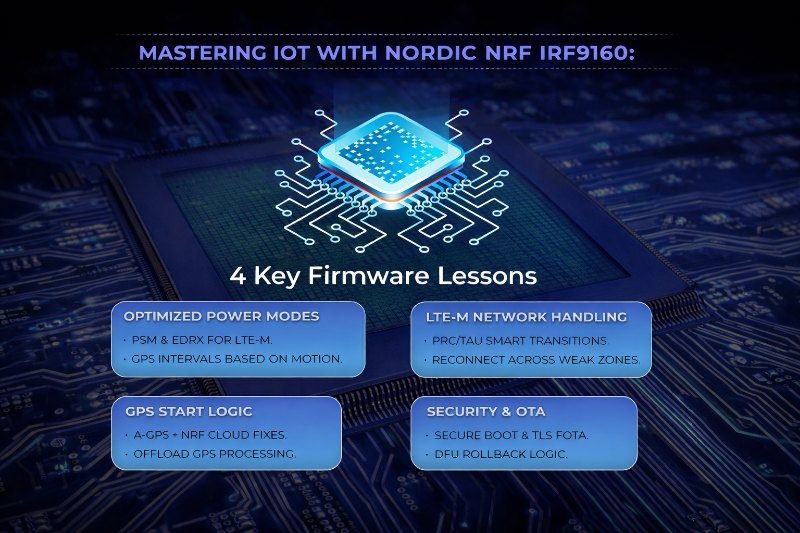
Firmware brings a product to life. High-quality Firmware Development Services go far beyond making features work. They focus on building systems that are:
- Modular
- Test-driven
- Update-ready
- Predictable under stress
Firmware manages power, communications, error recovery, and security often under tight constraints.
Modular firmware enables safer updates, easier bug tracing, and long-term maintenance.
Prototyping: Learning Fast Without Breaking the System
Prototypes are not about perfection. They are about learning.
Fast prototype builds enable teams to:
- Validate assumptions
- Uncover edge cases
- Test integration points
- Expose failure modes early.
The key is to treat failure as feedback, not as a setback.
When cross-functional teams engage during prototyping, each cycle delivers actionable insight and reduces late-stage surprises.
Pre-Compliance Testing Saves Time and Reputation
One of the most expensive mistakes in product development is waiting too long to think about compliance.
Late discovery of EMI/EMC, thermal, or safety issues disrupts schedules and significantly increases costs.
Pre-compliance testing allows teams to:
- Identify risks early.
- Fix issues while design changes are still affordable.
- Approach certification with confidence.
A proactive compliance strategy ensures alignment with regulatory requirements, avoids last-minute setbacks, and preserves reputational value.
Regulatory Strategy Is a Design Input, not a Checkbox
Whether targeting CE, FCC, or medical regulations, the regulatory strategy must inform design decisions early.
This includes:
- Component selection
- Isolation strategies
- Data handling and logging
- Update mechanisms
- Documentation practices
Early regulatory alignment transforms certification from an obstacle to a market enabler.
Pilot Production: Designing for Scale, Not Just Function
A product that works in the lab can still fail in manufacturing.
Pilot production bridges that gap by validating:
- Assembly processes
- Test coverage
- Yield consistency
- Supply chain reliability
This ensures the product can be built reliably, repeatedly, and economically.
It is here that Hardware Firmware Development meets operational reality.
Go-to-Market Support Aligns Technology with Business
Technology does not exist in a vacuum.
Decisions made during development impact:
- Cost structure
- Time-to-market
- Serviceability
- Upgrade paths
- Customer experience
End-to-end execution ensures that technical choices support business goals rather than undermine them.
The Common Thread: Integration From Day One
Across all successful products, one pattern is clear.
The teams that succeed are those where:
- Engineering collaborates with compliance early.
- Firmware and hardware evolve together.
- Manufacturing realities influence design.
- Business strategy informs technical trade-offs.
End-to-end execution is not only efficient but also a key risk management strategy, preserving resources, momentum, and product longevity.
Why End-to-End Is the Only Sustainable Approach
Fragmented development appears fast but creates hidden, costly risks that surface at the highest-impact stages.
End-to-end execution:
- Shortens development cycles overall
- Reduces redesign and revalidation
- Improves product quality
- Strengthens regulatory outcomes
- Supports long-term scalability
Replace reactive problem-solving with deliberate, outcome-driven engineering strategies.
Final Thoughts
Ideas launch products, but execution defines commercial outcomes. The key takeaway: seamless integration at every stage, from requirements and architecture to firmware, compliance, and production, is what distinguishes successful products from promising concepts.
At Pinetics, we specialise in end-to-end product development electronics, bringing together Electronic Product Design Services, Firmware Development Services, and Hardware Firmware Development into a single, cohesive engineering journey. We help innovators move from idea to market-ready product with clarity, confidence, and control without costly surprises along the way.
Going end-to-end isn’t just a development choice. True product longevity and impact come only from fully integrated end-to-end execution.