
Cardiovascular disease remains the leading cause of death worldwide, yet the most dangerous cardiac events rarely arrive without warning.
Clinical studies suggest that nearly 70% of major cardiac incidents are preceded by subtle micro-patterns; brief, transient electrical anomalies that appear long before symptoms become obvious. The challenge is not the absence of signals. It is our inability to capture, interpret, and act on them on time.
Traditional diagnostic systems were never designed for this level of precision.
They rely on intermittent monitoring, centralized data processing, and post-event analysis. Latency, signal noise, and fragmented workflows mean that many early indicators simply disappear before they can be analyzed.
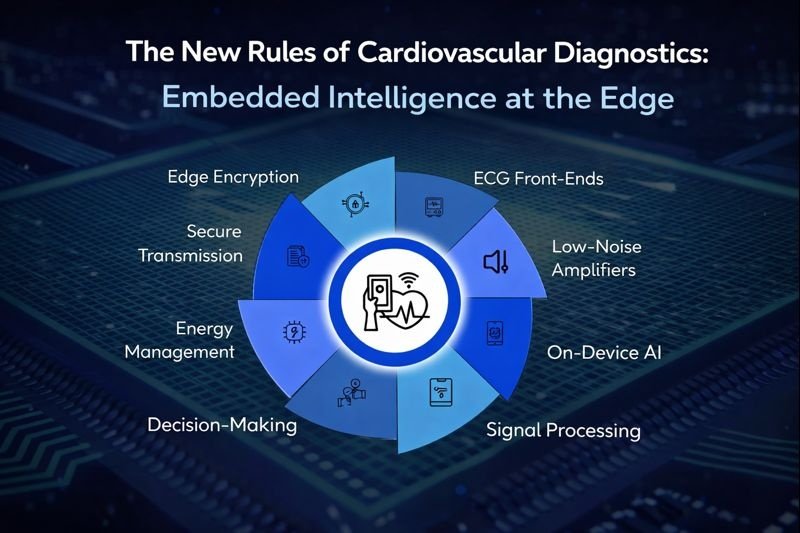
That paradigm is now changing. Advances in Embedded Systems Development and Medical Device Hardware Design are rewriting the rules of cardiovascular diagnostics, shifting the industry from reactive snapshots to continuous, predictive intelligence embedded directly at the edge.
Why Traditional ECG Systems Fall Short
Conventional ECG systems have served medicine well for decades, but they were designed for a different era of diagnostics.
Their limitations are structural:
- Transient cardiac anomalies are often too brief to be captured.
- Signal fidelity degrades due to motion artifacts and environmental noise.
- Centralized data processing introduces latency.
- Diagnostic insight arrives after the event, not before.
In critical care and continuous monitoring scenarios, these limitations become dangerous. A missed micro-pattern today can become a life-threatening event tomorrow.
To close this gap, diagnostics must move closer to the patient both physically and computationally.
Embedded Intelligence Is Closing the Diagnostic Gap
The next generation of cardiovascular devices is built on a fundamentally different architecture.
Instead of capturing raw signals and sending them elsewhere for interpretation, intelligence is now embedded directly into the device. This shift is powered by several converging innovations.
High-Resolution Signal Acquisition
Modern cardiac devices embed multi-lead ECG front ends with greater than 18-bit resolution, dramatically increasing the system’s ability to capture ultra-fine electrical variations.
These high-resolution architectures allow clinicians to see what was previously invisible, minute waveform deviations that may indicate early arrhythmias or ischemic changes.
In Medical Device Hardware Design, this requires careful component selection, precise analog layout, and aggressive noise-mitigation strategies.
Ultra-Low-Noise Analog Front Ends
Signal resolution alone is not enough. Without clean amplification, increased resolution only amplifies noise.
Next-generation systems incorporate low-noise amplifiers with input-referred noise below 1 μV, enabling accurate capture of micro-volt-level cardiac signals even during patient movement.
This level of performance demands hardware designs that account for:
- Grounding integrity
- Shielding strategies
- Power isolation
- Thermal stability
It is a reminder that medical innovation begins at the physical layer.
On-Device Intelligence: Thinking Locally, Acting Faster
One of the most significant shifts in cardiovascular diagnostics is the move toward on-device signal processing and decision-making.
Real-Time AI Filtering
Motion artifacts have long plagued ambulatory cardiac monitoring. Traditional systems rely on post-processing to clean noisy data, often losing critical information in the process.
Embedded AI now enables real-time artifact filtering, distinguishing true arrhythmic patterns from motion noise as the signal is captured.
This allows devices to make clinically relevant distinctions instantly without waiting for cloud analysis.
ARM Cortex-M Signal Processing Pipelines
Advanced signal processing pipelines now run directly on ARM Cortex-M class microcontrollers, executing sophisticated algorithms within tight power and timing budgets.
In modern Embedded Systems Development, this requires:
- Deterministic task scheduling
- Optimized fixed-point computation
- Tightly controlled memory usage
- Predictable interrupt handling
The result is critical cardiac decisions made locally in under 5 milliseconds per cardiac cycle, fast enough to matter when every heartbeat counts.
Energy Efficiency Enables Continuous Monitoring
Continuous cardiac monitoring only works if devices can operate for extended periods without frequent recharging or replacement. Energy efficiency is no longer a secondary design goal. It is foundational.
Advanced Power Management
Modern devices leverage switched-capacitor power converters and ultra-low-power operating modes to extend operational life beyond 20 days, an essential requirement for continuous, real-world monitoring.
From a Medical Device Hardware Design perspective, this involves:
- Power domain optimization
- Intelligent sleep and wake cycles
- Energy-aware signal processing
- Component-level efficiency tuning
The success of continuous diagnostics depends as much on power architecture as on signal accuracy.
Security Must Be Embedded, Not Added Later
Cardiac data is among the most sensitive health information a device can generate. As diagnostics move closer to the patient, security becomes inseparable from safety.
Next-generation devices implement:
- Secure BLE communication
- AES-256 encryption at every transmission hop.
- Edge-level encryption before data leaves the device.
By encrypting data at the source, systems reduce dependency on cloud-side security layers and minimize attack surfaces.
In regulated environments, security is no longer optional. It is a prerequisite for trust, adoption, and approval.
From Snapshots to Predictive Intelligence
The true transformation in cardiovascular diagnostics is philosophical as much as technical. The future is not about capturing better snapshots of the heart. It is about continuous, predictive cardiac intelligence.
Embedded systems now:
- Monitor continuously instead of intermittently.
- Detect trends rather than isolated anomalies.
- Act locally rather than wait for centralized analysis.
This shift moves healthcare from a reactive to a preventive model.
When devices can identify early micro-patterns and respond in real time, interventions happen sooner, outcomes improve, and lives are saved.
Embedded Systems as Clinical Infrastructure
As intelligence moves into devices, embedded systems are becoming a form of clinical infrastructure quietly operating in the background, continuously learning and acting with precision.
This places enormous responsibility on engineering teams.
Systems must be:
- Deterministic
- Reliable under worst-case conditions
- Secure by design
- Energy efficient
- Regulator-ready
In cardiovascular care, there is no margin for unpredictable behavior.
Why Medical Device Hardware Design Matters More Than Ever
AI and analytics often dominate the conversation, but without robust hardware foundations, intelligence cannot function safely.
Effective Medical Device Hardware Design ensures:
- Signal integrity under real-world conditions
- Consistent performance across device lifecycles
- Predictable interaction with embedded software
- Compliance with stringent medical standards
The most advanced algorithms are only as reliable as the hardware executing them.
The Heart Doesn’t Wait and Neither Should Our Devices
Cardiac events do not pause data uploads, cloud latency, or post-hoc analysis. They unfold in milliseconds.
The devices designed to protect patients must operate at the same speed, think locally, respond instantly, and function reliably under all conditions. This is the new standard for cardiovascular diagnostics.
Final Thoughts
The future of cardiovascular care will be defined by real-time, predictive intelligence embedded directly into ultra-portable medical devices. The shift from reactive diagnostics to continuous prevention is being driven by advances in Embedded Systems Development and Medical Device Hardware Design disciplines that turn raw electrical signals into life-saving insight.
At Pinetics, we will help medical innovator engineers in the future. Our teams specialize in designing embedded systems and medical device hardware that deliver precision, reliability, security, and regulatory readiness from day one. By integrating intelligence at the edge and engineering systems to think locally, we help transform cardiovascular diagnostics from a delayed reaction to proactive prevention. Because when it comes to the heart, timing is everything. And the heart does not wait.
 Sr. Test Engineer
 Sales Marketing Manager
 Marketing & Sales – BBA : Fresher