
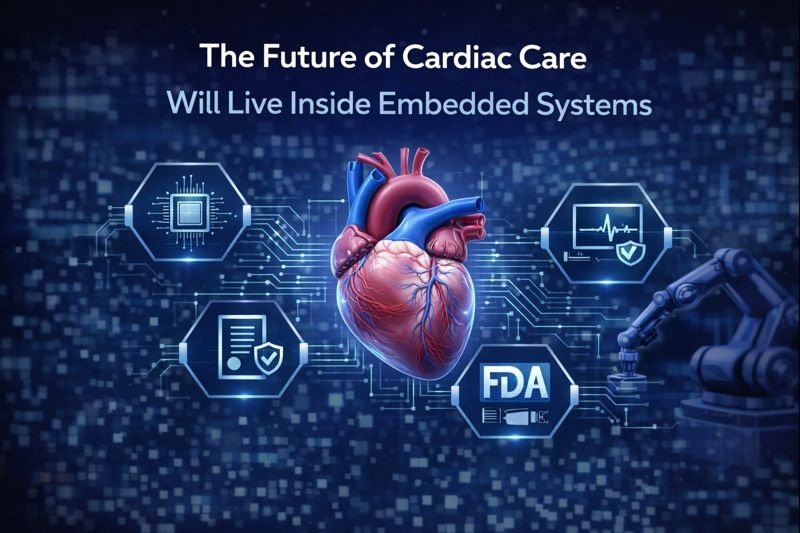
For decades, cardiovascular care has been centered around hospitals. Patients visit clinics for tests. Data is captured intermittently. Clinicians analyze results after the fact. Intervention happens when symptoms become visible or when it is already too late.
This model is no longer sufficient. The future of cardiac care will move beyond hospitals, becoming seamlessly integrated into embedded systems that operate continuously and intelligently alongside patients.
This evolution centers on speed, continuity, and predictive intelligence, all enabled by advances in embedded systems and medical device hardware design.
A Fundamental Shift in Cardiovascular Diagnostics
Cardiovascular diagnostics are undergoing structural transformation. What is changing is not only where testing occurs, but how, when, and how fast insights are generated.
Traditional diagnostic workflows are reactive in design. They rely on scheduled testing, centralized analysis, and delayed interpretation. Embedded systems enable an entirely different paradigm; one built on real-time intelligence and continuous monitoring.
Here are the main shifts shaping the future of cardiac care.
From Delayed Analysis to Real-Time Detection
One of the most critical limitations of traditional cardiac diagnostics is latency.
Signals are captured, transmitted, processed centrally, and reviewed later. For transient cardiac events, this delay can be the difference between early intervention and missed warning signs.
Edge Processing Changes the Equation
With modern Embedded Systems Development, ECG waveforms can now be processed directly on the device at the edge.
- No cloud dependency
- No network latency
- No delayed interpretation
Embedded processors analyze cardiac signals in real time, enabling immediate detection of abnormalities as they occur.
This local intelligence allows devices to respond within milliseconds, matching the pace of the heart itself.
From Static Testing to Continuous Monitoring
Most cardiac diagnostics today rely on snapshots: short ECG tests performed at specific moments in time. But the heart does not fail on schedule.
Arrhythmias, ischemic events, and conduction abnormalities often appear sporadically, lasting only seconds or minutes before disappearing.
Continuous Sensing Is Now Possible
Advances in sensor technology and Medical Device Hardware Design have made 24/7 cardiac monitoring practical.
Modern wearable sensors now feature:
- High-precision analog front ends
- Sub-microvolt signal detection
- Improved motion artifact suppression
These systems continuously record cardiac activity, capturing subtle variations that static tests routinely miss.
Continuous monitoring transforms diagnostics from episodic observation to persistent awareness.
From Data Collection to Predictive Analytics
Recording data is no longer enough. The real breakthrough lies in predictive analytics embedded directly into the device.
Embedded AI at the Point of Care
Embedded AI models now analyze cardiac waveforms locally, detecting patterns associated with:
- Early arrhythmias
- Conduction abnormalities
- Heart rate variability trends
- Pre-symptomatic deterioration
Instead of waiting for symptoms to escalate, devices can issue proactive alerts that prompt early clinical intervention.
This represents a fundamental shift from reactive medicine to preventive care.
In Embedded Systems Development, this requires balancing:
- Computational efficiency
- Deterministic behavior
- Power consumption
- Regulatory constraints
Intelligence must be fast, reliable, and explainable.
From Bulky Equipment to Miniaturized Systems
Traditional cardiac diagnostic equipment has been large, stationary, and power-hungry. That form factor is incompatible with continuous, real-world monitoring.
SoC-Driven Miniaturization
Modern System-on-Chip (SoC) architectures integrate:
- Signal acquisition
- Digital signal processing
- Embedded AI acceleration
- Wireless communication
All within ultra-compact footprints suitable for wearable patches and portable devices.
This level of integration is redefining Medical Device Hardware Design, demanding careful coordination between:
- Analog signal integrity
- Digital processing pipelines
- RF performance
- Thermal and power constraints
The result is a new class of cardiac devices that are both powerful and unobtrusive.
From Power-Hungry to Energy-Efficient Systems
Continuous monitoring only works if devices can operate for extended periods without frequent charging or replacement.
Energy efficiency is no longer a secondary concern; it is a core design requirement.
Intelligent Power Management
Modern cardiac devices employ:
- Dynamic voltage and frequency scaling
- Duty-cycled sensing strategies
- Low-power sleep modes
- Energy-aware signal processing
These techniques enable continuous operation for weeks without sacrificing data fidelity or analytical accuracy.
In Medical Device Hardware Design, power architecture decisions directly impact clinical usability and patient compliance.
Embedded Systems as the New Care Infrastructure
As intelligence moves into the device, embedded systems are becoming a form of distributed healthcare infrastructure.
They do more than measure signals. They:
- Interpret physiological data
- Adapt to patient behavior
- Operate autonomously
- Communicate securely when needed
This decentralization reduces dependence on centralized hospital systems and enables care to follow the patient rather than the other way around. Embedded systems are no longer supporting tools. They are active participants in care delivery.
Designing for Safety, Reliability, and Trust
With greater autonomy comes greater responsibility. Cardiac devices operate in safety-critical environments where errors are unacceptable.
Robust Embedded Systems Development must account for:
- Deterministic real-time behavior
- Fail-safe operation
- Data integrity
- Secure communication
- Long-term reliability
Hardware and software must be engineered together to anticipate worst-case conditions, not just ideal scenarios.
Trust in cardiac devices is built not only on clinical accuracy, but on consistent, predictable performance over time.
Why Medical Device Hardware Design Is Foundational
AI, analytics, and connectivity often receive the most attention. But without a solid hardware foundation, none of these capabilities can function safely.
Effective Medical Device Hardware Design ensures:
- High-fidelity signal acquisition
- Resilience to environmental noise
- Stable long-term operation
- Compatibility with embedded intelligence
Hardware decisions made early in development shape everything that follows, from firmware behavior to regulatory approval.
In cardiac care, the margin for error is zero.
The Shift from Hospitals to the Patient’s Side
The most transformative change in cardiac care is not technological, but contextual. Care is moving from controlled clinical environments to real-world, everyday settings.
Embedded systems enable this transition by delivering:
- Precision at the edge
- Intelligence without interruption
- Continuity across time and context
Future cardiac diagnostics will rely on discreet, decisive systems that act only when most needed.
Final Thoughts
The next breakthroughs in cardiac care will not come from larger machines or more centralized systems. They will come from embedded, intelligent devices designed to operate continuously, predictively, and safely at the patient’s side.
Advances in Embedded Systems Development and Medical Device Hardware Design are enabling earlier detection of cardiac risk, faster response times, and moving healthcare from reaction to prevention.
At Pinetics, we will help MedTech innovator engineers in the future. Our teams design embedded systems and medical device hardware that deliver real-time intelligence, energy efficiency, security, and regulatory readiness built from the ground up to support continuous, patient-centric care.
Because the heart does not operate on schedules. And the devices protecting it shouldn’t either.
 Sr. Test Engineer
 Sales Marketing Manager
 Marketing & Sales – BBA : Fresher