
Smart infrastructure is evolving rapidly, but many “smart” systems still carry the limitations of yesterday’s architecture. Smart lockers are a perfect example. While widely deployed in logistics, retail, corporate campuses, residential buildings, and healthcare environments, most existing smart locker systems continue to depend heavily on centralized servers and constant internet connectivity.
This dependence creates hidden operational risks.
When servers go down, networks fail, or latency spikes; access is delayed, and systems stall. For users, that means frustration. For operators, it means lost productivity, security exposure, and rising maintenance costs. In environments such as hospitals, transportation hubs, or last-mile delivery centers, even short disruptions can cascade into larger operational issues.
At Pinetics, we believe the answer is autonomy.
We design standalone, AI-driven smart locker ecosystems that make decisions locally, operate without dependency on central servers, and maintain full functionality even in offline or low-connectivity environments. Through deep expertise in Embedded Systems Development and IoT Product Development Services, we are reimagining what “smart” truly means.
True intelligence is not about being connected; it is about being capable.
The Problem with Today’s Centralized Smart Locker Architectures
Most current locker ecosystems rely on a client–server model. Lockers act as thin endpoints, dependent on a remote platform for:
- Authentication
- Authorization
- Access logging
- Configuration changes
- Operational decisions
While workable in ideal connectivity conditions, this creates multiple failure points.
Centralized Systems Introduce Three Core Risks
Network dependency: If connectivity drops, access becomes delayed or impossible.
Single point of failure: A server’s malfunction can shut down an entire locker network.
High latency: Every authentication request must travel to the server and back, slowing access.
This architecture also increases operating cost, since cloud dependency requires permanent bandwidth, storage, and server infrastructure.
In contrast, next-generation lockers must be intelligent endpoints able to authenticate, record events, secure data, and allocate compartments independently.
Pinetics’ Vision: Fully Autonomous Smart Lockers
Pinetics’ standalone smart lockers are engineered around three core design principles:
- Local intelligence
- Decentralized decision-making
- Resilient, secure operations
They continue to function regardless of server status or internet connection. Synchronization happens when connectivity is available, not as a dependency for operation.
This design eliminates bottlenecks and makes locker infrastructure truly future-ready.
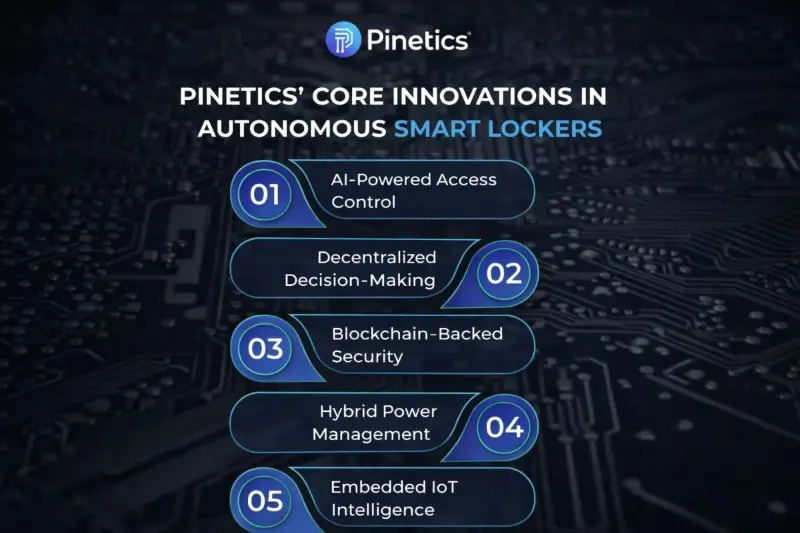
Core Innovations Powering Pinetics’ Autonomous Smart Lockers
AI-powered Local Access Control
Rather than forwarding authentication requests to a remote platform, our lockers run edge AI models on embedded hardware. They support:
- Facial recognition
- Biometric verification
- QR/BLE/NFC authentication
- PIN and token-based access
All of this happens locally. The result is:
- Faster authentication
- Zero dependency on constant connectivity
- Greater privacy, as raw biometric data remains on-device
This capability showcases the power of modern Embedded Systems Development, combining AI inferencing chips, sensor fusion, and optimized firmware pipelines.
Decentralized Decision Making
Each locker unit is self-governing.
Lockers communicate via secure peer-to-peer messaging when coordination is required, for example, sharing availability information or redistributing load, but decision authority remains local.
This means:
- There is no system-wide downtime due to a single controller failure.
- Lockers continue functioning independently.
- Maintenance or upgrades do not disrupt the entire network.
It is an infrastructure built for resilience.
Blockchain-Backed Tamper-Proof Logging
Security and auditability are critical in asset management environments.
Access logs and transactions are recorded on a blockchain ledger, enabling:
- Tamper-proof historical records
- Transparent traceability
- Secure dispute verification
- Fully auditable compliance reporting
Unlike centralized databases, distributed ledgers remove the risk of silent log tampering or data loss.
Hybrid Power Management for Non-stop Operation
Our locker systems are engineered to function even in unstable power environments.
Design options include:
- Built-in battery backups
- Solar-assisted systems
- Power-optimized electronics and firmware
- Smart sleep and wake operations
Autonomous hardware requires power autonomy; our designs account for both.
Embedded IoT Intelligence with Predictive Maintenance
Sensors embedded in locker modules monitor:
- Hinge and door stress levels
- Component wear trends
- Temperature and environmental conditions
- Electronic subsystem health
AI-based analysis identifies anomalies and predicts failures before they occur. Operators receive proactive alerts rather than reacting after downtime.
This exemplifies the integration of IoT Product Development Services with intelligent device lifecycle management.
Secure and Intelligent Standalone Operations
Pinetics’ smart locker architecture delivers capabilities most centralized systems cannot match.
Full Offline Mode
Access to control, decision-making, queuing, and logging occurs locally. Users continue interacting with lockers without realizing that connectivity issues exist.
Edge AI Optimization
Local intelligence enables:
- Automatic space optimization
- Dynamic allocation based on package size
- Prioritized compartments for special workflows
Systems become not just storage devices, but active collaborators in logistics efficiency, improving space utilization by up to 50 percent.
Self-healing Infrastructure
If one locker node loses connectivity or functionality, others dynamically absorb its workload. The network adapts automatically, without operator intervention.
This represents the convergence of:
- Embedded autonomy
- Distributed computing
- Resilient systems architecture
Why Autonomy Is Critical for the Next Generation of Smart Lockers
Smart lockers are increasingly deployed in environments where availability is mission-critical:
- Hospitals and pharmacies
- Corporate facilities
- Military and defense bases
- Transportation hubs
- Residential delivery ecosystems
- Universities and research campuses
In many of these contexts, connectivity cannot be guaranteed. Relying solely on central cloud systems introduces operational fragility.
Autonomy delivers:
- Higher uptime
- Greater user trust
- Improved security posture
- Compliance alignment
- Reduced cloud operating cost
- Faster user experience
It also supports remote or under-connected locations, expanding possible deployment environments.
The Role of Embedded Systems Development in Locker Autonomy
Standalone intelligence is possible only because of advances in Embedded Systems Development.
Autonomous lockers integrate:
- Specialized microcontrollers and SoCs
- Real-time operating systems (RTOS)
- Secure boot and trusted execution environments
- On-device AI accelerators
- Low-power hardware architectures
Engineering at this level requires deep expertise in:
- Hardware–software co-design
- Power optimization
- Security architecture
- Edge ML inference
- Industrial interface design
This is more than just connecting devices to the cloud; it is building intelligent systems that think for themselves.
The Intersection of IoT Product Development Services and Autonomy
Autonomous lockers are part of a larger evolution in connected product ecosystems.
Through IoT Product Development Services, intelligence shifts from centralized applications to distributed devices. Systems become:
- More scalable
- More private
- More robust
- Less dependent on single failure points
Instead of pushing everything to the cloud, processing is balanced between:
- The device
- Peer nodes
- Edge gateways
- Cloud systems for analytics and fleet management
This orchestration defines modern IoT maturity.
Are Centralized Locker Systems Becoming Obsolete?
Centralized systems will continue to exist, but their role is changing. Cloud systems will support analytics, fleet insight, long-term data storage, and enterprise integrations. However, day-to-day operational control is increasingly migrating to the intelligent edge.
The organizations that move first will:
- Reduce operational downtime
- Lower lifetime infrastructure costs
- Deliver better user experience
- Strengthen cybersecurity resilience
- Unlock new deployment geographies
Autonomy is no longer experimental; it is becoming the standard expectation.
Final Thoughts
Smart lockers are evolving from simple connected cabinets into distributed intelligent systems. The next generation must be autonomous, AI-driven, secure, and capable of operating independently of central servers. Systems built this way are faster, more resilient, more secure, and better aligned with real-world deployment conditions.
Pinetics is at the forefront of this shift. Through deep expertise in Embedded Systems Development and end-to-end IoT Product Development Services, we design and deliver standalone, AI-powered locker ecosystems built for real-world performance. Our solutions eliminate single points of failure, enable offline operation, strengthen security, and redefine what smart infrastructure can achieve.
If you are exploring the future of smart lockers or decentralized smart infrastructure, Pinetics is ready to partner with you to build it.
 Sr. Test Engineer
 Sales Marketing Manager
 Marketing & Sales – BBA : Fresher