
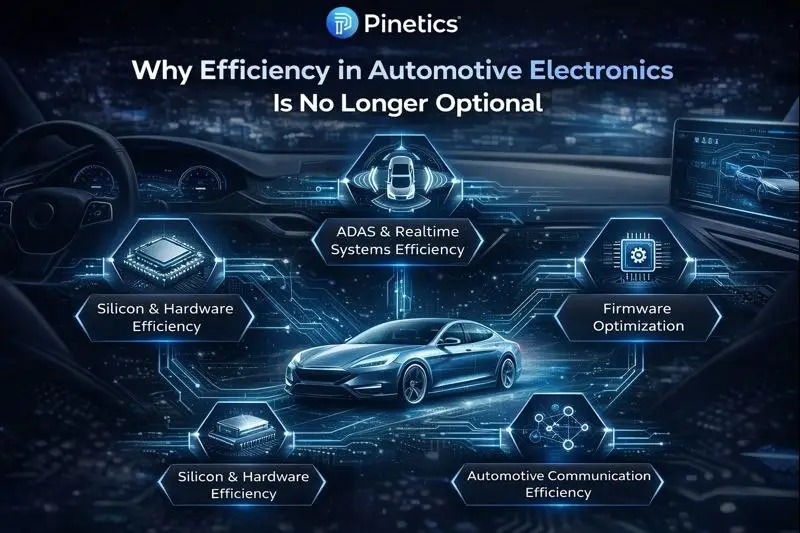
Modern vehicles are no longer defined solely by mechanical engineering. Today cars are real-time computing ecosystems on wheels, powered by millions of lines of code, dozens of electronic control units (ECUs), high-speed networks, and complex software stacks.
Advanced Driver Assistance Systems (ADAS), infotainment platforms, battery management systems, vehicle-to-everything (V2X) communication, and autonomous features all operate simultaneously, often under strict real-time constraints. In this environment, efficiency in automotive electronics is no longer a “nice to have.”
It is a requirement for safety, reliability, and long-term viability.
At Pinetics, we see efficiency not as an optimization phase added near the end of development, but as a foundational engineering principle, one that must be embedded from the earliest stages of Hardware Design and Development, Electronic Product Design Services, Firmware Development Services, and Embedded Systems Development.
The Growing Complexity of Automotive Electronics
A modern vehicle can contain more than 100 ECUs communicating over multiple in-vehicle networks. Each subsystem competes for computing cycles, memory bandwidth, power, and thermal headroom.
Key challenges include:
- Ultra-low latency requirements for safety-critical systems
- Deterministic behavior under peak load
- Strict power and thermal constraints
- Long operational lifecycles
- Continuous software updates through OTA mechanisms
- Increasing cybersecurity threats
Generic, off-the-shelf hardware and software stacks struggle to meet these demands simultaneously. As automotive electronics evolve, efficiency becomes the differentiator between systems that merely function and systems that can scale safely and reliably.
Efficiency Starts at the Silicon Level
In automotive systems, performance and efficiency are inseparable from silicon architecture.
Choosing a microcontroller or system-on-chip (SoC) is not a procurement exercise; it is a system-level design decision that impacts:
- Clock domain behavior
- Memory hierarchy and access latency
- Interrupt response times
- Power state transitions
- Thermal dissipation
- Long-term reliability
Custom or automotive-grade SoCs allow engineers to:
- Minimize idle power states
- Optimize thermal envelopes
- Tailor compute resources to real workloads
- Extend operational lifespan under harsh conditions
This level of optimization is only possible when Hardware Design and Development are aligned with system requirements from the outset. Selecting silicon without firmware and system-level input often leads to wasted resources, thermal throttling, or unpredictable real-time behavior.
Firmware as a Performance Multiplier
Firmware is not simply application logic running on automotive hardware. It is the control layer that orchestrates how silicon resources are used cycle by cycle.
Effective Firmware Development Services focus on:
- DMA orchestration to reduce CPU load
- Optimized interrupt handling paths
- Memory access patterns aligned with cache architecture
- Deterministic scheduling under RTOS environments
- Power-aware task management
Saving even a few milliseconds at the firmware level can be the difference between a successful safety response and a system failure.
In ADAS applications, for example, sensor fusion pipelines must process camera, radar, and lidar data with strict timing guarantees. Any inefficiency, whether in memory transfers or interrupt latency, can compromise system predictability.
Automotive Communication Protocols Demand Optimization
Vehicles rely on a mix of communication protocols, each with different performance and reliability characteristics:
- CAN for robustness and simplicity
- LIN for low-cost body electronics
- FlexRay for deterministic, time-triggered communication
- Automotive Ethernet for high-bandwidth data transfer
Implementing these stacks “out of the box” is rarely sufficient.
True efficiency requires protocol tuning, including:
- Optimized message scheduling
- Priority handling aligned with safety requirements.
- Reduced protocol overhead
- Efficient buffer management
- Power-aware network activity
Poorly tuned communication stacks increase power draw, introduce jitter, and reduce predictability, directly impacting system safety and responsiveness.
This is where deep Embedded Systems Development expertise becomes critical. Engineers must understand both the protocol specifications and the real-world behavior of the underlying hardware to achieve reliable performance.
Deterministic Reliability Is a Safety Requirement
In automotive systems, efficiency is not just about power consumption or performance metrics; it is about deterministic reliability.
Safety-critical functions such as braking assistance, lane keeping, or collision avoidance must behave predictably under all operating conditions. This requires:
- Tightly controlled timing behavior
- Bounded latency across all execution paths
- Graceful degradation under fault conditions
- Isolation between safety-critical and non-critical tasks
Achieving this level of reliability demands close coordination between hardware architecture, firmware design, and system-level scheduling. Efficiency, in this context, is the ability to deliver consistent behavior even when the system is under stress.
Security Must Be Engineered, Not Added
As vehicles become increasingly connected, cybersecurity is inseparable from efficiency and reliability.
Firmware must support:
- Secure boot mechanisms
- Hardware-backed root-of-trust
- Encrypted and authenticated OTA updates
- Runtime integrity checks
If security is treated as an add-on, it often introduces unnecessary overhead or, worse, vulnerabilities that compromise the entire system.
Modern Firmware Development Services integrate security directly into the hardware abstraction layer, ensuring that authentication, key management, and update mechanisms operate efficiently without compromising real-time performance.
Why Off-the-Shelf Solutions Fall Short
Generic platforms are designed to be flexible, not optimal.
In automotive electronics, this flexibility often translates into:
- Unused hardware resources consume power.
- Software layers add latency.
- Unnecessary abstraction reduces predictability.
- Limited control over timing behavior.
Custom architectures designed through integrated Electronic Product Design Services allow engineers to strip away excess and focus on what truly matters for the application.
Efficiency emerges not from adding more compute power, but from using exactly the right amount of power in exactly the right way.
Efficiency as a System-Level Discipline
True efficiency cannot be achieved by optimizing components in isolation. It must be treated as a system-level discipline encompassing:
- Silicon selection and board design
- Power distribution and thermal management
- Firmware architecture and scheduling
- Communication protocol optimization
- Security integration
- Lifecycle management and OTA strategy
This holistic approach ensures that every layer reinforces others rather than competing for resources.
In automotive electronics, where systems must operate reliably for years under extreme conditions, this integrated mindset is essential.
Designing for the Long Term
Vehicles are expected to last a decade or more. During that time, software updates, feature additions, and regulatory changes are inevitable.
Efficient systems are easier to evolve because they:
- Maintain headroom for future features
- Avoid thermal and power bottlenecks
- Support secure and reliable updates
- Scale without destabilizing existing functionality
Efficiency, therefore, is not just about current performance; it is about futureproofing.
Final Thoughts
The future of automotive electronics will not be defined by raw speed alone. It will be defined by precision engineering, where hardware, firmware, and system architecture are designed as a tightly coupled whole.
Real efficiency is not layered late in development. It is architected from the very first design decision, from silicon selection to firmware scheduling to communication protocol tuning.
At Pinetics, we bring this philosophy to life through deep expertise in Hardware Design and Development, Electronic Product Design Services, Firmware Development Services, and Embedded Systems Development. We partner with automotive innovators to engineer systems that are not only powerful but efficient, secure, and built to endure real-world demands.
If your automotive electronics program demands deterministic reliability, long-term scalability, and true system efficiency, Pinetics is ready to help you design it right from the ground up.
 Sr. Test Engineer
 Sales Marketing Manager
 Marketing & Sales – BBA : Fresher