
The pace of business transformation has accelerated beyond anything organizations experienced in previous decades. Market dynamics shift rapidly, technology stacks evolve continuously, and customer expectations change in real time. Yet many companies are still constrained by the workforce and hiring models designed for a far more predictable world.
Traditional hiring structures assume stability, fixed workloads, well-defined skill requirements, and slow change. Today’s reality is the opposite. Product roadmaps evolve quarterly; engineering competency requirements expand constantly, and innovation cycles shorten every year. In this environment, rigid workforce models do not just limit growth; they actively undermine competitiveness.
At Pinetics, we believe that workforce flexibility is no longer optional. It is now the cornerstone of business resilience, particularly engineering-driven organizations involved in Embedded Systems Development, Embedded Product Development Services, and IoT Product Development Services. Companies that align talent capacity dynamically with business priorities outperform those tied to slow, traditional hiring cycles.
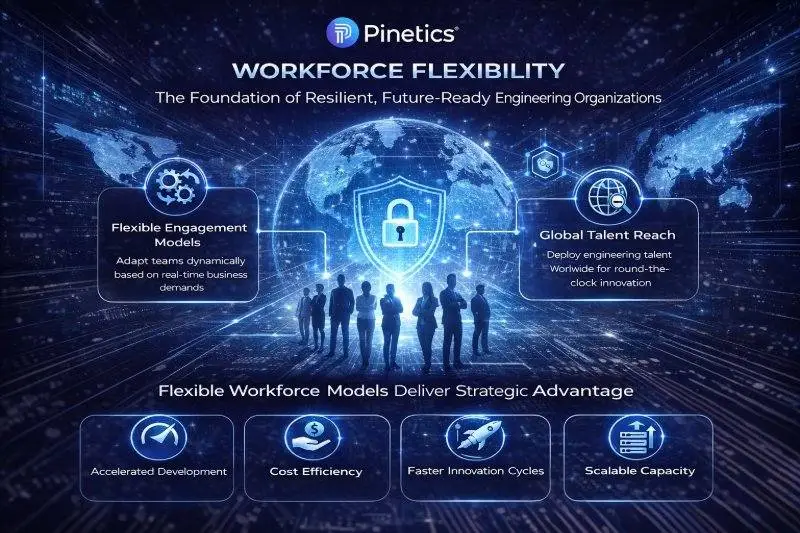
Flexible engagement models enable organizations to scale quickly, access niche skills immediately, control costs intelligently, and keep innovation moving without disruption.
Why Traditional Workforce Models Fail Modern Engineering Businesses
Most organizations recognize that technology drives growth today. However, they continue relying on workforce structures that slow innovation instead of supporting it.
The most common challenges include:
High Fixed Overhead and Long-term Commitments
Permanent hiring models come with:
- Recurring salary obligations
- Benefits and compliance costs
- Infrastructure and onboarding investments
- Long-term retention responsibilities
These costs remain even when project demand declines or shifts direction. The result is a capacity that cannot easily scale down or pivot when new opportunities emerge.
Long Recruiting Cycles Delay Market Opportunities
Hiring deeply specialized engineering talent often takes months. In the meantime:
- Initiatives stall
- Competitive launches pass
- Investors and customers experience delays
- Teams are forced to “do more with less.”
Opportunity costs often exceed recruitment costs.
Internal Teams Cannot Cover Every Emerging Skillset
Modern product ecosystems require expertise across:
- Embedded Systems Development
- Firmware and real-time OS engineering
- Hardware and electronics
- Cloud platforms and DevOps
- AI and data platforms
- Cybersecurity
- Wireless connectivity
- Mobile and UX application integration
No in-house team, regardless of size, can maintain deep expertise in all these domains simultaneously.
Global Operations Require Global Talent Reach
Entering new regions requires:
- Local engineering presence
- Cultural and language fluency
- Regional regulatory understanding
- Market-specific integrations
Permanent staffing in every market is slow and expensive, and often impractical.
Flexible Workforce Models: The New Strategic Advantage
Rigid hiring belongs to a predictable world. Today’s world prioritizes:
- Adaptability
- Speed
- Innovation capacity
- Targeted expertise
Flexible engagement models replace static staffing assumptions with dynamic, demand-driven capacity. Rather than asking, “What can we do with the team we already have?”, organizations can instead ask:
“What expertise do we need to execute this strategy, and how do we access it immediately?”
Pinetics delivers this flexibility through Staff Augmentation Services designed for engineering-intensive businesses.
How Pinetics Flexible Engagement Models Work
We replace generic staffing with purpose-built workforce structures aligned to your projects and outcomes. Our approach recognizes that every organization has unique delivery models, risk structures, and resource dependencies.
1) On-Demand Staff Augmentation
On-demand models allow businesses to extend their engineering teams instantly without the burden of permanent hiring. With Pinetics, organizations gain access to specialists in:
- Embedded Systems Development
- IoT Product Development Services
- AI, data science, and analytics
- DevOps and platform automation
- Cloud and edge engineering
Benefits include:
- Zero recruitment delay
- Instant integration into current team workflows
- The ability to scale teams up or down
- No long-term employee liability
This model is ideal for organizations facing rapid delivery schedules, increased workload peaks, or skill-gap situations in upcoming initiatives.
2) Retainer-Based Expert Teams
Some programs require continuity and sustained innovation, not temporary support. In these scenarios, Pinetics provides retained engineering teams dedicated to long-term engagement.
These teams:
- Become embedded within your ongoing program structure
- Preserve domain knowledge over time
- Own deliverables alongside your internal stakeholders
- Provide predictable month-to-month cost structures
This is especially valuable in multi-year transformation initiatives, complex Embedded Product Development Services, or platforms that require continuous evolution and post-deployment enhancement.
3) Hybrid Onshore–Offshore Delivery
Global engineering capability produces a global competitive advantage.
Pinetics combines:
- onshore technical leads for communication and strategy
- offshore delivery centers for scalable execution and cost-efficiency
This hybrid approach enables:
- continuous 24/7 development
- faster release cycles
- resilience against regional staffing constraints
- lower total cost of ownership
Compliance, IP protection, and security frameworks are built into engagement, not appended afterward.
Flexible Workforce Models Power Product Engineering Success
Nowhere is workforce flexibility more valuable than in product engineering environments.
In Embedded Systems Development, resource needs vary drastically across lifecycle phases:
- Concept exploration
- Architecture and feasibility
- Hardware bring-up
- Firmware development
- Testing and validation
- Certification
- Post-market enhancement
Flexible staffing aligns expertise precisely where and when it is needed.
In IoT Product Development Services, teams require complementary skillsets across:
- Embedded devices and edge nodes
- Gateway platforms
- Wireless and connectivity stacks
- Mobile and cloud applications
- Cybersecurity
- Analytics and visualization
Traditional hiring models often lead to over-staffing phases and under-staffing others. Flexible engagement eliminates this imbalance.
How Staff Augmentation Services Accelerate Innovation
Staff Augmentation Services provide more than just additional personnel. When designed correctly, they:
- Compress development timelines
- Support parallel engineering streams
- Eliminate recruitment bottlenecks
- Introduce niche technical knowledge
- Reduce burnout of existing teams.
- Improve delivery predictability
Businesses can continue scaling innovation regardless of talent shortages in the local hiring market.
Building Workforce Agility Builds Organizational Resilience
Resilient businesses do not avoid change; they adapt quickly.
Flexible workforce solutions allow organizations to:
- Expand during market growth phases
- Pivot development direction immediately
- Respond to new regulatory or compliance demands.
- Accelerate digital transformation
- Maintain momentum during uncertainty
Organizations that embed workforce agility into their operating model are better positioned to handle disruption, competition, and opportunity simultaneously.
A Mindset Shift: From Hiring Strategy to Capability Strategy
To thrive in the digital economy, companies must transition from headcount thinking to capability thinking.
Instead of asking:
“How many people can we afford to hire?”
Future-ready organizations ask:
“What capabilities must we access to win, and how do we deploy them rapidly?”
Flexible engagement unlocks this mindset shift.
Final Thoughts
The future belongs to organizations that can adapt their workforce as quickly as they adapt their strategy. Traditional hiring models create cost rigidity, slow execution, and constrain innovation capacity just when companies need flexibility the most.
Flexible workforce engagement, supported by the right engineering partner, delivers resilience.
Pinetics provides this capability through strategic Staff Augmentation Services aligned to core technology disciplines, including Embedded Systems Development, Embedded Product Development Services, and IoT Product Development Services. Our flexible engagement models allow companies to scale confidently, accelerate development, access specialized engineering talent on demand, and stay competitive in a rapidly shifting marketplace.
If your organization is ready to transition from rigid hiring constraints to flexible, future-oriented workforce models, Pinetics is ready to partner with you.
 Sr. Test Engineer
 Sales Marketing Manager
 Marketing & Sales – BBA : Fresher