
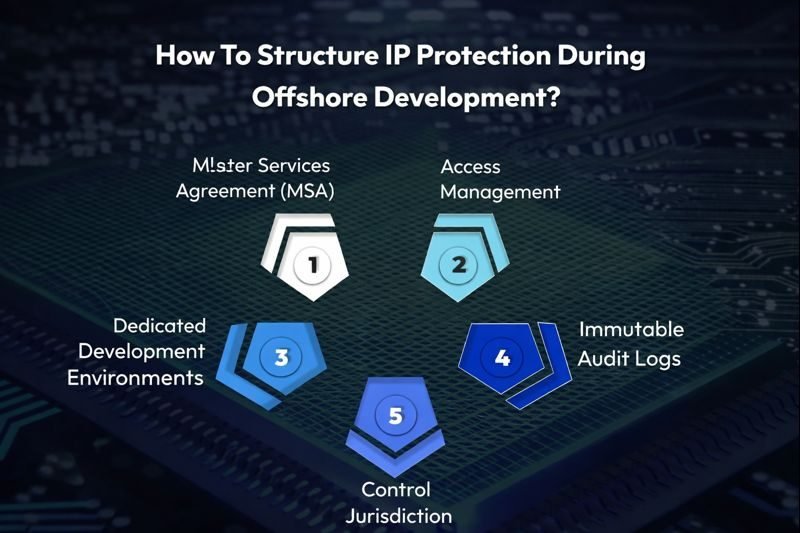
Offshoring development is a strategic necessity for many organizations, offering access to global talent, faster scaling, and cost efficiency for both startups and enterprises.
However, concerns about intellectual property protection persist. Most IP breaches occur because companies use weak frameworks, informal controls, or assume that trust is enough, rather than taking deliberate measures to prevent theft.
If you are offshoring development today, one principle matters more than any other. IP protection is not a document. It is a system. And that system must be engineered as carefully as the product itself.
Why NDAs Are Not Enough
Many companies believe they are protected once they sign an NDA. That belief is dangerous.
An NDA is a legal boundary, not an operational safeguard. It does not control who can access your source code, how files are shared, or where critical assets are stored. It does not prevent accidental exposure, poor access to hygiene, or uncontrolled replication of sensitive data.
In modern Offshoring Development, IP risk is introduced not through intent, but through:
- Overly broad access to repositories
- Shared infrastructure across multiple clients
- Unclear ownership clauses
- Poorly defined development environments
- Lack of auditability
Protecting IP requires tight, layered controls across legal structure, access architecture, and technical governance.
Start With the Right Legal Foundation
The first and most critical layer of IP protection begins with your Master Services Agreement (MSA).
Your MSA must explicitly define:
- Work-for-hire status under your local jurisdiction
- Immediate ownership transfer of all code, designs, documentation, and derivatives
- Clear treatment of background IP versus project-specific IP
- Obligations that survive contract termination
All code, schematics, and design artifacts must legally belong to you upon creation.
Ambiguity is costly. Without clear ownership, you may retain usage rights but lose control, a fatal distinction in disputes, acquisitions, or audits.
Effective Offshoring Development Services always begin with contracts that leave no room for interpretation.
Access Management Is Non-Negotiable
Once legal ownership is established, access control becomes the most important operational safeguard.
A common offshoring mistake is granting developers full repository access for convenience, which creates risk.
Instead, access must be:
- Role-based
- Minimal by default
- Continuously reviewed
Role-Based Access Control (RBAC) ensures that developers only see what they are actively working on, not your entire codebase, roadmap, or proprietary algorithms.
For example:
- Firmware engineers access firmware modules, not hardware IP.
- Frontend developers access UI layers, not core business logic.
- Test teams access building artifacts, not source repositories.
This compartmentalization sharply limits the impact of mistakes or malicious actions.
Dedicated Development Environments Are Essential
Shared environments are among the most overlooked IP risks in offshoring. No shared laptops. No personal GitHub accounts. No uncontrolled cloud storage.
Every offshore engagement should operate inside dedicated, client-owned development environments that enforce:
- Encrypted storage
- Controlled device policies
- Centralized identity management
- Enforced backup and retention rules
Your IP should never sit on personal devices or unmanaged platforms. Ownership means nothing if assets are scattered.
Professional Offshoring Development Services treat infrastructure as part of IP protection, not an afterthought.
Build Auditability into Your Development Workflow
If something goes wrong, you must be able to answer a simple question:
Who accessed what, and when?
That requires immutable audit trails. Modern version control systems such as GitLab and Bitbucket support detailed logging of:
- Repository access
- File pulls
- Commits and merges
- Permission changes
These capabilities only work with the correct configuration.
Audit logs should be:
- Immutable
- Centrally retained
- Periodically reviewed
This is not about surveillance. It is about accountability. In regulated industries, during due diligence or in legal disputes, auditability can be the difference between confidence and chaos.
Control Jurisdiction Before You Need It
One of the most common regrets companies express after IP disputes is leaving jurisdiction vague.
Your contract must clearly define:
- Governing law
- Dispute resolution mechanisms
- Venue for enforcement
Choosing jurisdiction ensures enforceability, not distrust.
Many organizations discover too late that enforcing IP rights across borders is expensive, slow, or impractical. Clear jurisdictional control preserves leverage and reduces uncertainty if issues arise. Strong Offshoring Development Services always account for this upfront.
Separate Trust from Control
Trust matters. But unstructured trust is fragile. High-performing offshore teams often operate with strong ethical standards and professional discipline. Yet even the best teams are subject to:
- Human error
- Process gaps
- Infrastructure failures
Engineering control does not signal mistrust; it signals maturity.
Just as you design systems to fail safely, you must design offshore engagements to protect IP even when assumptions break down.
Why IP Protection Must Be Designed Upfront
IP frameworks cannot be retrofitted. Once repositories are shared, environments mixed, or ownership unclear, leverage is lost. Reversing these choices is costly, disruptive, and incomplete.
Teams that structure IP protection upfront:
- Retain long-term control
- Scale offshore teams with confidence
- Simplify audits and acquisitions
- Reduce dependency risk
Unstructured teams spend years untangling preventable issues.
Offshoring Without Losing Control
Offshoring development does not mean losing control. When done correctly, Offshoring Development allows organizations to:
- Accelerate innovation
- Access specialized skills
- Scale engineering capacity
- Maintain full ownership of their IP
The difference lies in how deliberately you design the engagement. IP protection is an ecosystem of coordinated legal, technical, and operational decisions.
Final Thoughts
You can offshore development. But you cannot offshore responsibility for protecting what you create.
In today’s global engineering landscape, intellectual property is often the company’s most valuable asset. Protecting it requires more than contracts; it requires systems, discipline, and foresight.
At Pinetics, we approach Offshoring Development Services with this philosophy at the core. We help organizations build offshore teams that are secure by design, combining strong legal frameworks, controlled-access architectures, and robust technical governance.
We believe in building trust but engineering for control. Because sustainable innovation is only possible when ownership, security, and accountability are never in question.
 Sr. Test Engineer
 Sales Marketing Manager
 Marketing & Sales – BBA : Fresher