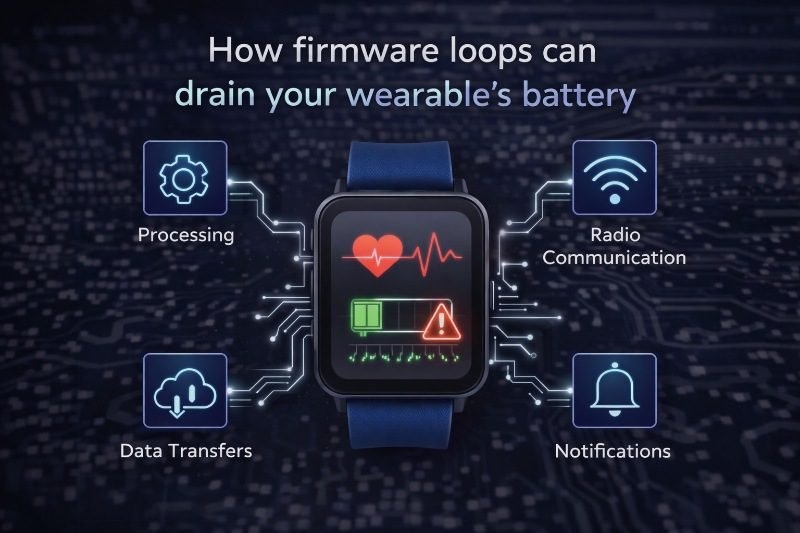
Firmware loops can quietly drain a wearable’s battery by keeping the processor awake when nothing needs it: a polling loop, a busy-wait delay or a timer set “just to be safe” stops the device ever reaching deep sleep. Firmware loops that drain wearable batteries pass every functional test, because the device works; only the runtime is wrong.
If your wearable’s runtime is shorter than the datasheet arithmetic says it should be: measure how often the processor wakes, list every timer and polling loop that wakes it, then ask which of them a patient’s data actually needs. The gap between the two lists is the battery you are losing.
Consider an illustration: a wearable heart monitor fails in the field, not because of faulty sensors, poor manufacturing, or inaccurate algorithms. It fails because of a firmware loop. A single loop that never allows the processor to truly rest.
The result? The battery drains eight hours earlier than expected, shutting the device down just before a critical cardiac episode. In consumer electronics, this would be a usability problem. In MedTech, it is a clinical safety event.
Power efficiency in wearables is not a nice-to-have performance metric. It is directly tied to continuity of care, diagnostic reliability, and patient trust. And yet, firmware power behaviour remains one of the most underestimated risks in medical device development.
Why is power a safety requirement in a medical wearable?
Power is a safety requirement in a medical wearable because the device is expected to run continuously for days or weeks and every minute of downtime is lost clinical visibility. Battery capacity is fixed by size, weight, thermal limits and patient comfort, which leaves firmware behaviour as the single biggest lever for extending or destroying runtime.
Medical wearables, especially cardiac monitors, are expected to operate continuously, often for days or weeks, without interruption. Every minute of downtime is lost clinical visibility. From a medical device hardware design perspective, battery capacity is finite. Size, weight, thermal limits, and patient comfort constrain the amount of energy that can be stored.
This makes firmware behaviour the single biggest lever for extending or destroying runtime. When firmware wastes power, no amount of battery optimisation can save the device.
The regulatory frame for that lever already exists. Medical device software, which is what a medical wearable’s firmware is, has its life cycle requirements defined by IEC 62304. The engineering consequence, ours rather than the standard’s wording, is that a runtime which depends on firmware behaviour is a software requirement to write down, verify and trace like any other. The question for a product owner is whether “the battery lasts the shift” is in the requirements at all, or only in the brochure.
What does always-on firmware thinking cost a wearable?
Always-on firmware thinking costs a wearable its runtime without failing a test. Continuous polling instead of event-driven execution, high-frequency timers set “just to be safe”, peripherals left enabled by default and a CPU that never fully sleeps pass bench testing, because the device works and the data looks correct, while the processor stays awake more than it needs to.
Many firmware teams inherit design habits from non-medical embedded systems:
- Continuous polling instead of event-driven execution.
- High-frequency timers “just to be safe”.
- Peripherals are left enabled by default.
- The CPU never fully enters sleep states.
These patterns often go unnoticed in bench testing. The device works. The data looks correct. The UI is responsive.
But beneath the surface, the processor is awake far more than it needs to be. In a medical wearable, silent inefficiency compounds over hours and days until the battery gives out at the worst possible moment.
Which firmware loops drain a wearable battery?
The firmware loops that drain a wearable battery are the ones that keep a core running while it waits: polling sensor status instead of taking its interrupt, busy-wait delays instead of low-power timers, background loops checking rarely changed flags and RTOS tasks that never block or yield. Each looks harmless alone; together they stop the system reaching deep sleep.
Firmware loops are among the most common and dangerous sources of unnecessary power consumption.
Typical examples include:
- Polling sensor status instead of using interrupts.
- Busy-wait delays instead of low-power timers.
- Background loops check flags that rarely change.
- RTOS tasks that never block or yield properly.
Each loop may seem harmless in isolation. Together, they prevent the system from entering deep sleep modes where real power savings occur.
In hardware firmware development, power optimisation starts with one question: “What absolutely needs to be awake right now?” If the answer is “nothing,” the system should be sleeping.
The question “what absolutely needs to be awake right now?” has a measurable answer, and it is how the silent battery killers are found. On a bench with a power analyser in series with the battery, a wearable that has genuinely reached deep sleep draws microamps between wake-ups; one with a hidden loop draws milliamps and never shows the flat floor between events. The floor is the test: if the trace never flattens, a loop is still running, and the code review that missed it is not the tool that will find it.
How do you balance accuracy against battery life in a wearable?
You balance accuracy against battery life in a wearable by setting the sampling rate, data density and transmission frequency from the clinical requirement, not from what the hardware can do. Sampling ECG too fast, rendering waveforms continuously or transmitting too often can double or triple power draw without clinical benefit, and accuracy that drains the battery prematurely is failure.
Wearable device teams often prioritise:
- Higher sampling rates
- Denser data streams
- Faster UI updates
Accuracy matters, but so does duration.
Sampling ECG data at unnecessarily high rates, rendering waveforms continuously, or transmitting data too frequently can double or triple power draw without meaningful clinical benefit.
This is where firmware engineers must collaborate closely with hardware and clinical teams.
Effective firmware development services align:
- Clinical requirements
- Signal fidelity needs
- Power budgets
Accuracy that drains the battery prematurely is not accurate; it is failure.
The clinical requirement is the number to start from, because it is the one a regulator and a clinician will both recognise. A cardiac wearable that must detect a class of arrhythmia has a minimum sampling rate that follows from the signal it must resolve, and everything above that minimum, beyond the margin the filter chain needs, is battery spent on precision nobody asked for. How a device’s whole power budget is set and defended from the first architecture meeting is the subject of our post on how power optimisation changes MedTech devices.
Why do wearables never reach their sleep states?
Wearables fail to reach their sleep states because something is always “just running”: a misconfigured RTOS tick timer, a peripheral left clocked, a debug interface still enabled in production or a software timer firing too often. Most MCUs offer sleep, stop, standby and deep sleep, but a firmware architecture not designed for idle time leaves every one of them theoretical.
Most modern MCUs support multiple low-power modes: sleep, stop, standby, and deep sleep. Yet many devices never truly enter them.
Why? Because something is always “just running.”
Common culprits include:
- Misconfigured RTOS tick timers.
- Peripherals were left clocked unnecessarily.
- Debug interfaces are enabled in production.
- Software timers are firing too frequently.
If the firmware architecture is not intentionally designed for idle time, sleep modes remain theoretical.
In medical wearables, power management must be architectural, not reactive.
Architectural rather than reactive has a project-plan meaning as well as a code meaning. On a connected-health wearable programme, the sleep-mode implementation at Pinetics was a tracked workstream in its own right, because the sleep current a datasheet promises is reached only after every peripheral, pull-up and pin state has been accounted for on the real board. The check for a buyer is to ask whether sleep-mode bring-up appears on the project plan by name; if it does not, ask what measurement shows the sleep modes are reached rather than assumed.
What does power-aware firmware architecture look like?
Power-aware firmware architecture treats power as a first-class design constraint: event-driven task execution instead of polling, interrupt-based sensor handling, work batched to lengthen sleep windows, aggressive peripheral shutdown when idle and deterministic wake-up paths. The firmware behaves like a disciplined scheduler that does the necessary work quickly and then gets out of the way, and anything else is wasted battery.
High-quality hardware firmware development treats power as a first-class design constraint.
That means:
- Event-driven task execution instead of polling
- Interrupt-based sensor handling
- Batching work to maximise sleep windows
- Aggressive peripheral shutdown when idle
- Deterministic wake-up paths
Firmware should behave like a disciplined scheduler doing necessary work quickly, then getting out of the way. Anything else is wasted energy.
Four always-on habits a wearable inherits from non-medical firmware, and the power-aware practice that replaces each
| Always-on habit | Power-aware practice that replaces it |
|---|---|
| Continuous polling instead of event-driven execution | Event-driven task execution and interrupt-based sensors |
| High-frequency timers “just to be safe” | Work batched to lengthen the sleep window |
| Peripherals left enabled by default | Aggressive peripheral shutdown when idle |
| The CPU never fully enters sleep states | Deterministic wake-up paths |
Each power-aware practice is a decision made in the architecture, and none can be retrofitted cheaply once the driver layer assumes a peripheral is always powered. How a firmware engagement is scoped so that these decisions are made before the first line of application code is set out on our page on how a firmware development engagement is structured.
Why must hardware and firmware be designed together for power?
Hardware and firmware must be designed together for power because power problems emerge at the boundary: the hardware must provide regulators that switch state quickly, sensors with low-power modes and clocks that scale, while the firmware must use those capabilities, sequence transitions correctly and handle failure cases. A wearable’s power budget collapses when either side assumes the other’s ideal.
Power issues are rarely “just firmware” or “just hardware.” They emerge at the boundary.
From a medical device hardware design standpoint:
- Power regulators must support fast state transitions.
- Sensors must expose low-power modes.
- Clocks must be configurable and scalable.
From the firmware side:
- Those capabilities must be actively used.
- Transitions must be correctly sequenced.
- Failure cases must be handled safely.
When hardware features are ignored or firmware assumes ideal conditions, power budgets collapse.
True efficiency only happens when hardware and firmware are designed as a single system.
The battery itself sits on that boundary and has its own safety standard: IEC 62133-2 covers portable sealed secondary lithium cells and the batteries made from them, for use in portable applications. The standard is about the cell; the firmware point is separate. A firmware team that gates behaviour on battery level, refusing a long operation on a nearly flat cell, is using information the hardware has to expose through a fuel gauge or a measured cell voltage. Ask early which side owns the battery state, because a wearable in which nobody owns it will discover the answer in the field.
Why are power bugs harder to detect than functional bugs?
Power bugs are harder to detect than functional bugs because functional bugs crash a system and power bugs quietly degrade it: a wearable can pass unit testing, integration testing and basic validation and still fail in the field from power behaviour that only appears over long runtimes. Power profiling therefore belongs inside development, not only in pre-release testing.
Functional bugs crash systems. Power bugs quietly degrade them.
A wearable can pass:
- Unit testing
- Integration testing
- Basic validation
And still fail in the field due to power behaviour that only emerges over long runtimes.
This is why power profiling must be part of development, not just pre-release testing.
Effective firmware development services include:
- Current profiling during real workloads
- Long-duration soak tests
- Idle state verification
- Battery discharge curve analysis
If you don’t measure power, you don’t control it.
Four power measurements to run on a wearable during development, and the fault each one catches
| Power measurement | Fault it catches |
|---|---|
| Current profiling during real workloads | A task or radio that draws more than its budget |
| Long-duration soak tests | Drift and leaks that only appear over days |
| Idle state verification | A loop or peripheral that stops deep sleep |
| Battery discharge curve analysis | A runtime shorter than the cell’s capacity predicts |
Battery discharge curve analysis is where the illustrated heart monitor’s fault would be caught: a discharge curve that reaches empty eight hours early on the bench is the same curve that reaches empty eight hours early on the patient. How a wearable that passes every functional test is debugged when its battery life fails in the field is the subject of our post on firmware debugging for wearable devices.
What are the regulatory implications of a drained battery?
A drained battery in a medical wearable is a regulatory issue as well as a technical one, because an unexpected shutdown reopens the questions a submission answered: was the risk adequately mitigated, was the runtime validated under real conditions, were the failure modes foreseeable? A firmware loop that shortens runtime can invalidate the safety assumptions documented in the submission.
In MedTech, a drained battery is not just a technical issue; it is a regulatory one.
Unexpected shutdowns raise questions such as:
- Was risk adequately mitigated?
- Was the runtime validated under real conditions?
- Were failure modes foreseeable?
Firmware loops that cause early battery depletion can invalidate safety assumptions documented during regulatory submission.
This turns a design oversight into a compliance risk. Power-aware firmware is not only good for engineering but also for regulatory protection.
For a wearable worn at home, “real conditions” means the home healthcare environment, and that environment has a collateral standard a submission can point to: IEC 60601-1-11, for medical electrical equipment and systems used there. The runtime claim a device makes should hold in that environment, not only on a desk beside a charger. Pinetics holds no certification of its own and works inside its customers’ quality systems, so the design records that support a runtime claim are the customer’s own, not ours.
How do you design a wearable for worst-case use, not best-case?
You design a wearable for worst-case use by assuming the patient is not typical: some move more, some sleep less, some generate noisier signals and some rely on the device continuously. The firmware handles that behaviour without exhausting the power reserve through adaptive sampling rates, conditional processing and dynamic power scaling, because static assumptions are dangerous in a wearable.
Many devices are designed around “typical use.” But patients are not typical. Some move more. Some sleep less. Some generate noisier signals. Some rely on the device continuously.
Firmware must handle worst-case behaviour gracefully without exhausting power reserves.
That means:
- Adaptive sampling rates
- Conditional processing
- Dynamic power scaling
Static assumptions are dangerous in medical wearables.
Worst case is a number, not a mood. Take the patient who moves most, the noisiest signal and the longest continuous wear the intended use allows, and run the power budget on that profile with every adaptive mechanism forced to its highest setting. If the runtime claim survives that profile it can be defended in the field; if it needs typical use to hold, the claim is optimistic and the submission is carrying the risk.
What is the human cost of power blindness in a wearable?
The human cost of power blindness in a wearable is measured in missed arrhythmias, delayed intervention, lost clinician confidence and reduced patient adherence. A device that cannot be trusted to stay alive cannot be trusted to save lives, so power awareness is a patient safety issue and a firmware loop that passes code review can be catastrophic.
When a wearable battery dies early, the impact is not abstract.
It can mean:
- Missed arrhythmias
- Delayed intervention
- Lost clinician confidence
- Reduced patient adherence
A device that cannot be trusted to stay alive cannot be trusted to save lives. This is why power awareness is ultimately a patient safety issue.
Firmware loops may look small in code reviews, but their impact on wearable medical devices can be catastrophic. In MedTech, power efficiency is not an end. It is a prerequisite for clinical reliability.
At Pinetics, we approach medical device hardware design, firmware development services and hardware firmware development with power awareness built into every architectural decision, and we ask three things of every wearable plan: that the sleep-mode work is on it by name, that the power budget is run on the worst-case patient and that the discharge curve is measured before anyone claims a runtime. We help teams design systems that balance accuracy, responsiveness and endurance without sacrificing patient safety, inside the customer’s quality system rather than under a certification of our own. That work rests on 100,000+ engineering hours and a leadership team with 20+ years of experience. If your wearable’s runtime is shorter than the arithmetic says it should be, the cause is findable on a bench with a power analyser in series with the battery, and we are happy to help find it.
Because when a wearable fails silently due to poor power management, it is not just a technical failure. It is a broken promise to the patient relying on it.
Alankar Dhobale, Co-Founder and Global CTO, Pinetics. 21+ years in electronic product development. BE Electronics, Shivaji University. LinkedIn