Debugging battery drain in a wearable’s firmware starts by measuring what the device draws when it should be asleep, then finding which peripheral, interrupt or task is keeping it awake. The faults are small, a few microamps or a timer firing too often, and invisible in lab testing. They only show up as battery life lost in the field.
If your wearable is losing battery life in the field: measure idle current with the radios off, then with each peripheral disabled in turn, and log how often the processor wakes. Those two measurements usually point at the peripheral or the timer responsible. The method and the worked example behind it are below.
Everyone notices the finished wearable device, the lightweight wristband, the seamless interface, and the real-time health insights delivered with a tap. What most people never see is the engineering reality behind it.
A wearable fault of this kind is rarely dramatic. Take a worked example: a current drain of a few microamps, invisible on paper, quietly halving battery life overnight.
On paper, the device worked perfectly. In real life, it didn’t. And that difference is exactly where embedded systems development becomes critical.
Why does a wearable that passes lab testing fail in the field?
A wearable passes lab testing and fails in the field because the lab holds still. On a bench the sensors sit flat, the temperature is constant, the radio is clean and testing lasts an afternoon. On a wrist it moves, meets sweat and loses skin contact over two days. Faults that cost nothing on the bench cost battery life there.
The wearable device had completed internal testing.
- The ECG signals were stable.
- SpO2 readings were accurate.
- PPG waveforms were clean and consistent.
From a validation perspective, everything appeared ready for release. But field trials told a different story.
Unexpected issues emerged quickly:
- Battery runtime dropped from 48 hours to 18 hours
- Signal acquisition failed during motion
- Real-time alerts lagged under system load
- Power consumption varied unpredictably
This is a familiar scenario in wearable development. Lab environments are controlled. Real-world usage is not.
Wearables operate in dynamic conditions:
- Movement
- Temperature changes
- Wireless interference
- Variable sensor contact
- Continuous runtime expectations
These conditions expose firmware weaknesses that hardware validation alone cannot detect.
What causes a wearable's battery life to drop suddenly?
A wearable’s battery life drops when something stops the processor or a peripheral from sleeping. In a worked example three faults did it together: an ADC that never entered sleep mode, an interrupt firing every 2 milliseconds, which is 500 wake-ups a second, and a scheduler race that dropped signal frames during motion. None was visible in normal testing.
Once the issue was confirmed, a systematic debugging process began, a core component of professional firmware development services.
Three root causes eventually emerged. First, the ADC (Analog-to-Digital Converter) never entered sleep mode. Even during idle periods, it continued consuming power.
Second, a firmware interrupt was misconfigured. Instead of triggering only when needed, it fired every 2 milliseconds, keeping the processor active.
Third, a scheduler race condition caused intermittent frame drops in signal capture, especially during motion.
None of these problems was obvious during normal testing. Together, they significantly reduced battery life and degraded system reliability.
This is the reality of embedded systems engineering: small inefficiencies compound quickly.
What each field symptom points to, and the measurement that confirms it
| Field symptom in a wearable | What to suspect first | Measurement that confirms it |
|---|---|---|
| Runtime 48 hours to 18 | A peripheral never sleeping | Idle current with and without it enabled |
| Runtime 48 hours to 18 | An interrupt firing too often | GPIO toggled in the ISR, on a logic analyser |
| Alerts lag under load | An interrupt firing too often | Wake count per second in a debug counter |
| Signal fails during motion | A scheduler race | Sequence numbers on every frame, checked for gaps |
| Power varies unpredictably | More than one of these at once | Current profile logged over a full night |
What does firmware control in a wearable?
Firmware controls everything a wearable does between the sensor and the radio: when each sensor samples, how data moves through the acquisition pipeline, which power state the processor and each peripheral sit in, how memory is allocated, when the radio transmits, how interrupts are prioritised and what the safety monitor checks. Hardware sets the limits. Firmware decides the behaviour.
In wearable medical and health devices, firmware is not just software. It is the control system that governs every hardware interaction.
Firmware manages:
- Sensor timing
- Data acquisition pipelines
- Power states
- Memory allocation
- Wireless communication
- Interrupt handling
- Safety monitoring
- Real-time processing
A wearable device may look simple externally, but internally, it operates as a tightly synchronised embedded system.
This is why embedded product development services must treat firmware architecture as foundational, not secondary. Hardware determines capability. Firmware determines behaviour.
Every one of those eight functions is a firmware decision. The ADC’s sleep state, the radio’s transmit interval and the I2C battery gauge’s polling rate are all set in code, which is why a power fault that looks like a battery problem is investigated in the firmware first.
How do you fix wearable firmware once the root causes are found?
Fixing wearable firmware after the root causes are found usually means re-architecting rather than patching. In a worked example the interrupt timing logic was rebuilt, the power management layer rewritten, scheduler priorities re-tuned, deeper peripheral sleep states added, watchdog-based validation routines introduced and motion scenarios added to the test plan. Battery runtime returned to the expected level.
Fixing the issues required more than patching code. The firmware architecture had to be redesigned to ensure deterministic behaviour and efficient power usage. Several improvements followed:
- Re-architected ISR timing logic
- Rewrote the power management layer
- Optimised scheduler priorities
- Implemented deeper peripheral sleep states
- Introduced watchdog-based validation routines
- Added real-world motion testing scenarios
Each improvement contributed incrementally to system stability. Once complete:
- Battery runtime returned to expected levels
- Signal acquisition remained stable during movement
- Alerts became responsive under load
- Power consumption became predictable
The device was finally ready for deployment.
How do you find where a wearable's power is going?
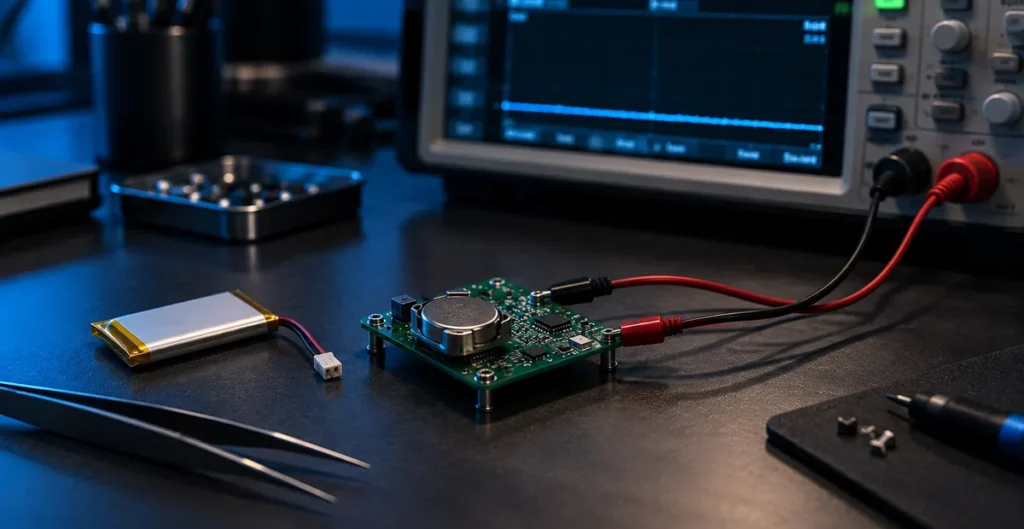
Finding where a wearable’s power goes means measuring each consumer separately before touching the code. On a battery-powered wearable, Pinetics measured the Wi-Fi module’s sleep current on its own first, so that every later reading of the whole board could be compared against a known floor.
A device like this typically carries optical and motion sensors, a battery gauge and a combined Wi-Fi and Bluetooth LE module, whose power management features have to be driven correctly in firmware if a Wi-Fi radio is to sit inside a wearable’s power budget at all. Battery life was agreed as a deliverable at the start, so it had an owner before the first line of code was written.
On a connected wearable the radios are the least predictable part of the power budget, because each one wakes on its own schedule and neither knows about the other. A common pattern is to let the Wi-Fi module sleep and wake at a fixed interval to post telemetry, and to synchronise the Bluetooth LE and Wi-Fi transmit intervals so the two radios share one wake window instead of waking the board twice. When there is no network, readings are buffered in non-volatile memory and posted when the link returns, so a dropped network costs nothing but a delay. An over-the-air update should only start above a safe battery level, because an update that starts on a nearly flat battery and dies halfway is a brick on someone’s wrist.
The sleep-current budget method
| Step in the sleep-current budget | What you switch off or hold still | What you measure |
|---|---|---|
| 1 | Everything: radios off, sensors off | The processor’s own deep-sleep floor |
| 2 | Radios off, one sensor on at a time | Each sensor’s idle and sampling cost |
| 3 | Sensors off, one radio on at a time | Each radio’s sleep floor and wake cost |
| 4 | Nothing: normal firmware running | The real profile over one full night |
| 5 | Nothing: build the budget from steps 1 to 3 | The gap between the budget and step 4 |
The budget is the deep-sleep floor plus each consumer’s cost multiplied by the fraction of time it is actually on. Adding steps 1 to 3 straight counts the sleep floor several times over and overstates what the board should draw.
Our page on how a firmware development engagement is structured, from architecture to verification sets out how this kind of work is scoped. The wider power question for medical wearables is covered in our post on why power efficiency decides a medical device’s design.
Why is wearable debugging different from other embedded systems?
Wearable debugging differs from other embedded work because the device runs continuously, on a battery, on a moving person, while staying accurate and safe. Every fix trades one constraint for another: faster sampling improves accuracy and costs power, deeper sleep saves power and risks missing an event, more processing improves analytics and adds latency. There is no free setting.
Wearables introduce unique engineering challenges. Unlike many embedded systems, they must operate continuously in unpredictable environments while maintaining extremely low power consumption. Wearable firmware must balance:
- Accuracy
- Responsiveness
- Battery life
- Thermal limits
- Wireless connectivity
- Safety requirements
Optimising one dimension often impacts another. For example:
- Increasing sampling frequency improves accuracy but increases power consumption.
- Aggressive sleep modes save power but risk missing events.
- Higher processing loads improve analytics but increase latency.
This balancing act defines wearable embedded systems development.
None of these trades can be settled by reading the code. They are settled on a bench, with the supply current measured alongside a logic analyser trace of when the processor is awake, on a board running the real firmware, because the cost of each setting only shows up as current over time.
Which power optimisations belong in firmware rather than hardware?
Power optimisations that belong in firmware are the ones that decide when things are on: coordinating peripheral sleep, driving the system from events rather than polling, prioritising interrupts, moving data by DMA, scaling the clock, duty-cycling sensors and batching radio transmissions. None of these needs new hardware. Each needs someone owning the power budget in code.
Battery performance is often perceived as a hardware problem, but in reality, firmware plays a dominant role. Effective power optimisation includes:
- Peripheral sleep coordination
- Event-driven architecture
- Interrupt prioritisation
- DMA utilisation
- Clock scaling
- Sensor duty cycling
- Communication batching
Even microamp-level inefficiencies matter. In wearable devices, small firmware errors can dramatically reduce runtime. Power-aware firmware design must be intentional from the beginning, not added later.
The battery drain patterns firmware creates on its own, without any hardware fault, are the subject of our post on the firmware loops that drain a wearable battery.
What real-world tests should a wearable pass before release?
A wearable should pass tests that a bench cannot run: motion during acquisition, signal noise, battery edge cases, long-duration operation, communication interruptions and sensor misalignment. The test cases should be written as documents before execution, with a set for every feature of the device, from power and radios to factory reset and over-the-air update.
One of the biggest lessons in wearable development is that lab validation alone is insufficient. Firmware must be tested under:
- Motion conditions
- Signal noise scenarios
- Battery edge cases
- Long-duration operation
- Communication interruptions
- Sensor misalignment
Real-world validation reveals issues that simulations cannot. Professional embedded product development services incorporate field testing early in the development lifecycle to avoid late-stage failures.
Why does firmware reliability decide clinical reliability in a wearable?
Firmware reliability decides clinical reliability because in a health wearable a missed signal event, a delayed alert, data lost during motion or an unexpected power-down is a clinical failure, not a user experience fault. That is why medical device software is assessed against IEC 62304 across its lifecycle, and why firmware is engineered with the same rigour as hardware.
In health-monitoring wearables, firmware performance directly impacts clinical outcomes. If a wearable:
- Misses a signal event
- Delays an alert
- Loses data during motion
- Powers down unexpectedly
The consequences go beyond user experience. They affect safety. This is why firmware must be engineered with the same rigor as hardware design.
Reliability is not achieved solely through testing. It is achieved through architecture.
How IEC 62304, risk management and the design history file fit together in a connected medical device is on our medical device software page.
What separates prototype firmware from production firmware?
Production firmware differs from prototype firmware in what it does when things go wrong. It handles edge cases, recovers from faults, runs continuously, keeps its timing guarantees, supports updates and meets regulatory expectations. A prototype proves the sensor works. Production firmware proves the device still works months later, after a dropped network, a flat battery and an update.
Many wearable prototypes work well in controlled demonstrations. Scaling them into reliable products requires a deeper engineering discipline. Production-ready firmware must:
- Handle edge cases
- Recover from faults
- Operate continuously
- Maintain timing guarantees
- Support updates
- Meet regulatory expectations
This transition from prototype firmware to production firmware is where experienced firmware development services become essential.
The update path is where most prototypes fall short. Where a product moves to a new microcontroller, the firmware is ported and re-verified first, then given a secure over-the-air update image, a local update route and an automatic update gated on battery level, with test cases written for the update path. A prototype does not need any of that. A product on a wrist needs all of it.
What is the invisible work in wearable firmware?
The invisible work in wearable firmware is the part that never shows up in the product: the timing analysis, the power-state debugging and the weeks spent proving the device behaves the same on a wrist as it did on the bench. A buyer sees battery life and reliable alerts. Those are what that work buys.
The most important engineering work in wearable development is often invisible. Users see:
- A comfortable device
- A clean interface
- Reliable notifications
- Long battery life
They don’t see:
- ISR timing diagrams
- Power-state debugging
- Scheduler analysis
- Memory profiling
- Signal integrity validation
- Weeks of optimisation
Yet those invisible efforts define whether the product succeeds or fails. This is the reality of embedded systems development.
Debugging a wearable device is rarely about fixing obvious problems. It is about identifying subtle system-level interactions between hardware, firmware, and real-world usage.
The invisible engineering work behind firmware stability determines whether a wearable device delivers reliable health insights or fails silently in the field.
In wearable technology, the most important engineering work is the work no one ever sees, yet every user depends on it.
You can see the battery life. You cannot see the microamps that decide it.
Pinetics designs and builds the firmware inside wearables like these: the sleep-mode architecture, the radio scheduling, the sensor pipelines and the update path that keeps a device on a wrist maintainable. Our embedded systems development, firmware development services and embedded product development services put system-level validation, power-aware firmware architecture and real-world reliability testing into the programme from the earliest stages. We hold no quality certification of our own, by choice, and work inside our customers’ quality systems instead, which is why the test cases are written down before the tests are run. The team has logged over 100,000 engineering hours across medical, industrial and IoT programmes and is led by engineers with 20+ years in electronic product development. If your wearable works on the bench and not on the wrist, Pinetics can find out why.