Power optimisation turns a MedTech device that works on the bench into one that works on the patient: it decides how long a monitor runs between charges, whether an alert still fires on a low battery and whether the device passes the safety standards it is sold under. That is the importance of power efficiency in medical devices.
If you are specifying a battery-powered medical device now: write down the runtime the clinical use demands, the events the device must never miss, the environment it will be charged in and the standards it will be tested to, IEC 60601-1 for the equipment and IEC 60601-1-11 if it will be used at home. Those four answers shape the processor, the battery, the firmware architecture and the test plan before any part is chosen. Each of those four decides part of the answer, because power efficiency is set at architecture, not patched in firmware.
In modern healthcare technology, portability is no longer a luxury; it is an expectation. From wearable cardiac monitors to portable diagnostic equipment and home-care devices, medical innovation is moving closer to the patient than ever before. But behind every portable medical device lies a constraint that determines whether the product succeeds or fails in power.
No matter how advanced the sensing technology, connectivity stack, or clinical algorithms may be, a device that cannot maintain reliable power operation cannot fulfil its clinical mission. In medical environments, battery life is not just a convenience metric; it is directly tied to patient safety, reliability, and regulatory compliance.
This is where thoughtful medical device hardware design, intelligent firmware architecture, and disciplined hardware firmware development converge to define product success.
Why does power optimisation matter more in MedTech than in consumer devices?
Power optimisation matters more in MedTech because a medical device that stops is a clinical failure, not an inconvenience. A battery-powered monitor has to sense continuously, communicate wirelessly, process in real time, run its own safety diagnostics, meet IEC 60601-1 and last its full operating life, all from one battery. Every milliamp is a trade between those demands.
Unlike consumer electronics, medical devices operate under strict reliability and safety expectations. A smartwatch running out of battery is inconvenient. A portable cardiac monitor shutting down during a patient’s episode is unacceptable.
Battery-powered medical devices must balance multiple competing requirements:
- Continuous sensing and monitoring
- Wireless communication
- Real-time processing
- Safety diagnostics
- Regulatory compliance
- Long operational lifetime
Power optimisation, therefore, becomes a system-level engineering discipline rather than a single hardware decision.
In portable medical systems, every milliamp matters.
When should power be designed into a medical device?
Power is designed into a medical device from the first architecture review, when the processor, the analog front end, the regulator topology, the battery chemistry and capacity, each component’s sleep behaviour and the radio module are chosen. Those six decisions fix most of the power profile before a line of firmware exists, and firmware can only spend what they leave.
One of the most common mistakes in device development is treating power optimisation as a late-stage firmware task. Power efficiency must be engineered into architecture from the beginning.
Effective medical device hardware design considers:
- Processor selection
- Analog front-end efficiency
- Power regulation topology
- Battery chemistry and capacity
- Component sleep characteristics
- Communication module consumption
These decisions shape the power profile long before firmware is written.
When hardware and firmware teams collaborate early through structured hardware firmware development, systems achieve significantly better runtime and reliability.
Power is designed in from day one because the regulator choice is a decision firmware cannot undo. The two regulator types pull in opposite directions: a low-dropout linear regulator is quiet but wastes the difference between battery and rail voltage as heat, so it belongs on a sensing rail that must be clean; a switching regulator is efficient but noisy, so it belongs on the digital and radio rails. Which type sits on which rail is settled at schematic stage, which is why “what is on the sensing rail?” is a fair question to put to your hardware team before layout starts. A device that puts everything on one linear rail has already spent part of its battery life before the first sleep mode is written.
How does dynamic power scaling work in a medical device?
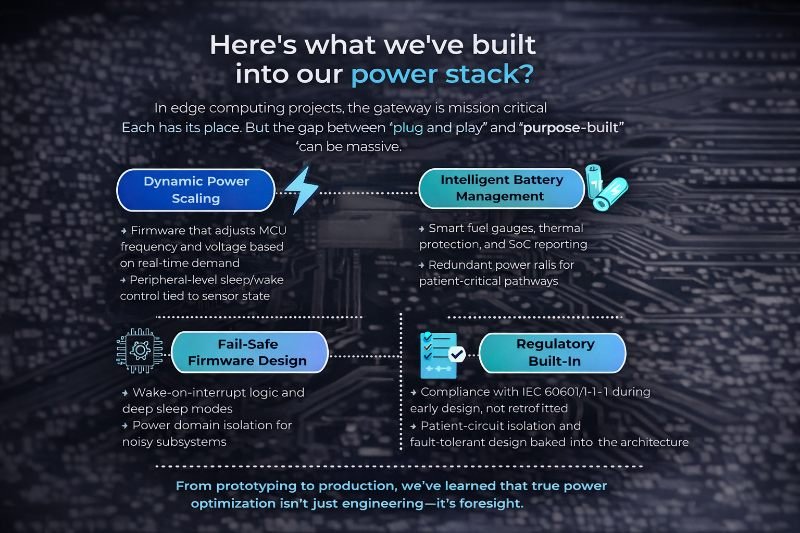
Dynamic power scaling in a medical device runs the processor at the lowest clock and voltage the workload needs, switches peripherals on only when used and wakes into a high-performance burst when the signal calls for it. A wearable spends most of its life in a low-power monitoring state and steps up only when an abnormal reading appears.
Modern embedded processors support multiple power states, allowing devices to dynamically adjust performance based on workload.
Dynamic power scaling enables:
- Reduced clock frequency during idle periods
- Adaptive voltage scaling
- Selective peripheral activation
- Workload-based processing bursts
This approach ensures that the processor only consumes energy when necessary.
Through advanced firmware development services, devices can monitor sensor activity and automatically adjust power states in real time. For example, a wearable device may operate in low-power monitoring mode most of the time, switching to high-performance processing only when abnormal signals are detected.
This balance between responsiveness and efficiency is essential in medical applications.
The power states a medical device processor moves between, what stays on in each and what brings it back
| Power state | What stays on | What wakes the device |
|---|---|---|
| Run | Core, clocks, active peripherals, radio as needed | Nothing to wake; it is awake |
| Sleep | Core halted, RAM held, timers and sensor interfaces live | Sensor interrupt, timer, radio event |
| Deep sleep | Retention RAM only, real-time clock, wake pins | Real-time clock alarm, wake pin, button |
| Shutdown | Real-time clock at most | Power button, charger insertion |
Power state is where the clinical requirement meets the datasheet. For every event your device must never miss, settle two questions early: which part of the device is still awake to catch that event in the deepest sleep state it uses, and has the time it takes to wake up been measured on the real board rather than read off a datasheet? On a cardiac monitor that means the sensor interrupt is wired to a wake-capable pin and the wake-up time is a measured number in the test record.
What does a battery management system do in a portable medical device?
A battery management system in a portable medical device measures the charge remaining, watches cell temperature, protects the cell against over-charge, over-discharge and short circuit, estimates state of charge and tracks battery health over its life, so the runtime the device reports is one a clinician can plan around. In patient-critical systems it also feeds redundant power paths.
Battery management is another critical element of power optimisation in portable medical devices.
Modern systems integrate:
- Smart fuel-gauge ICs
- Thermal monitoring circuits
- Redundant protection mechanisms
- State-of-charge estimation algorithms
- Battery health monitoring
These features allow devices to operate safely while providing accurate runtime predictions.
In patient-critical systems, redundant power pathways may be implemented to ensure that essential functions continue operating even during partial power failures. Battery management is not just about extending runtime; it is about ensuring predictable and safe operation.
The cell itself carries its own standard. IEC 62133-2:2017 “specifies requirements and tests for the safe operation of portable sealed secondary lithium cells and batteries containing non-acid electrolyte, under intended use and reasonably foreseeable misuse”, and a medical device that ships a lithium pack will be asked for that evidence alongside its own. The fuel gauge is where the theory gets hard: on a connected-health wearable programme Pinetics ran, integrating the gauge IC was tracked work on the I2C path, with the datasheet study, the configuration and the calibration each recorded, because a gauge that is not calibrated to the actual cell reports a runtime the device cannot deliver.
How does firmware waste or save battery life?
Firmware in a medical device wastes battery life by waking the processor when nothing has happened: polling loops, unnecessary wake cycles, chatty communication stacks, excessive memory traffic and badly ordered sleep transitions. It saves battery life by being event-driven: interrupt-based sensing, DMA transfers that move data while the core sleeps, a low-power RTOS schedule and deliberate deep-sleep orchestration.
Firmware architecture has a profound impact on energy consumption.
Inefficient firmware often causes:
- Unnecessary CPU wake cycles
- Continuous polling loops
- Poorly managed communication stacks
- Excessive memory operations
- Improper sleep state transitions
These inefficiencies accumulate over time, draining batteries faster than expected.
Professional firmware development services focus on designing event-driven firmware architectures that minimise processor activity while maintaining responsiveness.
Examples include:
- Interrupt-based sensor handling
- DMA-driven data transfers
- Low-power RTOS scheduling
- Deep sleep state orchestration
- Wake-on-interrupt logic
When implemented correctly, these techniques can dramatically extend battery life without sacrificing performance.
One firmware decision is often missed on that list: what the device does with an update. On the same connected-health wearable programme, over-the-air updates are gated on battery level, so an update cannot start on a battery too flat to finish it. An update that stops half way is a worse outcome than an update that never starts, which is why the gate is a firmware requirement rather than a convenience. Finding where the milliamps actually go once the device is on a patient rather than on a bench is the subject of our post on debugging battery drain in a wearable’s firmware, and sleep-mode, scheduling and update work of exactly this kind is the firmware work we are engaged for.
Why do medical devices separate analog and digital power domains?
Medical devices separate analog and digital power domains because the sensing circuits that read a heartbeat or a blood-oxygen signal are microvolt-sensitive, and the switching regulators, processors and radios beside them are noisy. Separate rails, filtered regulators, an isolated radio supply and a stable reference voltage protect the signal and let each domain shut down independently when idle.
Medical devices often contain both sensitive analog circuits and high-noise digital subsystems. Without proper power domain isolation, these systems can interfere with each other.
Power-aware medical device hardware design ensures:
- Separation of analog and digital power rails
- Filtering of switching regulators
- Isolation of communication modules
- Stable reference voltages for sensing circuits
This improves both signal quality and energy efficiency.
Isolating power domains also allows certain subsystems to shut down independently when not in use.
The same partitioning decides whether the device passes EMC testing first time, because a noisy digital rail coupled into an analog front end shows up twice: as a degraded signal on the bench and as an emission in the chamber. Discovering it in the chamber means a board respin and a slipped date, which is why it is a schematic-stage decision rather than a test failure to be debugged later. The same boundary decides whether the device meets the patient isolation and leakage current limits IEC 60601-1 sets, because the isolation barrier sits between the patient-connected front end and everything noisy on the other side of it. How the two are designed together is the subject of our post on EMI and EMC design for MedTech devices.
Which standards govern the power design of a medical device?
The power design of a medical device is governed by IEC 60601-1 for basic safety and essential performance, by IEC 60601-1-11 where the device is used at home rather than in a clinic and by IEC 62133-2 for the lithium cell inside it. Together they set electrical safety, patient isolation, leakage current limits, fault tolerance and thermal protection.
Power architecture in medical devices must comply with international safety standards such as IEC 60601-1 and IEC 60601-1-11.
These standards address:
- Electrical safety
- Patient isolation
- Leakage current limits
- Fault tolerance
- Thermal protection
Regulatory compliance influences hardware layout, component selection, and firmware behaviour.
When regulatory requirements are incorporated early in hardware firmware development, devices avoid costly redesign cycles later in development. Compliance and efficiency must evolve together.
The three standards that govern the power design of a battery-powered medical device, what each covers and where to find it
| IEC standard | What it governs in a battery-powered device | Source |
|---|---|---|
| IEC 60601-1:2005 | Basic safety and essential performance of the equipment | IEC 60601-1 page |
| IEC 60601-1-11:2015 | The same equipment when used in the home healthcare environment | IEC 60601-1-11 page |
| IEC 62133-2:2017 | Safety of the portable sealed lithium cell or pack itself | IEC 62133-2 page |
Where these standards land in a device programme, alongside IEC 62304 for the software life cycle and ISO 14971 for risk management, is decided when the programme is scoped, standard by standard. Pinetics holds no certification of its own and works inside its customers’ quality systems, so the evidence these standards ask for is produced in the customer’s design records, not in ours.
How does power optimisation make a medical device portable?
Power optimisation makes a medical device portable by letting it run where charging is occasional and connectivity is unreliable: a patient’s home, an ambulance, a rural clinic, a remote monitoring set-up or an emergency response. IEC 60601-1-11 defines that home healthcare environment as the dwelling place and other places patients are present, without medically trained operators continually available.
Portable medical devices must operate reliably in diverse environments:
- Home healthcare
- Ambulances
- Rural clinics
- Remote monitoring setups
- Emergency response scenarios
In many of these environments, charging opportunities are limited, and connectivity may be unreliable.
Power optimisation ensures devices remain operational when they are needed most. Longer battery life also improves patient experience, reducing the need for frequent charging and maintenance.
That definition is why the standard exists as a separate part. IEC 60601-1-11 describes the home healthcare environment as “the dwelling place in which a patient lives; other places where patients are present both indoors and outdoors, excluding professional healthcare facility environments where operators with medical training are continually available when patients are present”. A device designed for that environment cannot assume a nurse will notice a low battery, so the low-battery behaviour, the alert and the shutdown sequence are safety functions, not user-interface polish.
Why does power reliability build clinical trust?
Power reliability builds clinical trust because a medical device is judged by whether it is there when needed: clinicians trust a device that behaves the same every shift, patients trust one available when they reach for it, regulators trust predictable performance. A power architecture delivering predictable runtime, stable sensing, low thermal stress and long life makes that trust rational.
In healthcare technology, reliability builds trust. Clinicians trust devices that operate consistently. Patients trust devices that remain available. Regulators trust devices that demonstrate predictable performance. Power optimisation contributes directly to all three.
A well-engineered power architecture ensures:
- Predictable device runtime
- Stable sensing performance
- Reduced thermal stress
- Longer product lifespan
- Improved safety margins
This reliability transforms engineering decisions into clinical confidence.
IEC 60601-1 is built around “basic safety and essential performance”, and a power architecture is where that phrase bites: if a flat battery or a brownout degrades the performance the device must keep, the risk has to be shown to have been assessed rather than assumed.
Why do medical devices miss their battery life in the field?
Medical devices miss their battery life in the field because low-power design was assumed from a datasheet rather than measured on the board and because resilience was designed at one level instead of four: hardware efficiency, firmware intelligence, battery safety and regulatory compliance. Surviving a missed charge, a cold ambulance and a dropped connection needs all four.
Across global projects involving portable and patient-facing medical devices, one consistent insight emerges: true power optimisation is not about reducing consumption alone; it is about designing resilience.
Effective systems combine:
- Hardware-level efficiency
- Firmware-level intelligence
- Battery-level safety
- Regulatory-level compliance
When these layers work together, portable medical devices become dependable tools rather than fragile electronics.
Power optimisation becomes a design philosophy rather than a feature.
“Measured, not assumed” is a working rule, not a slogan. On the same connected-health wearable programme, the sleep-mode implementation was a tracked workstream in its own right, because the sleep current that a datasheet promises is reached only after every peripheral, pull-up and pin state has been accounted for on the real board. If you are reviewing a development plan for a battery-powered device, this is the line to look for: sleep-mode bring-up named as its own piece of work with its own measurements, rather than assumed to come free with the processor. A plan that does not have it will usually discover the real sleep current after the enclosure is tooled.
Why is power the deciding constraint in the next generation of medical devices?
Power is the deciding constraint in the next generation of medical devices because the direction of medical technology, portability, remote monitoring and home-based care, moves the device away from mains, clinics and trained operators at once. Each move asks the battery to do more, and the device is only as available as its power architecture allows.
As medical technology continues moving toward portability, remote monitoring, and home-based care, power optimisation will play an increasingly central role in device development.
Battery-powered medical systems must balance performance, safety, and longevity while meeting strict regulatory requirements.
Pinetics helps healthcare innovators build reliable, portable devices, engineering power-aware architectures from concept to production: the regulator topology and power domains on the board; the sleep-mode, scheduling and update behaviour in the firmware; and the battery management between them, so the device operates longer, more safely and with greater confidence. Our medical device hardware design, firmware development services and hardware firmware development run inside our customers’ quality systems rather than under a certification of our own, so the evidence IEC 60601-1 asks for lands in your design records, not ours. That work rests on 100,000+ engineering hours and a leadership team with 20+ years of experience, and the first place we look for a runtime shortfall is in the decisions taken before firmware started. If your device works on the bench and not for the length of a shift, Pinetics will start with the runtime the clinical use demands, the events it must not miss, the environment it is charged in and the standards it will be tested to.
In MedTech, power is not just about consumption. It is about trust, reliability, and readiness when it matters most.
Alankar Dhobale, Co-Founder and Global CTO, Pinetics. 21+ years in electronic product development. BE Electronics, Shivaji University. LinkedIn