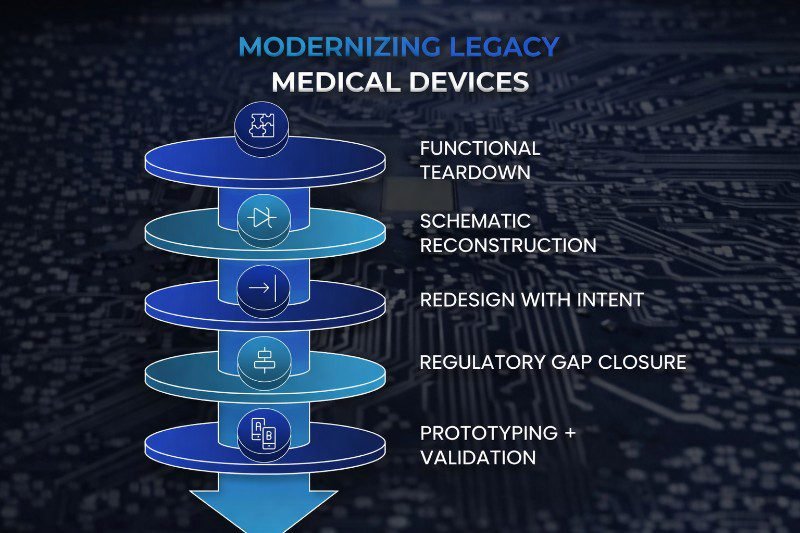
You modernise legacy medical devices through intelligent redesign by first learning what the device actually does, then reconstructing its schematic, redesigning with intent, closing the regulatory gaps and rebuilding the firmware against the original behaviour. Modernising legacy medical devices through redesign keeps the validated clinical function and replaces the obsolete electronics underneath it, without a rip-and-replace.
If you own a medical device that still sells but runs on parts you can no longer buy: ask for the functional teardown before anyone quotes a redesign; ask which behaviours of the original device the redesign is required to preserve, in writing; ask which standards the redesigned device will be assessed against; and ask how the new firmware will be validated against the old device. The method has five steps, in this order: functional teardown and behavioural mapping, schematic reconstruction, redesign with intent, closing regulatory gaps, and firmware integration and validation.
Across hospitals, clinics, and diagnostic labs worldwide, thousands of medical devices still operate electronics designed decades ago. These systems continue to perform essential clinical functions, yet their internal architectures often rely on obsolete components, undocumented firmware behaviour, and manufacturing processes that are increasingly difficult to sustain.
Legacy devices are rarely replaced quickly in healthcare environments. The cost of replacement, clinical validation, and regulatory approval makes modernisation more complex than simply building a new product. But that complexity also presents an opportunity.
When approached strategically, redesigning legacy medical electronics can deliver measurable benefits: improved performance, stronger regulatory alignment, lower maintenance costs, and extended product lifecycles.
Through years of medical device hardware design and hardware firmware development, we’ve seen how legacy redesign projects can transform ageing systems into future-ready medical platforms.
What follows is the structured methodology we use to modernise legacy medical devices safely and effectively.
Why do legacy medical devices still matter?
Legacy medical devices still matter because hospitals keep them: they perform essential clinical functions on electronics designed decades ago, with obsolete microcontrollers and analog parts, limited firmware update capability, missing documentation, parts that are hard to source and growing compliance gaps. The clinical insight built into them over years is worth preserving; the electronics underneath are what need modernising.
Healthcare technology evolves quickly, but clinical infrastructure does not always keep pace. Many hospitals rely on reliable but outdated devices.
Common challenges with legacy medical electronics include:
- Obsolete microcontrollers and analog components
- Limited firmware update capability
- Incomplete or missing documentation
- Difficulty sourcing replacement parts
- Growing regulatory compliance gaps
Despite these limitations, the core clinical functionality of these devices often remains valuable. Replacing them entirely may be unnecessary and sometimes impractical.
This is where structured redesign becomes powerful. Legacy systems contain years of clinical insight embedded in their design. The goal is not to discard that knowledge, but to modernise it through disciplined engineering.
Compliance gaps are the one legacy problem that cannot be solved by finding a substitute part. IEC 60601-1:2005 is the IEC publication whose requirements for basic safety and essential performance are generally applicable to medical electrical equipment, and establishing which edition of it the existing device file was built against is a check an owner can run before any engineering is quoted. It turns a general worry about compliance into a specific question for the redesign partner.
How do you map what a legacy medical device actually does?
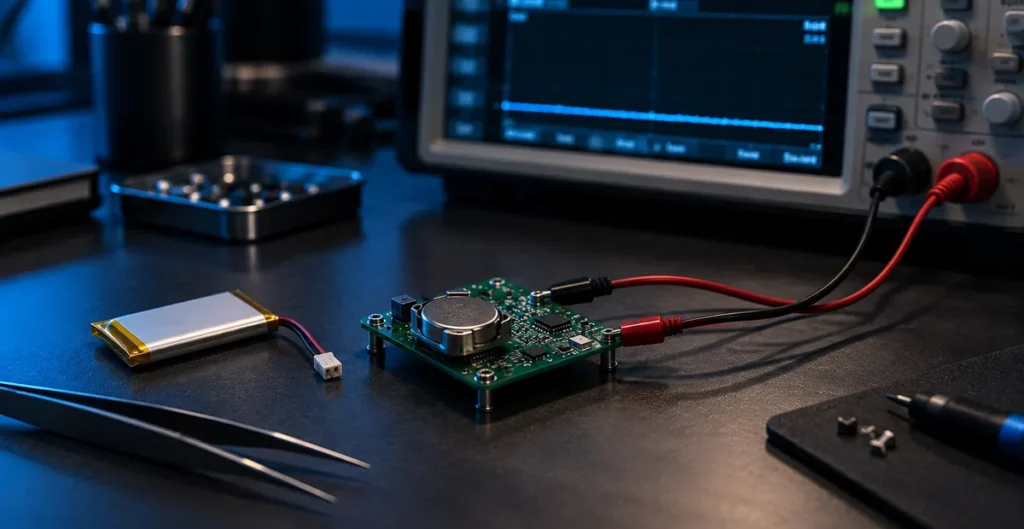
You map what a legacy medical device actually does with a functional teardown, not with its documentation: identify the power architecture, control logic, sensing circuitry, user interface and communication interfaces, then trace signals with oscilloscopes, logic analysers and runtime observation. The undocumented timing and analog behaviours this reveals can be clinically significant and must survive the redesign unchanged.
The first step in legacy redesign is understanding what the device truly does, not just what documentation claims it does.
We begin with a functional teardown to identify the primary subsystems:
- Power architecture
- Control logic
- Sensing circuitry
- User interface components
- Communication interfaces
Because legacy documentation is often incomplete, we rely heavily on:
- Signal tracing
- Oscilloscope measurements
- Logic analysers
- Runtime observation
This phase reveals undocumented behaviours that must be preserved during redesign. In medical devices, small timing interactions or analog signal characteristics can be clinically significant.
Functional teardown ensures that modernisation does not unintentionally alter validated device behaviour.
The five steps of a legacy medical device redesign, the question each answers and the evidence it leaves behind
| Redesign step | Question it answers | Evidence it leaves behind |
|---|---|---|
| Functional teardown | What does the device actually do? | Measured signals, timing, behaviour notes |
| Schematic reconstruction | How is it built today? | Netlist and schematic of the device as built |
| Redesign with intent | What changes, and what must not? | Preserved-behaviour list, new architecture |
| Closing regulatory gaps | What will it be assessed against? | Standards list, safety margins, audit trail |
| Firmware integration and validation | Does it still behave like the original? | Comparison against the original device |
Ask a redesign partner what artefact each step leaves behind. A quote that lists the steps but cannot say what each one produces is describing intentions; a programme that can show you the behaviour notes from the teardown before the schematic is touched is describing work.
How do you reconstruct the schematic of a legacy medical device?
You reconstruct the schematic of a legacy medical device by reverse engineering the PCB netlist from board scans, component identification, continuity testing and CAD recreation, until the drawing matches the device as built rather than as once documented. That reconstruction is where obsolete components, single-source dependencies, thermal risks, power inefficiencies and layout limitations become visible and can be acted on.
Once a functional understanding is established, the next step is to reconstruct the electronic design.
We reverse engineer PCB netlists from:
- Board scans
- Component identification
- Continuity testing
- CAD recreation
This allows us to rebuild schematics that accurately reflect the device’s current configuration.
During this process, we identify:
- Obsolete components
- Single-source dependencies
- Thermal risks
- Power inefficiencies
- Layout limitations
This stage forms the foundation for modern medical device hardware design, enabling redesign decisions to be made with confidence.
Obsolete components and single-source dependencies are the two findings that decide whether a redesign is urgent or merely desirable, and both are found here, on the reconstructed schematic, not in the field. How to design a replacement board so that the same finding does not come back at the next component end-of-life is the subject of our post on designing hardware and firmware against obsolescence.
What does redesigning a legacy medical device with intent mean?
Redesigning a legacy medical device with intent means improving reliability, maintainability and future scalability while preserving clinical behaviour, not swapping parts one for one: a low-power secure SoC in place of the legacy microcontroller, a better power architecture, modular subsystems, provision for wireless such as BLE and a firmware update path. The device stays clinically familiar and becomes technologically adaptable.
Redesigning a legacy medical device is not about replacing parts one-for-one. It is about improving reliability, maintainability, and future scalability while preserving clinical behaviour.
Typical redesign improvements include:
- Replacing legacy microcontrollers with low-power secure SoCs
- Improving power management architecture
- Modularising system components
- Preparing for wireless connectivity such as BLE or LTE-M
- Enabling firmware update capability
This is where hardware firmware development becomes central. Hardware decisions must anticipate future firmware requirements, and firmware architecture must leverage new hardware capabilities.
The redesigned system should remain clinically familiar while becoming technologically adaptable.
Two of those improvements change the device’s regulatory footprint as well as its electronics. Adding a BLE radio brings the Bluetooth Core Specification 6.1 into the design and changes the device’s emissions and immunity picture, which is why the redesign and the EMC work are planned together rather than in sequence, as our post on EMI and EMC design for MedTech devices sets out. Adding a firmware update path means the device can change after it has left the factory. That is worth having, but it brings work forward: the update mechanism, who is allowed to use it and how a released version is recorded all have to be decided during the redesign rather than after it.
How do you close the regulatory gaps in a legacy medical device?
You close the regulatory gaps in a legacy medical device by aligning the redesign with IEC 60601-1 safety requirements, ISO 13485 quality management expectations, EU MDR documentation needs and traceability from the first drawing. Pinetics is deliberately not ISO 13485 certified and works inside the customer’s quality system, so those records sit in the customer’s design records.
Legacy devices often predate modern regulatory expectations. Updating electronics without addressing compliance gaps can create future approval challenges.
We align redesign efforts with:
- IEC 60601 safety requirements
- ISO 13485 quality management expectations
- MDR documentation needs
- Serviceability and traceability requirements
Engineering improvements may include:
- Adding diagnostic interfaces
- Integrating self-test routines
- Improving logging capabilities
- Enhancing electrical safety margins
- Designing for auditability
Regulatory alignment is not an afterthought; it is integrated into the redesign process from the beginning.
This reduces future submission risk and simplifies lifecycle management.
Four regulatory instruments in a legacy redesign: device safety, quality management, EU market access and software life cycle, what each governs and where to find it
| Regulatory instrument | What it governs in a redesign | Source |
|---|---|---|
| IEC 60601-1:2005 | Basic safety and essential performance of the device | IEC 60601-1 page |
| ISO 13485:2016 | The manufacturer’s quality management system | ISO 13485 page |
| Regulation (EU) 2017/745 | Medical devices placed on the EU market | EUR-Lex page |
| IEC 62304:2006+A1:2015 | Life cycle of the rebuilt firmware | IEC 62304 page |
Pinetics holds no certification of its own, is deliberately not ISO 13485 certified and works inside its customers’ quality systems, so the records that IEC 60601-1, ISO 13485 and the EU MDR call for are produced in the customer’s design records, not in ours. What the redesign has to supply into those records is traceability. On a mains-powered patient-warming device, Pinetics’ design files carry a structured configuration-management code that ties every schematic, layout and review finding to a specific customer, board and revision, which is the traceability a regulated audit asks for. Where a legacy device arrives without that trail, the redesign is where it gets built.
How is legacy medical device firmware rebuilt and validated?
Legacy medical device firmware is rebuilt into a modular architecture with predictable timing, maintainable code, upgrade readiness and better diagnostics, because the original is often undocumented, tightly coupled to the old hardware and hard to update. Validation then compares the redesigned system with the original device’s behaviour, across edge cases and long-duration operation, so clinical confidence is preserved, not assumed.
Modernising hardware requires equally thoughtful firmware integration.
Legacy firmware is often:
- Undocumented
- Tightly coupled to hardware
- Difficult to update
- Inefficient in memory or power usage
Through structured firmware development services, we rebuild firmware architecture to support:
- Modular functionality
- Predictable timing behaviour
- Maintainable code structure
- Upgrade readiness
- Improved diagnostics
Validation then compares:
- Original device behaviour
- Redesigned system performance
- Edge-case scenarios
- Long-duration operation
The goal is not only to match legacy behaviour, but to enhance reliability while preserving clinical confidence.
The rebuilt firmware is medical device software, and IEC 62304:2006+A1:2015 is the standard for medical device software life cycle processes. That is why the rebuild is planned as a life cycle with records rather than as a straight port of the old code onto new hardware, and why the treatment of the original firmware is worth settling in writing before the rebuild starts. What that rebuild looks like as a piece of engagement, from architecture through validation against the original device, is set out on our page on firmware development for regulated and connected devices.
How does redesign extend a medical device's product life?
Redesign extends a medical device’s product life by letting the manufacturer keep a trusted, validated system in service on new electronics: product continuity is maintained, manufacturing risk falls as obsolete parts leave the bill of materials, serviceability improves, future firmware enhancements become possible and the regulatory position strengthens. The legacy hardware becomes a platform instead of an obstacle.
One of the greatest benefits of legacy redesign is lifecycle extension.
Rather than forcing healthcare providers to replace trusted systems, modernisation allows manufacturers to:
- Maintain product continuity
- Reduce manufacturing risk
- Improve serviceability
- Support future firmware enhancements
- Strengthen regulatory positioning
Legacy hardware becomes a platform for innovation instead of an obstacle.
Lifecycle extension has a regulatory clock attached to it. Regulation (EU) 2017/745, the EU MDR, has been in force since 26/05/2018, so a device that has been on the market for longer than that was documented before the regulation that now governs medical devices in the EU applied to it. An owner planning a life extension is better off settling early, with their regulatory lead, which documentation questions the redesign has to answer.
This is not a niche request. Pinetics is asked to take over engineering on products that already ship, sustaining engineering, cost reduction on an existing device and revising a part that works but costs too much, as often as it is asked to design something new. A legacy medical device redesign is work of that kind, and the first question it raises is the same as for any sustaining programme: which part will stop being available first, and how long does the device have to keep shipping after that?
Why redesign a legacy medical device instead of replacing it?
You redesign a legacy medical device rather than replace it because the existing device carries years of clinical validation, user familiarity and proven workflows that a new design starts without. Redesigned responsibly, it delivers improved performance, lower maintenance cost, better compliance alignment, longer lifespans and stronger patient safety margins, so its operational history becomes a technical asset.
Legacy medical devices represent years of clinical validation, user familiarity, and proven workflows. Redesigning them responsibly requires both technical precision and respect for their operational history.
When executed correctly, redesign projects deliver:
- Improved performance
- Reduced maintenance costs
- Better compliance alignment
- Extended product lifespans
- Stronger patient safety margins
Legacy systems are not outdated failures; they are engineering foundations waiting to be modernised.
Of everything a redesign improves, the safety margin is the one a buyer can hold a document against. IEC 60601-1:2005 contains requirements concerning basic safety and essential performance that are generally applicable to medical electrical equipment, so a board with more headroom against those requirements than the original had is an improvement a redesign can be asked to demonstrate rather than assert.
What does modernising legacy medical electronics require?
Modernising legacy medical electronics requires a structured approach that balances preservation, innovation and regulatory responsibility: teardown before redesign, reconstruction before replacement, intent before component choice, compliance from the first drawing and firmware validated against the original device. Component replacement alone does none of those, which is why it leaves the same questions to answer at the next shortage.
Modernising legacy medical electronics requires more than component replacement. It demands a structured approach that balances preservation, innovation, and regulatory responsibility.
At Pinetics, we specialise in medical device hardware design, firmware development services and hardware firmware development to help manufacturers transform legacy systems into future-ready medical platforms: the teardown that records what the device really does; the reconstructed schematic; the redesign that preserves clinical behaviour; the regulatory alignment with IEC 60601-1, ISO 13485 and the MDR; and the firmware rebuilt and validated against the original. By combining reverse engineering expertise with modern embedded design practices, we enable healthcare technologies to evolve without losing their proven clinical value. That work rests on 100,000+ engineering hours and a leadership team with 20+ years of experience, and it runs inside the customer’s quality system rather than under a certification of our own. If your device is still trusted on the ward or in the lab and its parts are disappearing from distributors’ shelves, the teardown is the place to start.
Legacy isn’t a dead end. It’s a blueprint for smarter reinvention engineered carefully for tomorrow’s healthcare systems.
Sanjay Barewar, Director, Co-Founder and Global Chief Delivery Officer, Pinetics. 22+ years in electronic product development. BE Electrical, Pune University. LinkedIn