
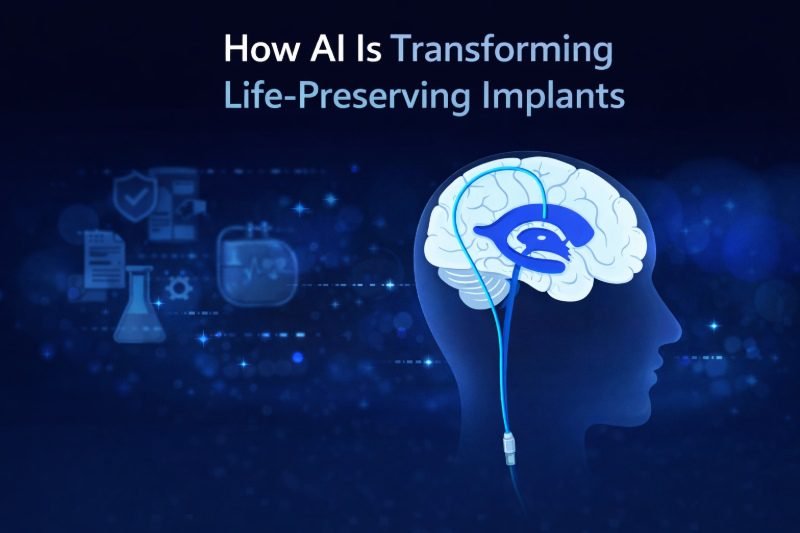
Medical implants have always represented the intersection of engineering precision and human survival. Devices such as pacemakers, insulin pumps, neurostimulators, and shunts already play a life-saving role in modern healthcare. But a new transformation is underway, one driven by artificial intelligence and embedded computing.
We are entering an era where implants will no longer operate as static, pre-configured devices. Instead, they will become adaptive systems capable of learning from patient physiology in real time. AI is beginning to move from external healthcare analytics platforms into the core of implantable medical devices.
This shift is redefining how engineers approach Medical Device Hardware Design, Embedded Systems Development, and Hardware Firmware Development for life-critical technologies.
From Reactive Implants to Adaptive Systems
Traditional implants are designed around fixed control logic. Even advanced devices like modern pacemakers rely on programmed response thresholds and sensor-driven feedback loops.
These systems are reliable but inherently reactive. AI introduces the possibility of predictive and adaptive implant devices that can anticipate physiological changes and respond proactively.
Today’s pacemakers already adjust cardiac pacing dynamically using sensor feedback. With embedded AI models, these systems could go further by:
- Predicting arrhythmias before they occur
- Adapting pacing algorithms to long-term patient behavior
- Identifying subtle physiological anomalies early
- Optimizing therapy delivery continuously
This evolution requires rethinking how implants are engineered from the ground up through advanced Embedded Product Development Services.
The Role of Embedded AI in Implantable Devices
Embedding AI inside implants is fundamentally different from running AI in cloud systems or external medical equipment.
Implants operate under strict constraints:
- Extremely limited power availability
- Small memory footprints
- Deterministic real-time requirements
- Long-term reliability expectations
- Strict regulatory requirements
To support embedded AI, engineers must carefully coordinate Embedded Systems Development with hardware architecture and firmware execution models.
Microcontrollers and specialized processors must support signal acquisition, inference computation, and safety monitoring simultaneously while maintaining ultra-low power consumption.
In implantable systems, every microamp matters. This is where tight integration between Medical Device Hardware Design and Hardware Firmware Development becomes essential.
Smart Pacemakers and Predictive Cardiac Care
Cardiac rhythm management devices are among the most promising candidates for embedded AI integration.
Modern pacemakers already rely on sensors to detect physiological changes such as motion, respiration rate, and cardiac electrical activity. AI models can enhance these capabilities by identifying complex patterns that traditional algorithms cannot detect.
Potential capabilities of AI-enabled pacemakers include:
- Predictive arrhythmia detection
- Adaptive pacing thresholds
- Long-term cardiac trend analysis
- Anomaly detection in electrical conduction patterns
- Personalized therapy adjustments
These capabilities significantly reduce the need for emergency interventions and improve patient outcomes.
However, implementing AI in such devices requires careful validation through robust Embedded Systems Development processes that ensure deterministic behavior and fail-safe operation.
Smart Shunts and Neurological Implants
Another emerging application for embedded AI is in neurological implants, particularly smart shunts used to treat hydrocephalus. Traditional shunts regulate cerebrospinal fluid flow using mechanical valves with fixed pressure settings. These systems often require manual adjustment and monitoring.
AI-enabled smart shunts could continuously monitor pressure and flow data to regulate fluid drainage autonomously. This would allow the device to adapt to changes in posture, activity levels, and physiological conditions.
Such systems would rely on:
- Continuous sensor monitoring
- Embedded inference engines
- Adaptive control algorithms
- Ultra-reliable firmware execution
Delivering this capability requires advanced Embedded Product Development Services that combine sensing, processing, and control into a single cohesive system.
Closed-Loop Therapeutic Systems
The broader trend across implantable medical devices is the emergence of closed-loop systems. Closed-loop implants continuously sense physiological signals, interpret them using algorithms or AI models, and automatically adjust therapy.
Examples include:
- Insulin pumps adjust delivery based on glucose levels
- Neurostimulators are adapting stimulation patterns
- Cardiac implants responding to electrical anomalies
- Pain management devices adjust output dynamically
These systems represent a major shift from pre-programmed therapy delivery to adaptive treatment.
This shift places new demands on Hardware Firmware Development, where firmware must manage sensing, inference, therapy control, and safety validation simultaneously.
Engineering Challenges in AI-Enabled Implants
While the potential of AI-enabled implants is enormous, the engineering challenges are equally significant.
Ultra-Low Latency Requirements: Implants must operate in real time. Delays in decision-making are unacceptable in life-critical systems.
Power Constraints: Implantable devices must operate for years on limited battery capacity. AI models must be optimized for energy efficiency.
Fail-Safe Design: AI systems must never override safety-critical control logic. Redundant monitoring and fallback mechanisms are essential.
Cybersecurity: Implants must be protected against unauthorized access and firmware tampering. Hardware-based security mechanisms are increasingly necessary.
Regulatory Validation: AI-enabled implants must demonstrate predictable and verifiable behavior under all operating conditions.
Addressing these challenges requires coordinated expertise in Medical Device Hardware Design, Embedded Systems Development, and Hardware Firmware Development.
The Regulatory Dimension of Intelligent Implants
AI inside implants introduces new regulatory considerations. Traditional approval models assume device behavior remains static over time. AI-enabled implants challenge that assumption.
Regulators now expect:
- Traceable decision-making processes
- Controlled algorithm updates
- Predictable performance boundaries
- Continuous monitoring capabilities
- Strong cybersecurity protections
Engineering teams must design implants with regulatory validation in mind from the earliest stages of development.
This makes Embedded Product Development Services increasingly multidisciplinary, involving hardware engineers, firmware developers, data scientists, clinical experts, and regulatory specialists.
The Future of Life-Preserving Implants
Implants are evolving from mechanical devices to intelligent systems capable of learning and adapting to individual patients.
Future implantable technologies may include:
- Adaptive cardiac rhythm management systems
- AI-driven neurostimulation devices
- Predictive insulin delivery systems
- Autonomous fluid regulation implants
- Personalized therapeutic implants
These technologies represent the convergence of electronics, embedded computing, and artificial intelligence in healthcare.
The goal is not simply smarter devices; it is safer, more personalized care delivered continuously and automatically.
Final Thoughts
Artificial intelligence is transforming life-preserving implants from static devices into adaptive therapeutic systems. This transformation requires deep integration between hardware, firmware, and embedded intelligence.
At Pinetics, we help healthcare innovators build next-generation implantable technologies through advanced Medical Device Hardware Design, Hardware Firmware Development, Embedded Systems Development, and Embedded Product Development Services. Our engineering approach focuses on reliability, safety, and long-term scalability, ensuring that intelligent implants operate predictably in real-world clinical environments.
The future of implants is not just smaller or smarter hardware. It is an intelligent system designed to continuously learn, adapt, and protect human life. And engineering that future requires precision, responsibility, and trust built into every layer of the system.