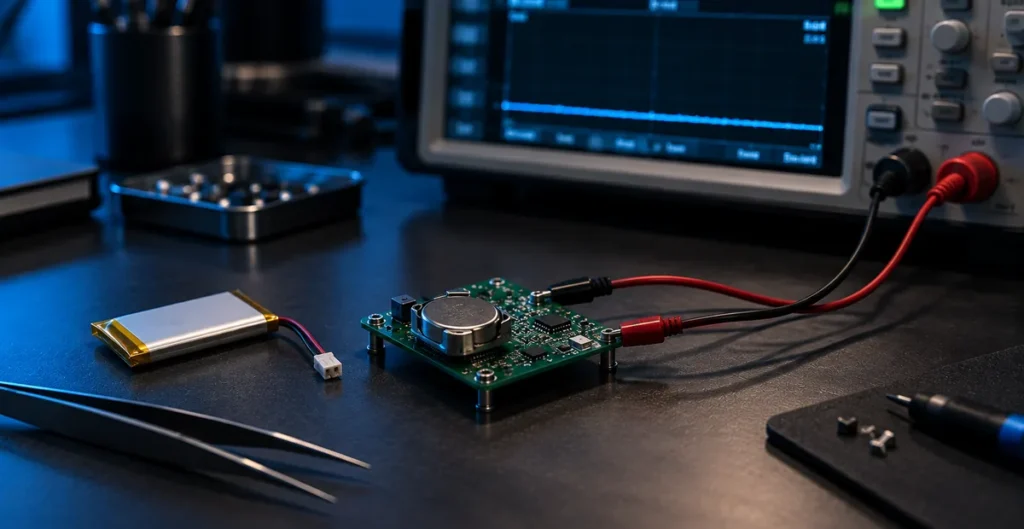
Many of the problems that would otherwise surface at the laboratory. Pre-compliance testing is a set of checks you run on your own bench, before the formal test at an accredited laboratory, to find safety and EMC problems while the design can still change cheaply. It cannot give you a certificate, but it can tell you whether the laboratory visit is likely to end in a pass or in a redesign.
When a device fails an IEC 60601 test, the cause is often a decision made months earlier: a gap on the board that was too small, a switching stage that was never checked for emissions, an enclosure that lets a finger reach something it should not. By the time the laboratory finds it, the boards are made, the enclosure is tooled and the schedule is committed. Pre-compliance testing moves those findings to a point where fixing them costs days, not months.
What will the laboratory actually test?
Two standards do most of the work for an active medical device. IEC 60601-1 covers basic safety and essential performance. IEC 60601-1-2 covers electromagnetic disturbances, which means both what the device emits and how well it keeps working when it is exposed to interference. Many devices also have a particular standard in the IEC 60601-2 series that adds requirements for that type of device; a warming blanket system, for example, falls under IEC 60601-2-35.
- Safety: protection against electric shock, including insulation, creepage and clearance distances, and leakage current to the patient and the operator
- Safety: dielectric strength of the insulation barriers
- Safety: temperatures of parts that can be touched, and behaviour under single fault conditions
- EMC: conducted and radiated emissions
- EMC: immunity to electrostatic discharge, radiated and conducted interference, fast transients, surges and supply dips
Which of these can you check on your own bench?
More than you might expect. None of these checks replaces the formal test, but each one moves a finding from the laboratory to your own bench.
Safety checks
- A design review of every isolation barrier against the insulation it needs, done on the schematic and again on the layout, before the boards are ordered
- Creepage and clearance measured on the first prototype boards, not only in the layout tool
- Leakage current measured on a powered prototype with a leakage current tester
- Dielectric strength checked on the isolation barriers with a hi-pot tester, by someone trained to use one safely
- Temperatures logged at full load on the parts a user or patient can touch
- Single faults simulated one at a time, such as a stuck relay or a failed fan, to see what the device does
EMC checks
- Conducted emissions measured on the mains lead with a line impedance stabilisation network and a spectrum analyser
- Radiated hot spots found with near-field probes over the boards and cables
- Electrostatic discharge applied with an ESD gun to the points a user will touch
- Behaviour watched during each test, because immunity is about whether the essential performance holds, not only whether the device survives
What can pre-compliance testing not replace?
The formal test. Bench equipment is not calibrated and set up the way an accredited laboratory’s is, and a radiated emissions scan with a near-field probe tells you where the noise comes from, not whether you pass the limit at the specified distance. Treat pre-compliance results as a strong signal, then book the laboratory early enough that its findings can still change the design.
What did this look like on a real project?
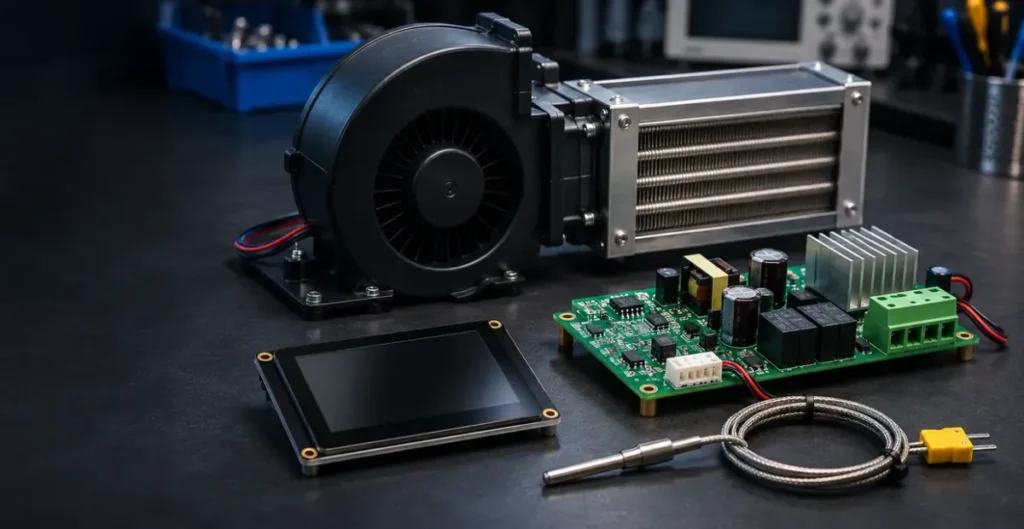
We designed a 1000 W convective patient warming system for a medical device company in Asia. The hard part was doing two things at once: driving 1000 W of heating while meeting the isolation, leakage current and emission limits of IEC 60601, and keeping a steady flow of warm air through a filter and a disposable blanket whose resistance changes from one setup to the next.
- Isolation, creepage and leakage current were designed in from the first schematic, then checked with pre-compliance tests before the formal laboratory
- Filtering, layout and switching were chosen for CISPR 11 emissions from the start, with pre-compliance scans before the formal test
- An over-temperature cut-off works separately from the main controller, so a firmware fault cannot overheat the patient
The system passed IEC 60601 safety and EMC testing in the first round, with no redesign, and was delivered on time. It is approved under the EU MDR (CE marking) and by CDSCO in India. Read the full case study.
A short checklist before you book the laboratory
- Every isolation barrier has a documented insulation requirement, and the layout meets it
- Leakage current has been measured on a powered prototype
- Conducted emissions have been measured on the mains lead
- The noisiest areas of the board have been scanned with a near-field probe
- ESD has been applied to every point a user touches, and the device kept working
- Touchable temperatures have been logged at full load
- The essential performance of the device is written down, so you know what immunity has to protect
Is pre-compliance testing required by IEC 60601?
No. The standard sets out the formal tests. Pre-compliance testing is something a design team chooses to do, because it is far cheaper to find a problem on the bench than at the laboratory.
When should pre-compliance testing start?
With the first schematic, as a design review of isolation and EMC choices, and then on the first powered prototype. Waiting for the final design removes most of the benefit.
Can Pinetics run pre-compliance testing on our design?
Yes, both on designs we build and on an existing design you bring to us. We run safety and EMC pre-compliance checks before the formal test at an accredited laboratory, so problems are found while they are still cheap to fix.
Planning an IEC 60601 test for your device? Tell us where your design is today.