
Industrial environments operate on precision, discipline, and safety. From aerospace manufacturing floors to heavy engineering plants and healthcare facilities, every tool has a purpose, and every misplaced tool introduces risk. Yet despite advances in automation, one critical area remains surprisingly manual and error-prone: tool management.
At Pinetics, we partnered with a customer delivering a next-generation, AI-powered tool management system built specifically for industrial environments. The goal was simple but ambitious: eliminate tool misplacement, automate accountability, and strengthen safety and compliance through real-time intelligence.
The result is a connected, autonomous system that combines AI, IoT, and predictive analytics to deliver unmatched operational visibility and safety assurance.
This is not just a smarter locker system; it is a fundamental rethinking of how industrial assets are tracked, secured, and managed.
The Industrial Safety Gap No One Talks About
When organizations think about safety, they often focus on machinery, protective equipment, or employee training. But tools that are small, mobile, and constantly in circulation are often overlooked.
This oversight creates serious challenges:
Tool Misplacement Creates Operational Risk
An unaccounted-for tool can shut down an entire production line, delay inspections, or compromise equipment safety. In regulated industries, missing tools are not just inconvenient; they are unacceptable.
Manual Check-in and Check-out Processes are Unreliable
Paper logs, spreadsheets, and badge-based systems depend heavily on human compliance. Workers forget to log tools, enter incorrect information, or bypass systems under time pressure.
Compliance Violations are Expensive
Industries such as aerospace, healthcare, energy, and heavy manufacturing face strict regulatory requirements around tool control. Audit failures can result in penalties, rework, production stoppages, and reputational damage.
Despite these risks, many organizations still rely on outdated processes that provide limited visibility and almost no predictive insight.
From Manual Tracking to Intelligent Accountability
The solution lies in automation and real-time intelligence, not more paperwork.
Pinetics helped enable an AI-driven smart tool management platform that removes manual dependency entirely. By leveraging advanced IoT Product Development Services, the system transforms tool tracking from a reactive process into a proactive, intelligent safety layer.
Instead of asking, “Where is this tool?” after something goes wrong, organizations can now ask, “How do we prevent issues before they happen?”
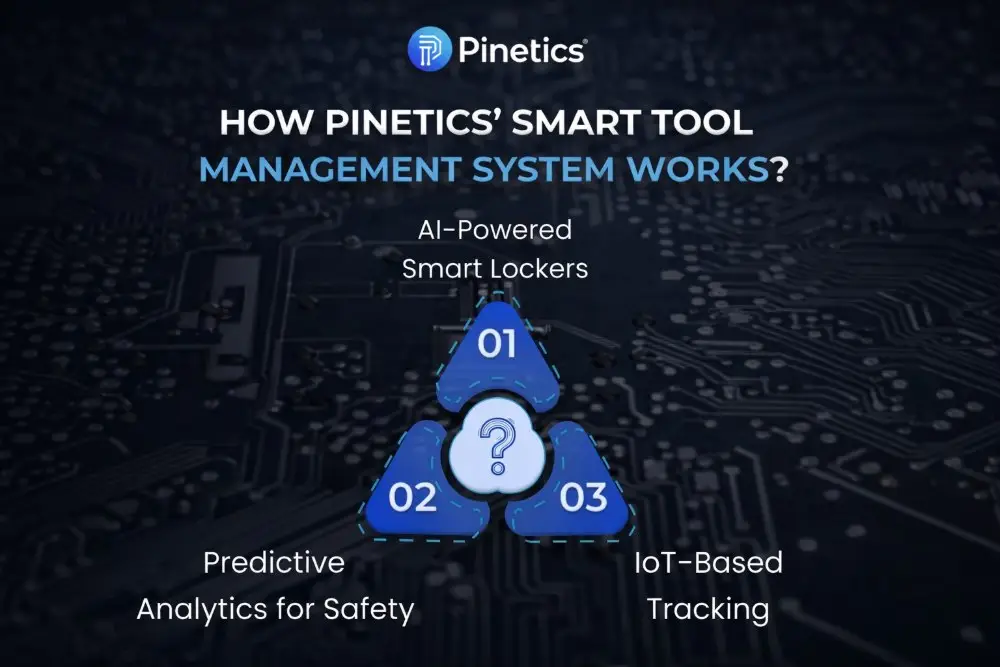
How the Smart Tool Management System Works
AI-powered Smart Lockers
At the core of the solution are intelligent lockers that automate tool access and accountability. Workers authenticate using secure methods such as biometrics, ensuring only authorized personnel can access specific tools.
Each interaction is recorded automatically, with no manual entry, no forgotten logs.
IoT-based Real-time Tracking
Every tool is equipped with BLE or NFC sensors that communicate continuously with the system. The platform always knows:
- Which tool is in use
- Who accessed it
- where it is located
- How long has it been out
This real-time visibility is powered by a robust IoT architecture designed using Pinetics’ IoT Product Development Services, ensuring scalability across large facilities and multiple sites.
Predictive Analytics for Safety
AI algorithms analyze movement patterns, access frequency, and usage behavior. If a tool behaves abnormally, such as leaving a restricted zone or being accessed at an unusual time, the system flags it immediately.
This allows organizations to prevent incidents rather than respond to them.
Ensuring Safety and Compliance Without Operational Friction
One of the biggest challenges in industrial safety systems is adoption. If safety processes slow down work, people find ways around them. This system was designed to eliminate friction entirely.
Real-time Accountability
Managers and safety officers have instant access to complete tool histories of who used what, when, and where. Accountability becomes built-in, not enforced.
Automated Audits
Instead of weeks spent preparing compliance reports, audits can be generated in minutes. Every tool of interaction is already logged, time-stamped, and verifiable.
Geo-fencing Alerts
Tools are digitally restricted to approved zones. If a tool crosses a boundary intentionally or accidentally, the system triggers immediate alerts, reducing theft and loss.
These capabilities shift compliance from a reactive burden to an always-on function of daily operations.
Why IoT Is the Backbone of Modern Tool Management
None of this intelligence is possible without a strong IoT foundation.
Through advanced IoT Product Development Services, connected systems can:
- Operate in real time
- Scale across thousands of assets
- Integrate with enterprise platforms
- Support edge processing for low latency
- Remain secure and resilient
In industrial environments, connectivity must be reliable, low-powered, and secure. Pinetics’ approach ensures that sensors, lockers, gateways, and analytics platforms work together as a cohesive ecosystem, not as disconnected components.
The Role of AI in Industrial Safety Evolution
AI elevates tool management from tracking to understanding.
Instead of static rules, the system learns from real usage patterns. Over time, it can:
- Identify inefficiencies in tool flow.
- Highlight underutilized or overused tools.
- Predict maintenance and recalibration needs.
- Recommend operational improvements
This intelligence supports both safety and productivity, two objectives that are often treated separately but should never be.
The Future of Industrial Safety Is Intelligent and Autonomous
Looking ahead, AI and IoT will redefine safety infrastructure across industries.
Emerging capabilities include:
Self-auditing Smart Lockers
Systems that automatically validate tool counts and usage compliance without human intervention.
Digital Twins for Tool Flow
Virtual replicas of tool movement patterns allow organizations to simulate workflows, identify bottlenecks, and optimize layout and access strategies.
Edge AI-Powered Maintenance
Tools can report wear, usage stress, or calibration drift automatically, ensuring compliance before inspections occur.
These advancements move safety systems from oversight tools to active participants in operational excellence.
Why This Matters Beyond Compliance
While compliance is a strong driver, the real value lies in trust and resilience.
When workers trust that tools are available, safe, and properly maintained, productivity increases. When management trusts that compliance is continuous, not episodic, decision-making improves. And when systems operate autonomously, organizations become more resilient to human error and operational pressure.
This is the promise of intelligent industrial infrastructure.
Final Thoughts
Industrial safety starts with accountability, and accountability starts with visibility. Manual systems can no longer keep pace with the complexity and scale of modern operations. The future belongs to automated, intelligent, and real-time safety solutions.
By combining AI, connected devices, and advanced IoT Product Development Services, smart tool management systems transform how organizations protect their workforce, maintain compliance, and operate efficiently.
At Pinetics, we partner with innovators to design and build intelligent industrial solutions that go beyond connectivity. We deliver scalable, secure, and future-ready IoT Product Development Services that turn operational challenges into strategic advantages.
If your organization is ready to move from reactive tool tracking to proactive safety intelligence, Pinetics is ready to help you build it.
 Sr. Test Engineer
 Sales Marketing Manager
 Marketing & Sales – BBA : Fresher