Smart tool management delivers tool accountability by making the record automatic. A worker authenticates at a locker, the locker releases a specific tool, a tag reports where that tool goes, and every event is logged with a name, a time and a location. Nobody writes anything down, and industrial safety stops depending on a paper log.
If you are evaluating a system now: ask what the reader link protocol is, ask whether the record survives a power cut at the locker and ask who owns the electronics design. The three answers tell you whether the accountability record can be trusted. Each is explained further down this page.
Industrial environments operate on precision, discipline, and safety. From aerospace manufacturing floors to heavy engineering plants and healthcare facilities, every tool has a purpose, and every misplaced tool introduces risk. Yet despite advances in automation, one critical area remains surprisingly manual and error-prone: tool management.
At Pinetics, we partnered with a customer delivering a next-generation, AI-powered tool management system built specifically for industrial environments. The goal was simple but ambitious: eliminate tool misplacement, automate accountability, and strengthen safety and compliance through real-time intelligence.
The result is a connected, autonomous system that combines AI, IoT, and predictive analytics to deliver unmatched operational visibility and safety assurance.
This is not just a smarter locker system; it is a fundamental rethinking of how industrial assets are tracked, secured, and managed.
Why is tool accountability a safety problem and not just a stores problem?
Tool accountability is a safety problem because an unaccounted tool is a foreign object. In aerospace, AS9100 requires an organisation to have provisions for the prevention, detection and removal of foreign objects, and AS9146, the IAQG standard, sets out the FOD prevention programme requirements. A tool nobody can account for at the end of a shift fails both.
When organisations think about safety, they often focus on machinery, protective equipment, or employee training. But tools that are small, mobile, and constantly in circulation are often overlooked.
This oversight creates serious challenges:
Tool Misplacement Creates Operational Risk
An unaccounted-for tool can shut down an entire production line, delay inspections, or compromise equipment safety. In regulated industries, missing tools are not just inconvenient; they are unacceptable.
Manual Check-in and Check-out Processes are Unreliable
Paper logs, spreadsheets, and badge-based systems depend heavily on human compliance. Workers forget to log tools, enter incorrect information, or bypass systems under time pressure.
Compliance Violations are Expensive
Industries such as aerospace, healthcare, energy, and heavy manufacturing face strict regulatory requirements around tool control. Audit failures can result in penalties, rework, production stoppages, and reputational damage.
The named standards matter to a buyer because they turn tool accountability from a good habit into an audit question. An auditor working to AS9146 does not ask whether tools are usually returned. They ask for the record.
Why do manual tool check-in and check-out processes fail?
Manual tool check-in and check-out fail because they depend on the person under the most time pressure doing an extra step. Paper logs, spreadsheets and badge-only systems record only what a worker chose to record. When a line is down and a technician needs a torque wrench, the log is the first thing skipped.
From that moment on the record is wrong, and nothing downstream knows it. Boeing’s supplier quality page names AS9100, AS9146 and NAS 412 among its FOD references. An auditor working to any of them asks to see the record, and a paper log is a record of what somebody remembered to write.
Despite these risks, many organisations still rely on outdated processes that provide limited visibility and almost no predictive insight.
The solution lies in automation and real-time intelligence, not more paperwork.
Pinetics helped enable an AI-driven smart tool management platform that removes manual dependency entirely. By leveraging advanced IoT product development services, the system transforms tool tracking from a reactive process into a proactive, intelligent safety layer.
Instead of asking, “Where is this tool?” after something goes wrong, organisations can now ask, “How do we prevent issues before they happen?”
How does an AI-driven smart tool management system work?
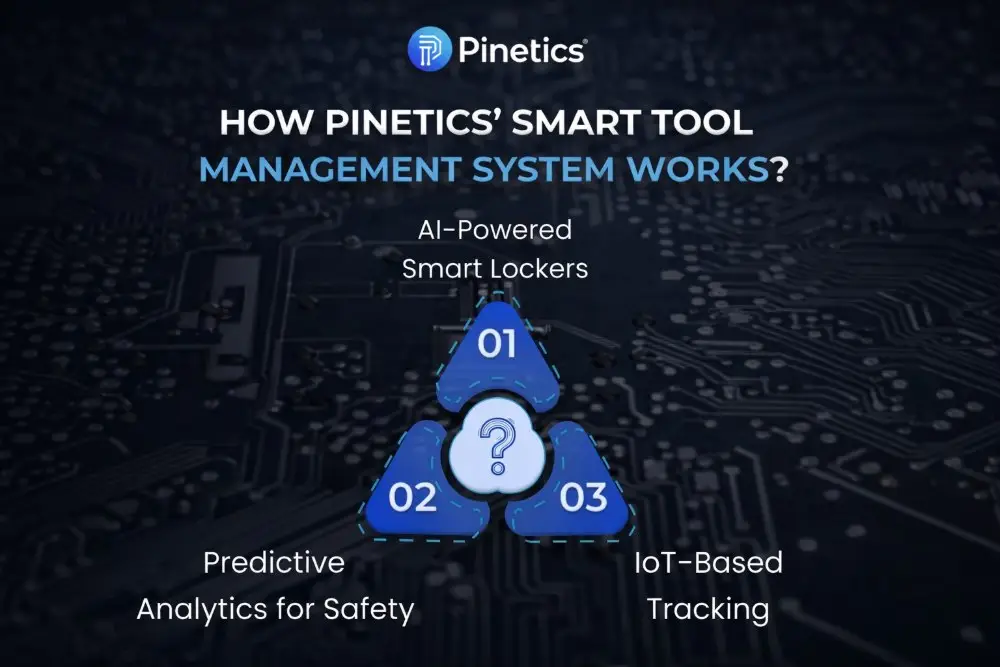
An AI-driven smart tool management system has three layers. Intelligent lockers authenticate the worker and release the tool, so the person and the item are recorded at the door. Tags on each tool report location, so the place is recorded on the floor. Analytics on the event stream flag abnormal movement before a tool is lost.
AI-powered Smart Lockers
At the core of the solution are intelligent lockers that automate tool access and accountability. Workers authenticate using secure methods such as biometrics, ensuring only authorised personnel can access specific tools.
Each interaction is recorded automatically, with no manual entry, no forgotten logs.
IoT-based Real-time Tracking
Every tool is equipped with BLE or NFC sensors that communicate continuously with the system. The platform always knows:
- Which tool is in use
- Who accessed it
- Where it is located
- How long it has been out
This real-time visibility is powered by a robust IoT architecture designed using Pinetics’ IoT product development services, ensuring scalability across large facilities and multiple sites.
Predictive Analytics for Safety
AI algorithms analyse movement patterns, access frequency, and usage behaviour. If a tool behaves abnormally, such as leaving a restricted zone or being accessed at an unusual time, the system flags it immediately.
This allows organisations to prevent incidents rather than respond to them.
What a tool accountability record has to contain
| Field in the tool accountability record | Where it is captured | What fails without it |
|---|---|---|
| Who | Reader at the locker door | Accountability has no name |
| Which tool | Compartment released, tag identity | “A wrench” is not a record |
| When | Controller real-time clock | Audit order cannot be proven |
| Where now | Tag reporting over BLE or NFC | Search instead of retrieval |
| How long out | Clock against the release event | No overdue alert |
| Returned by whom | Reader again, at return | The loop never closes |
What does the controller inside a smart locker do?
The controller inside a smart locker is the board that makes the accountability record trustworthy. It authenticates the worker through a reader, commands the compartment, timestamps the event, stores it and reports it to the operator’s tablet or server. Pinetics designed one for a smart locker manufacturer: hardware, firmware and the test suite it was verified against.
The manufacturer already had locker banks in the field, each with a slave board driving the compartment locks over an RS485 link. The brief was a new master controller that would sit in front of those banks and add authentication, networking and remote maintenance. Nothing already installed had to be replaced. The new controller speaks to the existing slave boards over their own RS485 protocol, which Pinetics worked out from the existing boards and code before writing the controller firmware. On the board itself: an ST microcontroller, a Bluetooth Low Energy module and an Ethernet interface with a TCP/IP stack, carrying the link to one or more tablets.
The board also carries provision for what a locker product is likely to need next: two spare RS485 ports and two spare Wiegand ports for additional readers, two USB-C host ports, a Wi-Fi module footprint and a high-speed expansion bus for modules such as a display, GPS or a cellular modem. Provision on the first board is cheap. Adding it once the product is in the field means a redesign, a requalification and a site visit to every locker bank.
In 2026 the same manufacturer came back with a different question: a design review of an existing hub board and its firmware. Where a board already exists, the review covers the same ground: schematic, layout, firmware architecture and a written list of what has to change before the next build. The controller hub Pinetics designed manages hundreds of smart locker units in industrial deployments and is running in the field with zero downtime.
Our page on how an electronic product development programme runs from architecture to design transfer sets out the stage gates this kind of build goes through.
How does a smart locker authenticate a worker?
A smart locker authenticates a worker through a reader wired to the controller: an access card reader, a fixed barcode scanner or a facial authentication terminal, and some banks carry more than one. The protocol between reader and controller decides how much the record can be trusted, and there are two in common use: Wiegand and OSDP.
Wiegand is a legacy one-way pulse interface that carries a card number and nothing else. The controller cannot ask the reader whether it is still there, whether it has been tampered with or whether the card number was replayed. OSDP, the Open Supervised Device Protocol, was approved by the International Electrotechnical Commission in May 2020 and published as IEC 60839-11-5:2020. It runs over RS485, is bidirectional, supports multi-drop on two wires instead of twelve or more, and its Secure Channel mode uses AES-128 encryption. The current version is 2.2.2, published in October 2024.
Wiegand and OSDP compared
| Reader link property | Wiegand | OSDP over RS485 |
|---|---|---|
| Direction | Reader to controller only | Both ways |
| Wires | Twelve or more | Two, multi-drop |
| Reader supervised | No | Yes, controller polls it |
| Encryption | None | AES-128 Secure Channel |
| Standard | De facto only | IEC 60839-11-5:2020 |
| Why it is chosen | Installed base | Security and audit |
The master controller Pinetics built supports both on every reader port, because a manufacturer with an installed base cannot force every site to rewire on the same day. One reader, three doors, both protocols. Pinetics wrote the drivers for Wiegand and for OSDP and tested them the way an installer would wire them, with the Wiegand data lines checked on a logic analyser at 3.3 V and on an oscilloscope at 5 V before the firmware was trusted. For a buyer choosing a locker system the question to ask is simple. Does the reader link run OSDP with Secure Channel, or is it Wiegand under a newer label?
How does smart tool management deliver tool accountability without slowing work down?
A smart tool management system delivers tool accountability without slowing work down because the worker does one thing they already do, authenticate, and the record writes itself. There is no form, no scan-then-type, no supervisor sign-off. The checks a supervisor used to enforce on people now sit in the locker, the tag and the software.
The six fields in the tool accountability record are captured by the reader, the compartment or the tag. Not one of them is typed by a person.
One of the biggest challenges in industrial safety systems is adoption. If safety processes slow down work, people find ways around them. This system was designed to eliminate friction entirely.
Real-time Accountability
Managers and safety officers have instant access to complete tool histories of who used what, when, and where. Accountability becomes built-in, not enforced.
Automated Audits
Instead of weeks spent preparing compliance reports, audits can be generated in minutes. Every tool interaction is already logged, time-stamped, and verifiable.
Geo-fencing Alerts
Tools are digitally restricted to approved zones. If a tool crosses a boundary intentionally or accidentally, the system triggers immediate alerts, reducing theft and loss.
These capabilities shift compliance from a reactive burden to an always-on function of daily operations.
What happens to the tool record when the network or the power fails?
A smart locker must keep its tool record on the controller when the network or the power fails. A locker that only logs to a server logs nothing during an outage, and an outage is exactly when tools go missing. The controller needs its own clock, its own non-volatile memory and a way to sense power failing.
On the controller Pinetics built, that meant a real-time clock so every event carries a true timestamp whether or not a server is reachable, FRAM and QSPI flash on the board, plus a power-sense input so the firmware knows when supply is failing. It also meant designing the over-the-air update path, bootloader, memory partitioning and update protocol, to survive a power cut in the middle of an update, because a locker bank that bricks during a firmware update is a locker bank with tools locked inside it. Field maintenance and troubleshooting commands were part of the specification from day one, not an afterthought. A related discussion of where processing should sit is in our post on choosing the right gateway for an IoT system.
What does the IoT architecture behind tool tracking have to provide?
The IoT architecture behind tool tracking has to provide five things: real-time operation, scale across thousands of tagged assets, integration with the enterprise systems that already hold the worker and asset records, edge processing for low latency at the locker and security from tag to server. Miss one and the accountability record has a hole in it.
None of this intelligence is possible without a strong IoT foundation.
Through advanced IoT product development services, connected systems can:
- Operate in real time
- Scale across thousands of assets
- Integrate with enterprise platforms
- Support edge processing for low latency
- Remain secure and resilient
In industrial environments, connectivity must be reliable, low-powered, and secure. Pinetics’ approach ensures that sensors, lockers, gateways, and analytics platforms work together as a cohesive ecosystem, not as disconnected components.
Where an existing plant network already runs Modbus or PROFINET equipment, the tool system has to sit beside it without disturbing it, which is covered in our post on bridging legacy and modern industrial protocols. The link from tag to gateway to server is an attack surface like any other; our post on what to require when securing IoT communication covers it.
What does AI add to tool management beyond tracking?
Beyond tracking, AI adds to tool management the ability to learn what normal tool flow looks like and to flag what is not. Analysis over months of events tells you which tools are always late back, which are due for recalibration by hours of use rather than by calendar, and which movements do not fit the shift.
Tracking tells you where a tool is. Analysis also shows which tools are never used at all.
AI elevates tool management from tracking to understanding.
Instead of static rules, the system learns from real usage patterns. Over time, it can:
- Identify inefficiencies in tool flow.
- Highlight underutilised or overused tools.
- Predict maintenance and recalibration needs.
- Recommend operational improvements.
This intelligence supports both safety and productivity, two objectives that are often treated separately but should never be.
What comes next for smart tool management?
What comes next for smart tool management is the locker doing the audit itself. Self-auditing lockers validate tool counts and usage compliance without a person walking the tool crib. Digital twins of tool flow let a plant simulate a layout change first. Edge AI on the tool reports wear, stress and calibration drift before an inspection finds it.
Looking ahead, AI and IoT will redefine safety infrastructure across industries.
Emerging capabilities include:
Self-auditing Smart Lockers
Systems that automatically validate tool counts and usage compliance without human intervention.
Digital Twins for Tool Flow
Virtual replicas of tool movement patterns allow organisations to simulate workflows, identify bottlenecks, and optimise layout and access strategies.
Edge AI-Powered Maintenance
Tools can report wear, usage stress, or calibration drift automatically, ensuring compliance before inspections occur.
These advancements move safety systems from oversight tools to active participants in operational excellence.
Why does tool accountability matter beyond compliance?
Tool accountability matters beyond compliance because it lets people trust the system instead of policing it. A technician who knows the tool will be there, calibrated, stops hoarding. A manager who knows compliance is continuous stops preparing for audits. A plant whose record does not depend on human memory still has a complete record on its worst shift.
While compliance is a strong driver, the real value lies in trust and resilience.
When workers trust that tools are available, safe, and properly maintained, productivity increases. When management trusts that compliance is continuous, not episodic, decision-making improves. And when systems operate autonomously, organisations become more resilient to human error and operational pressure.
This is the promise of intelligent industrial infrastructure.
Industrial safety starts with accountability, and accountability starts with visibility. Manual systems can no longer keep pace with the complexity and scale of modern operations. The future belongs to automated, intelligent, and real-time safety solutions.
By combining AI, connected devices, and advanced IoT product development services, smart tool management systems transform how organisations protect their workforce, maintain compliance, and operate efficiently.
You can automate the record. You cannot automate the decision to keep one.
At Pinetics we partner with innovators to design and build intelligent industrial solutions that go beyond connectivity: the controller in the locker, the reader interfaces, the network path and the update mechanism that keeps a fielded product maintainable. Our IoT product development services cover the electronics and the firmware inside systems like this. We hold no quality certification of our own, by choice, and work inside our customers’ quality systems instead, which is why the reader link, the record and the update path are specified in writing rather than inherited from a certificate. The team has logged over 100,000 engineering hours across industrial, medical and IoT programmes and is led by engineers with 20+ years in electronic product development.
If your organisation is ready to move from reactive tool tracking to proactive safety intelligence, Pinetics is ready to help you build it.