
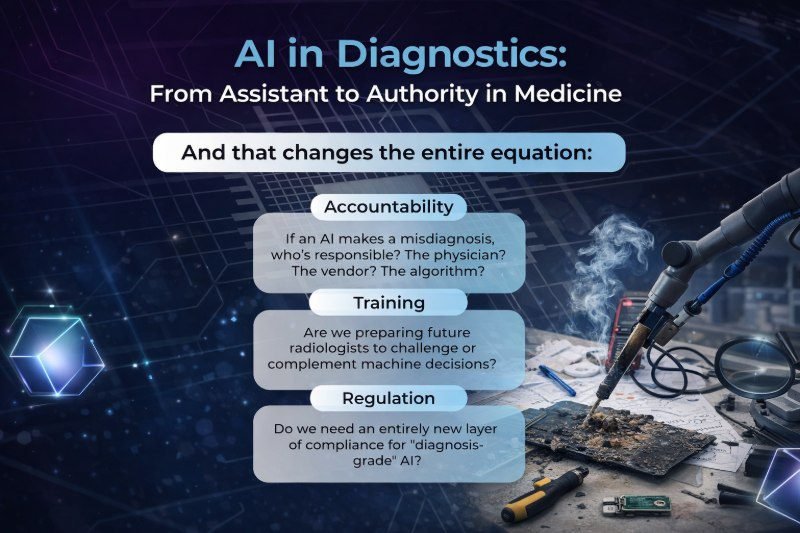
Artificial intelligence has crossed an important threshold in clinical diagnostics, and healthcare is beginning to feel the impact. For years, AI systems in radiology, pathology, and clinical decision support were positioned as assistants. They highlighted anomalies, suggested possibilities, and improved workflow efficiency. The final decision always remained with clinicians.
That boundary is changing. With regulatory approvals validating AI tools capable of making diagnostic determinations in tightly controlled contexts, healthcare is entering a new phase one where algorithms don’t just support decisions. They increasingly influence or even determine them.
This shift represents more than a technological milestone. It is a transformation in how clinical responsibility, medical training, device engineering, and regulatory oversight must evolve together. The future of diagnostics will not be defined by AI alone but by how well we integrate intelligence into medical systems safely, transparently, and responsibly.
From Assistance to Decision Authority
The early generation of AI diagnostic tools focused on pattern recognition. Algorithms analyzed imaging scans, pathology slides, and physiological signals to identify anomalies faster than humans. Their role was advisory. Clinicians remained the interpreters.
Today, AI systems are becoming capable of:
- Detecting subtle abnormalities invisible to the human eye
- Predicting disease progression using longitudinal data
- Identifying early-stage pathology from micro-patterns
- Reducing diagnostic variability across clinicians
- Delivering real-time interpretation in remote environments
This evolution is shifting AI from decision support to decision authority in certain clinical workflows.
That transition introduces new questions:
- Who is accountable when an AI system is wrong?
- How do clinicians maintain oversight?
- How do regulators evaluate continuous learning systems?
- What level of transparency is required in algorithmic decisions?
These questions are not theoretical. They are actively shaping the design of diagnostic devices today.
AI Diagnostics Depend on Embedded Intelligence
AI in diagnostics does not exist in isolation. It depends on integrated systems that connect sensing, computation, and clinical interfaces. In modern diagnostic devices, intelligence increasingly lives inside the hardware itself.
This is where Embedded Product Development Services and Firmware Development Services become critical enablers of AI-driven healthcare.
Diagnostic AI systems must operate under strict constraints:
- Deterministic timing
- Low power consumption
- Secure data handling
- Reliable real-time processing
- Regulatory traceability
Unlike cloud-based AI, clinical diagnostics often require decisions to be made directly at the point of care.
Examples include:
- Portable imaging devices
- Bedside diagnostic monitors
- Wearable patient monitoring systems
- Remote diagnostic platforms
- Emergency response equipment
In these environments, latency is unacceptable. Connectivity may be unreliable. Power resources are limited. Embedded intelligence is essential.
The Role of Medical Device Hardware Design in AI Diagnostics
AI-driven diagnostics begin with sensing, and sensing begins with hardware. Advances in Medical Device Hardware Design are enabling AI to operate with clinical-grade accuracy outside traditional hospital environments.
Modern diagnostic hardware incorporates:
- High-resolution analog front ends
- Precision sensor calibration systems
- Low-noise amplification circuits
- Dedicated AI accelerators
- Ultra-low-power microcontrollers
- Secure memory architectures
- High-speed data acquisition pipelines
Hardware design directly impacts AI reliability. If signal quality is compromised, AI interpretation becomes unreliable. If timing is inconsistent, real-time inference fails. If power management is inefficient, portable devices become impractical.
This is why AI diagnostics must be engineered as hardware–software systems, not software applications.
Firmware: The Bridge Between Hardware and Intelligence
Firmware plays a foundational role in AI-enabled diagnostic systems. It controls:
- Sensor acquisition timing
- Data preprocessing pipelines
- Memory allocation
- Real-time scheduling
- Device communication
- Power management
- Safety monitoring
Strong Firmware Development Services ensure that AI inference pipelines operate predictably under clinical constraints.
In diagnostic devices, firmware must:
- Guarantee deterministic behavior
- Support fail-safe operation
- Maintain traceable execution paths
- Provide audit-ready logs
- Enable secure software updates
- Protect patient data
AI models do not create diagnostic reliability. Firmware architecture ensures that models run correctly, consistently, and safely. This distinction is often overlooked, but it is central to clinical trust.
Accountability in AI Diagnostics
As AI becomes capable of diagnostic interpretation, accountability becomes more complex. Traditional medical responsibility is clear:
- Devices collect data
- Clinicians interpret it
- Physicians make decisions
AI blurs these boundaries.
If a diagnostic AI system produces an incorrect result:
- Is the clinician responsible for trusting it?
- Is the manufacturer responsible for the algorithm?
- Is the device developer responsible for system integration?
- Is the regulatory framework sufficient to address liability?
These questions are pushing regulators to rethink how diagnostic systems are evaluated.
Engineering teams must now design systems that support, not replace, human oversight. This includes:
- Explainable AI outputs
- Decision traceability
- Human-in-the-loop validation
- Fail-safe system behavior
- Transparent performance metrics
AI diagnostics must not only be accurate but also interpretable.
Training the Next Generation of Clinicians
AI in diagnostics also changes how clinicians are trained. Future radiologists, pathologists, and physicians must learn to:
- Validate algorithmic outputs
- Understand model limitations
- Interpret uncertainty metrics
- Detect AI failure modes
- Collaborate with intelligent systems
The clinician’s role is evolving from primary interpreter to clinical validator. This is not a reduction in responsibility. It is a transformation of expertise. Healthcare education must adapt accordingly.
Regulatory Frameworks Are Evolving
Regulatory bodies are actively adapting to AI-driven diagnostics. Traditional device approval models assume static behavior. AI systems challenge this assumption because models may evolve.
Regulators now focus on:
- Algorithm validation processes
- Dataset quality and bias control
- Real-time monitoring requirements
- Cybersecurity protections
- Lifecycle performance tracking
These requirements directly influence:
- System architecture
- Firmware design
- Hardware capabilities
- Data logging strategies
Regulation is no longer a final step. It is shaping engineering decisions from the beginning.
Hybrid Intelligence: The Future of Diagnostics
The future of clinical diagnostics will not be AI replacing clinicians. It will be a hybrid of intelligence. Human expertise contributes:
- Clinical context
- Ethical judgment
- Patient communication
- Holistic understanding
AI contributes:
- Pattern recognition
- continuous monitoring
- predictive modeling
- data-scale analysis
Together, they create a more reliable diagnostic ecosystem. The goal is not automation alone. The goal is to gain clinical confidence.
Engineering Trust into AI Diagnostics
For AI diagnostics to scale globally, trust must be engineered into every layer:
- Sensors must capture accurate signals
- Hardware must operate reliably
- Firmware must behave deterministically
- Algorithms must be transparent
- Systems must be secure
- Compliance must be continuous
Trust is not an afterthought. It is designed from the beginning. This is where engineering discipline meets clinical responsibility.
Final Thoughts
AI is transforming diagnostics, but the transformation is not just about algorithms. It is about building reliable, embedded medical systems that clinicians and patients can trust.
The transition from decision support to decision authority demands new standards in Medical Device Hardware Design, Firmware Development Services, and Embedded Product Development Services.
At Pinetics, we help MedTech innovators engineer diagnostic systems that integrate intelligence, reliability, and regulatory readiness from day one. Our approach combines hardware precision, robust firmware architecture, and system-level thinking to bring AI-driven medical devices safely into clinical practice. Because in diagnostics, innovation alone is not enough. Trust must be engineered into every decision the system makes.
 Sr. Test Engineer
 Sales Marketing Manager
 Marketing & Sales – BBA : Fresher