
Everyone notices the finished wearable device, the lightweight wristband, the seamless interface, and the real-time health insights delivered with a tap. What most people never see is the engineering reality behind it.
In one recent wearable project, more than 300 hours of firmware debugging went into solving a problem that seemed almost invisible: a 3-microamp current drain that quietly reduced battery life overnight.
On paper, the device worked perfectly. In real life, it didn’t. And that difference is exactly where Embedded Systems Development becomes critical.
When Lab Success Doesn’t Translate to Real-World Reliability
The wearable device had completed internal testing.
- The ECG signals were stable.
- SpO₂ readings were accurate.
- PPG waveforms were clean and consistent.
- From a validation perspective, everything appeared ready for release.
- But field trials told a different story.
Unexpected issues emerged quickly:
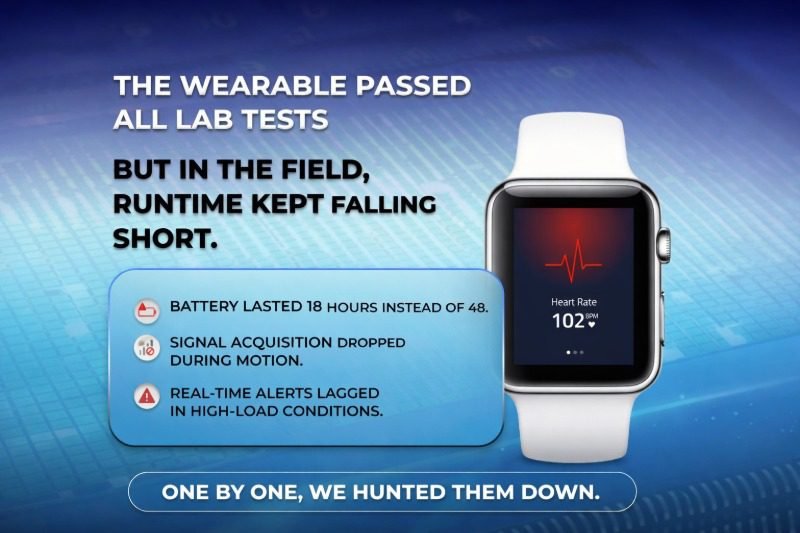
- Battery runtime dropped from 48 hours to 18 hours
- Signal acquisition failed during motion
- Real-time alerts lagged under system load
- Power consumption varied unpredictably
This is a familiar scenario in wearable development. Lab environments are controlled. Real-world usage is not.
Wearables operate in dynamic conditions:
- Movement
- Temperature changes
- Wireless interference
- Variable sensor contact
- Continuous runtime expectations
These conditions expose firmware weaknesses that hardware validation alone cannot detect.
The Discovery Phase: Finding the Invisible Problems
Once the issue was confirmed, the engineering team began a systematic debugging process, a core component of professional Firmware Development Services.
Three root causes eventually emerged. First, the ADC (Analog-to-Digital Converter) never enters sleep mode. Even during idle periods, it continued consuming power.
Second, a firmware interrupt was misconfigured. Instead of triggering only when needed, it fired every 2 milliseconds, keeping the processor active.
Third, a scheduler of race conditions caused intermittent frame drops in signal capture, especially during motion.
None of these problems was obvious during normal testing. Together, they significantly reduced battery life and degraded system reliability.
This is the reality of embedded systems engineering: small inefficiencies compound quickly.
Firmware as the Nervous System of Wearables
In wearable medical and health devices, firmware is not just software. It is the control system that governs every hardware interaction.
Firmware manages:
- Sensor timing
- Data acquisition pipelines
- Power states
- Memory allocation
- Wireless communication
- Interrupt handling
- Safety monitoring
- Real-time processing
A wearable device may look simple externally, but internally, it operates as a tightly synchronized embedded system.
This is why Embedded Product Development Services must treat firmware architecture as foundational, not secondary. Hardware determines capability. Firmware determines behavior.
Re-Architecting for Stability
Fixing the issues required more than patching code. The firmware architecture had to be redesigned to ensure deterministic behavior and efficient power usage. The team implemented several improvements:
- Re-architected ISR timing logic
- Rewrote the power management layer
- Optimized scheduler priorities
- Implemented deeper peripheral sleep states
- Introduced watchdog-based validation routines
- Added real-world motion testing scenarios
Each improvement contributed incrementally to system stability. Once complete:
- Battery runtime returned to expected levels
- Signal acquisition remained stable during movement
- Alerts became responsive under load
- Power consumption became predictable
The device was finally ready for deployment.
Why Wearable Debugging Is Different
Wearables introduce unique engineering challenges. Unlike many embedded systems, they must operate continuously in unpredictable environments while maintaining extremely low power consumption. Wearable firmware must balance:
- Accuracy
- Responsiveness
- Battery life
- Thermal limits
- Wireless connectivity
- Safety requirements
Optimizing one dimension often impacts another. For example:
- Increasing sampling frequency improves accuracy but increases power consumption.
- Aggressive sleep modes save power but risk missing events.
- Higher processing loads improve analytics but increase latency.
This balancing act defines wearable Embedded Systems Development.
Power Optimization: A Firmware Responsibility
Battery performance is often perceived as a hardware problem, but in reality, firmware plays a dominant role. Effective power optimization includes:
- Peripheral sleep coordination
- Event-driven architecture
- Interrupt prioritization
- DMA utilization
- Clock scaling
- Sensor duty cycling
- Communication batching
Even microamp-level inefficiencies matter. In wearable devices, small firmware errors can dramatically reduce runtime. Power-aware firmware design must be intentional from the beginning, not added later.
Real-World Validation Matters More Than Lab Testing
One of the biggest lessons in wearable development is that lab validation alone is insufficient. Firmware must be tested under:
- Motion conditions
- Signal noise scenarios
- Battery edge cases
- Long-duration operation
- Communication interruptions
- Sensor misalignment
Real-world validation reveals issues that simulations cannot. Professional Embedded Product Development Services incorporate field testing early in the development lifecycle to avoid late-stage failures.
Firmware Reliability Is Clinical Reliability
In health-monitoring wearables, firmware performance directly impacts clinical outcomes. If a wearable:
- Misses a signal event
- Delays an alert
- Loses data during motion
- Powers down unexpectedly
The consequences go beyond user experience. They affect safety. This is why firmware must be engineered with the same rigor as hardware design.
Reliability is not achieved solely through testing. It is achieved through architecture.
The Invisible Engineering That Makes Wearables Work
The most important engineering work in wearable development is often invisible. Users see:
- A comfortable device
- A clean interface
- Reliable notifications
- Long battery life
They don’t see:
- ISR timing diagrams
- power-state debugging
- scheduler analysis
- memory profiling
- signal integrity validation
- weeks of optimization
Yet those invisible efforts define whether the product succeeds or fails. This is the reality of Embedded Systems Development.
Building Firmware That Scales Beyond Prototype
Many wearable prototypes work well in controlled demonstrations. Scaling them into reliable products requires a deeper engineering discipline. Production-ready firmware must:
- Handle edge cases
- recover from faults
- operate continuously
- maintain timing guarantees
- support updates
- meet regulatory expectations
This transition from prototype firmware to production firmware is where experienced Firmware Development Services become essential.
Final Thoughts
Debugging a wearable device is rarely about fixing obvious problems. It is about identifying subtle system-level interactions between hardware, firmware, and real-world usage.
The invisible engineering work behind firmware stability determines whether a wearable device delivers reliable health insights or fails silently in the field.
At Pinetics, we specialize in Embedded Systems Development, Firmware Development Services, and Embedded Product Development Services that transform wearable concepts into reliable, production-ready devices. Our engineering approach focuses on system-level validation, power-aware firmware architecture, and real-world reliability testing from the earliest development stages.
In wearable technology, the most important engineering work is the work no one ever sees, yet every user depends on it.
 Sr. Test Engineer
 Sales Marketing Manager
 Marketing & Sales – BBA : Fresher