
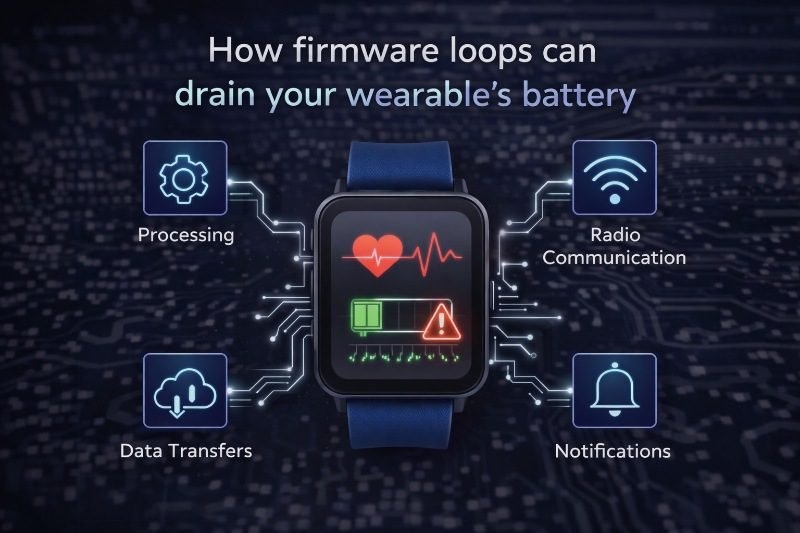
A wearable heart monitor once failed in the field, not because of faulty sensors, poor manufacturing, or inaccurate algorithms. It failed because of a firmware loop. A single loop that never allowed the processor to truly rest.
The result? The battery drained eight hours earlier than expected, shutting the device down just before a critical cardiac episode. In consumer electronics, this would be a usability problem. In MedTech, it is a clinical safety event.
Power efficiency in wearables is not a nice-to-have performance metric. It is directly tied to continuity of care, diagnostic reliability, and patient trust. And yet, firmware power behavior remains one of the most underestimated risks in medical device development.
Why Power Is a Safety Requirement in MedTech
Medical wearables, especially cardiac monitors, are expected to operate continuously, often for days or weeks, without interruption. Every minute of downtime is lost clinical visibility. From a Medical Device Hardware Design perspective, battery capacity is finite. Size, weight, thermal limits, and patient comfort constrain the amount of energy that can be stored.
This makes firmware behavior the single biggest lever for extending or destroying runtime. When firmware wastes power, no amount of battery optimization can save the device.
The Hidden Cost of “Always-On” Firmware Thinking
Many firmware teams inherit design habits from non-medical embedded systems:
- Continuous polling instead of event-driven execution.
- High-frequency timers “just to be safe”.
- Peripherals are left enabled by default.
- The CPU never fully enters sleep states.
These patterns often go unnoticed in bench testing. The device works. The data looks correct. The UI is responsive.
But beneath the surface, the processor is awake far more than it needs to be. In a medical wearable, silent inefficiency compounds over hours and days until the battery gives out at the worst possible moment.
Firmware Loops: The Silent Battery Killers
Firmware loops are among the most common and dangerous sources of unnecessary power consumption.
Typical examples include:
- Polling sensor status instead of using interruptions.
- Busy-wait delays instead of low-power timers.
- Background loops check flags that rarely change.
- RTOS tasks that never block or yield properly.
Each loop may seem harmless in isolation. Together, they prevent the system from entering deep sleep modes where real power savings occur.
In Hardware Firmware Development, power optimization starts with one question: “What absolutely needs to be awake right now?” If the answer is “nothing,” the system should be sleeping.
When Accuracy Competes with Battery Life
Wearable device teams often prioritize:
- Higher sampling rates
- Denser data streams
- Faster UI updates
Accuracy matters, but so does duration.
Sampling ECG data at unnecessarily high rates, rendering waveforms continuously, or transmitting data too frequently can double or triple power draw without meaningful clinical benefit.
This is where firmware engineers must collaborate closely with hardware and clinical teams.
Effective Firmware Development Services align:
- Clinical requirements
- Signal fidelity needs
- Power budgets
Accuracy that drains the battery prematurely is not accurate; it is failure.
Sleep States Are Only Useful If You Actually Reach Them
Most modern MCUs support multiple low-power modes: sleep, stop, standby, and deep sleep. Yet many devices never truly enter them.
Why? Because something is always “just running.”
Common culprits include:
- Misconfigured RTOS tick timers.
- Peripherals were left clocked unnecessarily.
- Debug interfaces are enabled in production.
- Software timers are firing too frequently.
If the firmware architecture is not intentionally designed for idle time, sleep modes remain theoretical.
In medical wearables, power management must be architectural, not reactive.
Power-Aware Firmware Architecture
High-quality Hardware Firmware Development treats power as a first-class design constraint.
That means:
- Event-driven task execution instead of polling
- Interrupt-based sensor handling
- Batching work to maximize sleep windows
- Aggressive peripheral shutdown when idle
- Deterministic wake-up paths
Firmware should behave like a disciplined scheduler doing necessary work quickly, then getting out of the way. Anything else is wasted energy.
Hardware Design and Firmware Must Co-Evolve
Power issues are rarely “just firmware” or “just hardware.” They emerge at the boundary.
From a Medical Device Hardware Design standpoint:
- Power regulators must support fast state transitions.
- Sensors must expose low-power modes.
- Clocks must be configurable and scalable.
From the firmware side:
- Those capabilities must be actively used.
- Transitions must be correctly sequenced.
- Failure cases must be handled safely.
When hardware features are ignored or firmware assumes ideal conditions, power budgets collapse.
True efficiency only happens when hardware and firmware are designed as a single system.
Power Bugs Are Harder to Detect Than Functional Bugs
Functional bugs crash systems. Power bugs quietly degrade them.
A wearable can pass:
- Unit testing
- Integration testing
- Basic validation
And still fail in the field due to power behavior that only emerges over long runtimes.
This is why power profiling must be part of development, not just pre-release testing.
Effective Firmware Development Services include:
- Current profiling during real workloads
- Long-duration soak tests
- Idle state verification
- Battery discharge curve analysis
If you don’t measure power, you don’t control it.
Regulatory Implications of Power Failure
In MedTech, a drained battery is not just a technical issue; it is a regulatory one.
Unexpected shutdowns raise questions such as:
- Was risk adequately mitigated?
- Was the runtime validated under real conditions?
- Were failure modes foreseeable?
Firmware loops that cause early battery depletion can invalidate safety assumptions documented during regulatory submission.
This turns a design oversight into a compliance risk. Power-aware firmware is not only good for engineering but also for regulatory protection.
Designing for Worst-Case, Not Best-Case
Many devices are designed around “typical use.” But patients are not typical. Some move more. Some sleep less. Some generate noisier signals. Some rely on the device continuously.
Firmware must handle worst-case behavior gracefully without exhausting power reserves.
That means:
- Adaptive sampling rates
- Conditional processing
- Dynamic power scaling
Static assumptions are dangerous in medical wearables.
The Human Cost of Power Blindness
When a wearable battery dies early, the impact is not abstract.
It can mean:
- Missed arrhythmias
- Delayed intervention
- Lost clinician confidence
- Reduced patient adherence
A device that cannot be trusted to stay alive cannot be trusted to save lives. This is why power awareness is ultimately a patient’s safety issue.
Final Thoughts
Firmware loops may look small in code reviews, but their impact on wearable medical devices can be catastrophic. In MedTech, power efficiency is not an end. It is a prerequisite for clinical reliability.
At Pinetics, we approach Medical Device Hardware Design, Firmware Development Services, and Hardware Firmware Development with power awareness built into every architectural decision. We help teams design systems that balance accuracy, responsiveness, and endurance without sacrificing patient safety.
Because when a wearable fails silently due to poor power management, it is not just a technical failure. It is a broken promise to the patient relying on it.
 Sr. Test Engineer
 Sales Marketing Manager
 Marketing & Sales – BBA : Fresher