
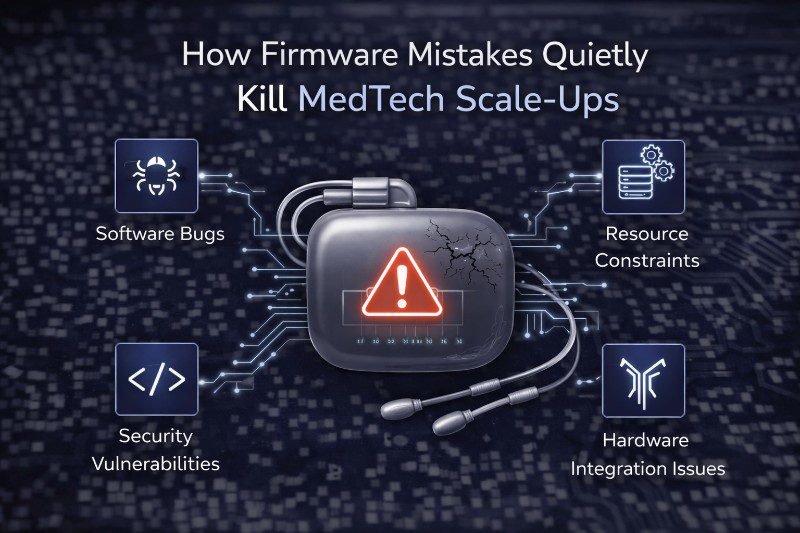
In early-stage MedTech development, hardware usually gets the spotlight. Investors ask about sensors, algorithms, clinical validation, and manufacturing readiness. Teams celebrate when prototypes work reliably in controlled environments.
However, as products transition from early development to scaling for real-world deployment, a different reality emerges, one that often catches teams off guard.
The challenge is not the hardware. Nor is it the funding. Nor the clinical concept. Rather, firmware mistakes quietly derail MedTech scale-ups. The prototype worked perfectly. The demo impressed stakeholders. The clinical concept was validated. Then, field testing began.
Unexpected resets appeared. A tiring drift occurred during continuous operation. Devices behaved unpredictably in real-world environments. Regulatory reviewers started asking questions that the firmware team wasn’t prepared to answer.
Nothing catastrophic, just small issues that compound over time. As a result, timelines begin to slip.
The Prototype-to-Production Gap
This leads to one of the most underestimated challenges in MedTech development: the shift from prototype firmware to production firmware.
Prototype firmware is built for:
- Proof of concept
- Speed
- Demonstration
- Experimentation
Production firmware must be built for:
- Reliability
- Traceability
- Regulatory compliance
- Long-term stability
Successfully navigating this transition requires a fundamentally different engineering mindset.
In Hardware Firmware Development, what works in a sprint often fails in a marathon. MedTech products require marathon-level endurance.
Firmware Mistake #1: Designing for Ideal Conditions
Many prototypes are tested in controlled environments:
- Stable power supply
- Predictable sensor signals
- Limited runtime duration
- Minimal environmental noise
Yet the reality is that real-world devices simply don’t operate under those controlled conditions.
Temperature drift, voltage variation, sensor noise, long-duration operation, and user behavior all introduce complexity that prototype firmware rarely anticipates.
From a Medical Device Hardware Design perspective, hardware variability is expected. Firmware must absorb it gracefully. Firmware that assumes ideal conditions will eventually fail in the field.
Firmware Mistake #2: Ignoring Long-Duration Behavior
A prototype that runs flawlessly for an hour may fail after 72 hours.
Common issues include:
- Memory leaks
- Timer overflow conditions
- Buffer fragmentation
- Cumulative timing drift
- Watchdog misconfiguration
These problems don’t appear during demos. They emerge during extended operation.
Given these demands, MedTech firmware must be validated under real-world, long-duration conditions. Reliable Firmware Development Services always include long-duration testing, not just functional validation.
Firmware Mistake #3: Treating Power as an Afterthought
Power efficiency is often addressed late in development. But firmware architecture determines power consumption more than hardware components do.
Polling loops, unnecessary interruptions, inefficient scheduling, and poorly managed peripherals can dramatically reduce battery life. In wearable and portable medical devices, battery life is not just a usability concern; it is a safety requirement.
When firmware drains power unpredictably, devices stop monitoring patients when they are needed most. That’s why power awareness must be built into Hardware Firmware Development from the very beginning.
Firmware Mistake #4: Weak Fault Handling
Prototype firmware often focuses on functionality rather than failure behavior. But in medical devices, failure handling is as important as normal operation.
Firmware must define:
- Safe states
- Recovery mechanisms
- Watchdog behavior
- Error logging strategies
- Fallback communication paths
If the firmware cannot recover gracefully from faults, small issues escalate into system-level failures. Regulators closely monitor fault handling because it directly affects patient safety.
Firmware Mistake #5: Lack of Traceability
Firmware that works perfectly can still fail to regulatory review if it lacks traceability.
Regulators expect to see:
- Requirements mapped to implementation
- Implementation mapped to tests
- Tests mapped to risk mitigation
Without traceability, firmware becomes difficult to validate, even if technically sound.
This is where many scale-ups stumble. Prototype code evolves organically, and documentation struggles to catch up. Strong Firmware Development Services treat traceability as part of engineering, not documentation cleanup.
Firmware Mistake #6: Architecture That Doesn’t Scale
Early firmware often grows organically:
- Features added incrementally
- Timing assumptions are layered over time
- Shared resources reused without structure
Prototypes allow organic growth; production does not.
As devices grow more complex, firmware architecture must support:
- Modularity
- Predictable scheduling
- Fault isolation
- Maintainability
Scaling MedTech firmware requires deliberate architecture, not incremental patches.
Firmware Mistake #7: Hardware-Firmware Misalignment
Hardware and firmware teams often move at different speeds. Hardware stabilizes early. Firmware continues to evolve.
If coordination breaks down, mismatches appear:
- Firmware assumes hardware timing guarantees that don’t exist.
- Hardware capabilities left unused by firmware.
- Power management features were ignored.
- Safety features are not fully integrated.
Effective Medical Device Hardware Design depends on close collaboration with firmware. In MedTech, hardware and firmware are inseparable.
Firmware Mistake #8: Underestimating Regulatory Expectations
Firmware engineers sometimes view regulatory work as documentation overhead. In MedTech, firmware is part of the safety case.
Regulatory reviewers evaluate:
- Architecture decisions
- Risk mitigation implementation
- Verification completeness
- Failure behavior
- Traceability
Firmware must survive compliance review, not just runtime execution. Ignoring regulatory expectations early leads to redesign later.
Why Firmware Mistakes Are So Expensive
Firmware problems rarely appear as dramatic failures.
Instead, they cause:
- Intermittent field issues
- Difficult-to-reproduce bugs
- Audit delays
- Validation setbacks
- Loss of stakeholder confidence
Each issue consumes time. Together, they stall scale-ups. In MedTech, delays don’t just affect schedules; they affect patient access to innovation.
Building Firmware That Scales
The difference between prototype firmware and production firmware is discipline.
Successful MedTech teams:
- Design for worst-case conditions.
- Validate long-duration operation.
- Integrate power awareness early.
- Implement structured fault handling.
- Maintain traceability continuously.
- Align hardware and firmware decisions.
- Treat regulation as a design partner.
This approach turns firmware from a risk into a competitive advantage.
Final Thoughts
MedTech scale-ups rarely fail due to poor ideas or weak innovation. More often, they stall because prototype firmware can’t handle the realities of production.
At Pinetics, we help MedTech teams bridge that gap through deep expertise in Medical Device Hardware Design, Firmware Development Services, and Hardware Firmware Development. Our approach focuses on building firmware that is reliable, traceable, power-aware, and ready for regulatory scrutiny from the earliest stages of development.
Because scaling a medical device isn’t just about making prototypes work. It’s about making them trustworthy, repeatable, and safe every time they run.
 Sr. Test Engineer
 Sales Marketing Manager
 Marketing & Sales – BBA : Fresher