
In medical technology, interface design emphasizes clarity over aesthetics. It is about clinical clarity. A well-designed interface can reduce cognitive overload, accelerate decision-making, and prevent critical errors. A poorly designed one can do the opposite, introducing friction at the exact moment when speed, confidence, and accuracy matter most.
In high-stakes environments such as intensive care units, operating rooms, and remote clinics, the interface becomes the frontline of patient safety.
This is why user experience in MedTech is more than a design choice; it is a clinical necessity.
As a product development partner working closely with global MedTech innovators, we see this reality repeatedly: even the most advanced medical devices struggle to deliver impact if their interfaces confuse the people who rely on them under pressure.
Why UX in MedTech Is Fundamentally Different
Designing interfaces for consumer apps and medical devices is fundamentally different.
In MedTech:
- Users operate under stress
- Mistakes can have clinical consequences
- Workflows vary by role, environment, and urgency
- Regulatory scrutiny applies to interface behavior
- Reliability matters more than visual novelty.
A nurse in an ICU, a technician in a rural clinic, and a clinician in a diagnostic lab do not interact with technology the same way, but all expect it to be intuitive, predictable, and safe.
This makes UX an integral part of end-to-end product development for electronics, not a layer added after hardware and firmware are finalized.
Interface Design Starts with System Architecture
One of the most common mistakes in MedTech product development is treating interface design as a standalone task.
Interface behavior is tightly coupled with:
- Hardware capabilities
- Processing latency
- Display technology
- Input mechanisms
- Power constraints
- Data integrity requirements
In Medical Device Hardware Design, early architectural decisions directly shape what the interface can and cannot do.
If interface requirements are not considered during hardware design, teams often face compromises, such as reduced responsiveness, cluttered displays, or unsafe interaction patterns. Effective MedTech UX starts at the system level.
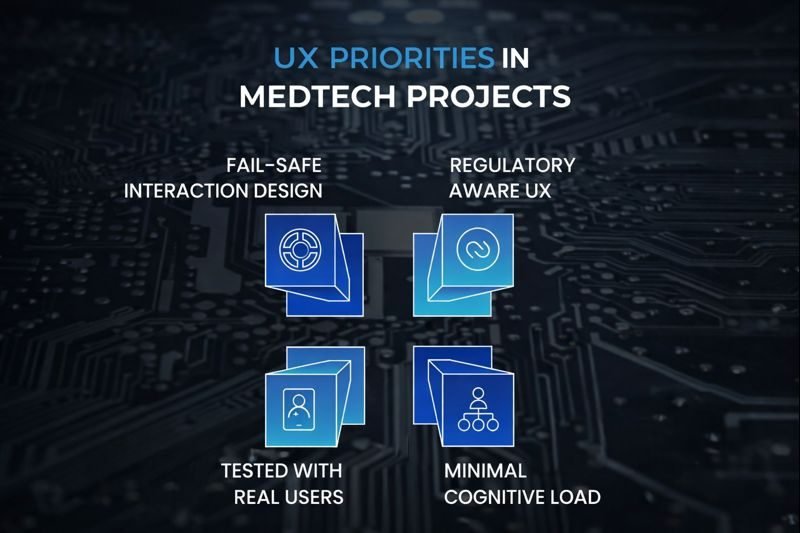
Priority 1: Minimal Cognitive Load Under Pressure
In clinical environments, users do not have time to “figure things out.” They need information to surface instantly, clearly, and in the right order.
Designing for Cognitive Simplicity
Minimal cognitive load means:
- Clear information hierarchy
- Prioritization based on urgency
- Role-aware displays
- Context-driven transitions
For example, an alarm condition should never compete visually with routine status information. Critical data must surface without requiring additional navigation or interpretation.
This approach reduces mental effort and lowers the risk of error, especially during emergencies.
Priority 2: Fail-Safe Interaction Design
In MedTech, interfaces must assume that users are tired, distracted, or operating in suboptimal conditions.
Fail-safe interaction design ensures that the system protects users from unintended actions.
Designing to Prevent Errors
Key principles include:
- Color schemes validated for accessibility and contrast
- Consistent visual language for alerts and warnings
- Guided workflows that enforce required steps
- Soft locks that prevent skipping critical actions
In Medical Device Hardware Design, this also requires:
- Responsive input handling
- Reliable tactile or haptic feedback
- Predictable display refresh behavior
Fail-safe design does not slow users down. It guides them safely through complex tasks.
Priority 3: Testing With Real Clinical Users
One of the most valuable lessons in MedTech UX is this: designers are not the end users. Interfaces that look intuitive in design reviews often fail in real clinical settings.
Bringing Clinicians into the Process Early
Effective teams:
- Test wireframes with nurses, technicians, and clinicians
- Observe real-world usage scenarios
- Validate assumptions before implementation
- Iterate continuously based on feedback
By baking usability testing into the sprint cycle, teams avoid late-stage surprises that can derail regulatory reviews or adoption.
This approach strengthens End-to-End Product Development Electronics by aligning design, engineering, and real-world use.
Priority 4: Regulatory-Aware UX Design
Unlike consumer interfaces, medical device interfaces are regulated as artefacts. Standards such as IEC 62366 require manufacturers to demonstrate that usability risks have been identified, mitigated, and validated.
UX as a Compliance Requirement
Regulatory-aware UX design includes:
- Documented usability engineering processes
- Traceable design decisions
- Clear mapping between risks and mitigations
- Auditable logs and alerts
- Interface behavior consistency across versions
This means UX decisions must be deliberate, documented, and defensible.
In MedTech, “it feels intuitive” is not enough. You must be able to prove it.
Hardware Constraints Shape Interface Experience
Interface performance is inseparable from hardware performance.
In Medical Device Hardware Design, factors such as:
- Processor speed
- Memory availability
- Display resolution
- Input latency
- Power management
directly affects how responsive and reliable an interface feels.
A lagging display, delayed input response, or inconsistent alert behavior erodes trust, especially in clinical environments.
This is why interface requirements must inform, not compete with, hardware architecture.
UX Is About Trust, Not Just Usability
In medical devices, trust is built through predictability.
Clinicians trust devices that:
- Behave consistently
- Respond instantly
- Present information clearly
- Never surprise them
A good interface disappears into the workflow. It does not demand attention; it supports action.
This is what we mean when we say great MedTech UX is intuitive, safe, and invisible under pressure.
Designing for Care Under Constraints
Medical environments are full of constraints:
- Limited time
- Variable lighting
- Gloves and protective equipment
- Fatigue and stress
- Inconsistent infrastructure
Designing under these constraints requires humility and discipline.
It requires teams to ask:
- What information is truly essential?
- What actions must never be ambiguous?
- What happens when something goes wrong?
These questions elevate UX from a design task to a clinical responsibility.
UX as a Differentiator in Global MedTech
As MedTech products scale globally, interface quality becomes a competitive advantage.
Devices deployed across regions must accommodate:
- Varying skill levels
- Different clinical workflows
- Language and cultural differences
- Diverse infrastructure conditions
A robust UX strategy makes devices more adaptable, easier to train on, and faster to adopt.
In global markets, usability is not optional; it determines outcomes.
UX Is a System, not a Screen
The most successful medical devices treat UX as a system-level discipline.
It spans:
- Hardware design
- Firmware behavior
- Data visualization
- Interaction patterns
- Regulatory documentation
When UX is integrated into End-to-End Product Development Electronics, the result is not just a better interface; it is a better product.
Final Thoughts
In medical technology, interface design is not about making devices look good. It is about ensuring they are clear, safe, and dependable when it matters most.
Great UX in MedTech reduces errors, builds trust, and improves outcomes, especially when embedded into thoughtful Medical Device Hardware Design and holistic End-to-End Product Development Electronics.
At Pinetics, we approach medical device development with this philosophy. We design interfaces as part of the system, not as an afterthought, aligning usability, hardware, firmware, and regulatory requirements into a single, cohesive product strategy.
We design with users in mind. We design care under constraints. And that is what ultimately elevates both experience and clinical outcomes.
 Sr. Test Engineer
 Sales Marketing Manager
 Marketing & Sales – BBA : Fresher