
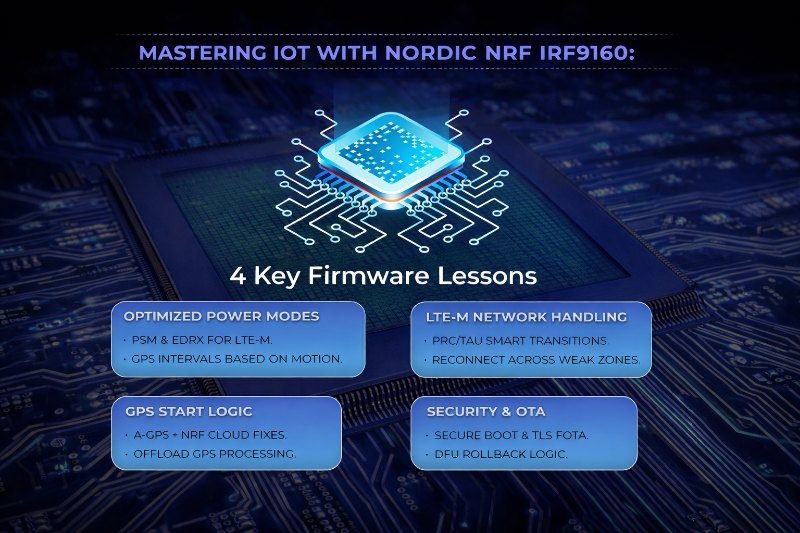
Working with Nordic’s nRF9160 has been one of the most technically rewarding journeys in IoT firmware engineering.
On the surface, it is a powerful module that combines LTE-M, NB-IoT, GPS, and an ARM Cortex-M33 in a single ultra-low-power package. For asset tracking, healthcare wearables, remote diagnostics, industrial telemetry, and logistics systems, it appears ideal.
But here’s what many teams underestimate:
Getting it to work efficiently in real-world deployments is not plug-and-play. It demands disciplined firmware architecture, intelligent power budgeting, network-state awareness, and a deep understanding of modem behavior under edge conditions.
For teams delivering serious IoT solutions, mastering the nRF9160 is less about writing code and more about building a resilient embedded system. This is where structured Firmware Development Services, Embedded Systems Development, and full-stack IoT Product Development Services become critical.
Why the nRF9160 Changes the IoT Game
The nRF9160 stands apart because it integrates:
- LTE-M / NB-IoT cellular connectivity
- GPS capability
- Secure boot and hardware-based security
- ARM Cortex-M33 MCU
- Integrated modem firmware stack
That combination eliminates the need for separate cellular modems and microcontrollers, reducing BOM complexity and board size. But integration also means interdependency.
Your firmware is no longer just managing sensors and communication. It must coordinate:
- Modem states
- Radio scheduling
- GPS acquisition cycles
- TLS handshakes
- Power domains
- OTA updates
Without disciplined architecture, power drains and instability appear quickly.
Lesson 1: Power Optimization Is the Core Discipline
Battery-powered IoT devices live or die by power management. The nRF9160 offers advanced low-power features, but they must be used intelligently.
PSM and eDRX Are Not Defaults
Power Saving Mode (PSM) and extended Discontinuous Reception (eDRX) can dramatically extend battery life. But improper configuration can:
- Increase network re-attachment delays
- Cause missed downlink messages
- Trigger unnecessary wake cycles
Effective firmware must dynamically manage these modes based on:
- Movement detection
- Transmission frequency
- Urgency of data
- Network conditions
For example, in asset tracking applications:
- When stationary → extend GPS intervals and increase PSM duration
- When movement is detected → shorten the reporting cycle and adjust the RRC state
This adaptive strategy requires a modular, event-driven firmware architecture, a cornerstone of professional Embedded Product Development Services.
Lesson 2: LTE-M Network Handling Is Where Most Power Is Lost
Many engineers assume the modem stack “handles everything.” In practice, firmware must actively manage network behavior.
Key considerations include:
- Tracking Area Updates (TAU)
- RRC Idle vs RRC Connected transitions
- Network registration retries
- Weak signal reconnection logic
A poorly managed LTE state machine can drain more battery than GPS acquisition.
Best practice includes:
- Minimizing RRC transitions
- Bundling data transmissions to reduce wake cycles
- Handling reconnection backoffs intelligently
- Monitoring signal strength before triggering the uplink
When implemented correctly, LTE-M becomes efficient and stable even in rural or low-coverage regions. This level of optimization is rarely achieved without deep experience in Embedded Systems Development for cellular IoT.
Lesson 3: GPS Optimization Requires Context Awareness
GPS is power-hungry. If left unmanaged, it will dominate your energy budget. The nRF9160 provides flexibility, but the firmware must carefully control the acquisition strategy.
Cold Start vs Hot Start Strategy
Cold start: Higher power, longer time-to-fix
Hot start: Faster acquisition if satellite data is retained
Combining A-GPS data from nRF Cloud significantly reduces time-to-first fix (TTFF). However, downloading A-GPS assistance data must be carefully scheduled to avoid unnecessary cellular activity.
Advanced implementations:
- Adjust the GPS interval dynamically based on accelerometer data
- Use geofencing logic to reduce fix frequency
- Offload non-critical processing to the modem
Balancing GPS performance and battery life is a firmware orchestration problem, not a hardware limitation.
Lesson 4: Security and OTA Must Be Architected Early
The nRF9160 includes built-in security features, including:
- Hardware root-of-trust
- Secure boot
- Cryptographic acceleration
But secure architecture requires more than enabling features.
OTA (FOTA) Design Considerations
Firmware Over-the-Air (FOTA) updates must include:
- TLS-secured downloads
- Image integrity validation
- Version management
- Fail-safe rollback logic
- Memory partition strategy
Without rollback protection, an interrupted update can permanently brick devices in the field. Professional Firmware Development Services treat OTA architecture as a core system requirement, not an afterthought.
Building a Modular Firmware Stack
One of the biggest mistakes in nRF9160 projects is tightly coupling application logic with modem control logic.
A scalable architecture separates:
- Sensor layer
- Communication layer
- Power management layer
- Security layer
- Cloud abstraction layer
This modularity ensures:
- Easier debugging
- Predictable state transitions
- Cleaner OTA updates
- Regulatory traceability
- Faster iteration cycles
In advanced IoT deployments, firmware must be cloud-integrated yet edge-resilient. Devices must operate fully offline and synchronize intelligently when connectivity returns. That balance defines successful IoT Product Development Services.
Custom Hardware Integration Matters
While the nRF9160 module simplifies design, hardware implementation still plays a critical role.
Key hardware considerations:
- RF layout discipline
- Proper antenna matching
- Low-noise power supply design
- Battery protection circuitry
- Thermal profiling
Firmware optimization alone cannot compensate for poor RF layout or unstable power rails. Successful products combine hardware awareness with firmware intelligence and an integrated philosophy central to professional Embedded Systems Development.
Common Mistakes Teams Make
Through experience, several recurring pitfalls emerge:
- Over-polling the modem for status updates
- Ignoring RRC state optimization
- Running GPS too frequently
- Neglecting sleep state validation
- Underestimating OTA complexity
- Testing only in ideal signal conditions
Real-world IoT systems operate in edge conditions: rural areas, moving vehicles, temperature extremes, and intermittent coverage. Firmware must be stress-tested under all these scenarios before deployment.
The Bigger Picture: Ecosystem Thinking
The nRF9160 is not just a chip. It is an ecosystem involving:
- nRF Connect SDK
- Zephyr RTOS
- Cloud integration tools
- Modem firmware updates
- LTE network variability
Mastering it requires holistic thinking. It’s not about getting the board to connect with you once. It’s about ensuring:
- Years of stable deployment
- Predictable power usage
- Secure field updates
- Seamless global roaming
This is where structured Embedded Product Development Services transform promising prototypes into scalable IoT products.
Final Thoughts
The nRF9160 represents the convergence of power efficiency and global connectivity. But it’s true potential is unlocked only through disciplined firmware architecture and system-level optimization.
At Pinetics, we deliver advanced Firmware Development Services, full-stack Embedded Systems Development, and comprehensive IoT Product Development Services that transform connected device concepts into resilient, production-ready platforms. From custom hardware integration to secure OTA strategies and power-aware firmware architecture, we engineer systems built for real-world deployment, not just lab validation.
When power efficiency meets global visibility, innovation becomes scalable. And that’s where we built it.
 Sr. Test Engineer
 Sales Marketing Manager
 Marketing & Sales – BBA : Fresher