
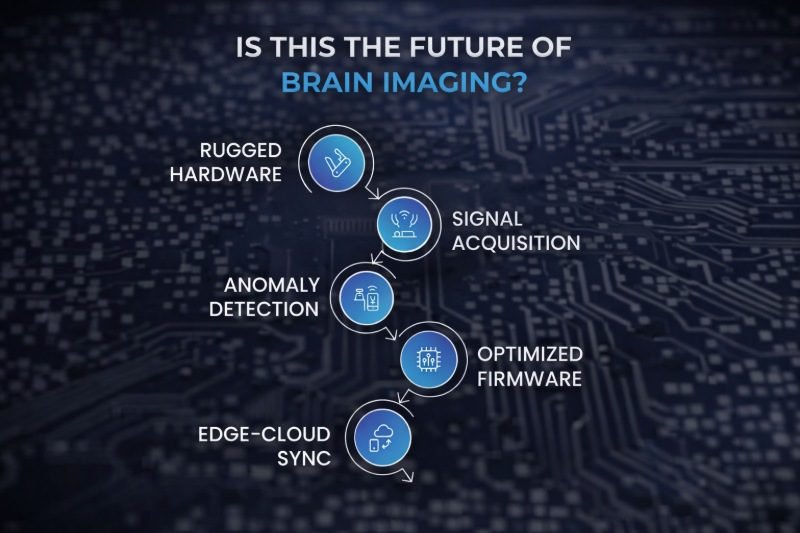
Brain injuries do not respect ideal clinical environments. Trauma, stroke, or neurological complications can strike anywhere, at any time. The crucial first hour after injury often determines long-term outcomes. Yet most diagnostic imaging tools remain confined to hospitals, tied to specialized infrastructure and trained operators.
Computed tomography (CT) scanners and MRI systems have set the standard in neurological imaging for years. While they offer power and precision, their large size, expense, and immobility are limited. This makes them inaccessible in emergencies, whether in roadside accidents, rural clinics, or on the battlefield.
This gap between injury and diagnosis has driven a new wave of innovation in portable brain imaging systems. The goal is simple but transformative: bring diagnostic capability directly to the patient.
These advances are driving progress across multiple domains. Through advancements in Medical Device Hardware Design, Firmware Development Services, and Hardware Firmware Development, portable brain scanners are moving from experimental prototypes toward clinically viable solutions.
The Challenge of Brain Imaging Outside the Hospital
Traditional imaging systems rely on controlled environments: stable power, minimal motion, and sophisticated infrastructure. In contrast, portable systems must perform under very different, unpredictable conditions.
They must be:
- Compact and lightweight
- Resistant to environmental stress
- Energy-efficient
- Capable of real-time processing
- Reliable in unpredictable field conditions
Most importantly, they must preserve signal fidelity. Detecting neurological abnormalities requires extremely precise measurement of weak biological signals. Miniaturization cannot come at the cost of accuracy.
Thus, achieving both portability and clinical reliability is now central to the design of portable brain imaging systems, marking a shift from conventional hospital-based tools.
Rethinking Hardware for Mobility and Reliability
The hardware architecture underpins any portable diagnostic system. Field deployment demands a fundamentally different design approach than equipment built solely for hospitals.
In modern Medical Device Hardware Design, portability starts with system integration. Where components once sprawled across multiple boards, they are now consolidated into compact modules. Designers must still maintain electromagnetic compatibility, thermal stability, and power efficiency, which is essential.
For portable brain scanners, this includes:
- Low-noise analog front ends for neural signal acquisition
- High-resolution ADCs for accurate data capture
- Energy-efficient microcontrollers or SoCs
- Rugged enclosures designed for transport and field use
- Battery systems optimized for extended operation
Signal acquisition becomes particularly critical with hybrid approaches such as EEG and near-infrared spectroscopy (NIRS). These technologies capture subtle physiological signals, yet noise, motion, or interference can easily distort them.
Preserving signal fidelity while reducing system size requires careful analog design, shielding strategies, and precision component selection.
Non-Invasive Signal Acquisition in Portable Systems
Modern portable brain imaging systems often rely on non-invasive sensing technologies to detect neurological abnormalities.
EEG provides insight into electrical brain activity, while NIRS measures changes in blood oxygenation associated with brain function. Combining these methods allows for hybrid diagnostic models capable of identifying conditions such as:
- Intracranial bleeding
- Swelling
- Ischemic events
- Abnormal neural activity
This hybrid sensing approach enables portable devices to provide meaningful neurological insight without requiring large imaging systems.
However, acquiring and interpreting these signals in real time requires tight coordination between hardware and firmware layers.
Firmware as the Intelligence Layer
Portable medical imaging systems face unique challenges. They must process data continuously, operating under strict power and performance constraints. As a result, firmware architecture becomes a critical pillar of system reliability.
Through specialized Firmware Development Services, embedded systems are designed to:
- Process sensor data in real time
- Filter noise and artifacts
- Manage power consumption
- Coordinate communication between subsystems
- Ensure safe system behavior under all conditions
Battery-optimized firmware becomes especially important in mobile medical devices. Efficient scheduling, sleep modes, and interrupt-driven processing help maximize runtime without compromising performance.
In portable diagnostic equipment, firmware is not merely software. It serves as the system’s operational backbone.
AI-Enhanced Anomaly Detection at the Edge
One of the most promising developments in portable brain imaging is the integration of AI-based anomaly detection directly into embedded systems. By analyzing neurological data in real time, AI helps quickly identify abnormalities and assists clinicians with faster, more informed decision-making.
Instead of transmitting raw data to the cloud for analysis, edge-based AI models can:
- Detect abnormal signal patterns
- Flag potential hematomas or swelling
- Identify ischemic indicators
- Alert clinicians in real time
This reduces latency and enables immediate decisions at the point of care.
From a Hardware Firmware Development perspective, deploying AI on embedded hardware requires careful optimization. Models must be small, efficient, and reliable enough to run continuously on low-power processors.
Edge intelligence allows portable imaging devices to support immediate, AI-driven diagnosis even in environments with limited connectivity, ensuring that clinicians still benefit from advanced detection capabilities regardless of location.
Edge-to-Cloud Connectivity for Clinical Collaboration
While local processing enables immediate decision-making, connectivity remains important for clinical collaboration.
Modern portable brain imaging systems often include secure edge-to-cloud synchronization capabilities. These allow:
- Encrypted transmission of diagnostic data
- Remote review by specialists
- Long-term patient monitoring
- Integration with hospital systems
Security is essential in this architecture. Medical data must be protected during storage and transmission, requiring encryption, authentication mechanisms, and secure firmware design practices.
By extending the value of portable diagnostics, connectivity strengthens patient safety rather than compromises it.
Regulatory Alignment in Portable Medical Imaging
Portable diagnostic devices must meet the same regulatory standards as traditional medical equipment.
Designing systems aligned with FDA Class II requirements and MDR guidelines involves:
- Risk management documentation
- Traceability from requirements to validation
- Cybersecurity safeguards
- Performance verification
- Usability validation
Regulatory alignment must be integrated into Medical Device Hardware Design and firmware architecture from the beginning.
Compliance is not simply about approval; it ensures reliability in life-critical situations.
The Impact on Emergency and Remote Care
Portable brain imaging systems have the potential to transform emergency medicine. Early detection of brain injury in ambulances could guide treatment decisions before hospital arrival. In remote clinics, portable diagnostics could offer neurological assessment where none was previously available.
By bringing imaging closer to the patient, healthcare systems can reduce diagnostic delays and improve outcomes.
Thanks to the combination of embedded intelligence, efficient hardware design, and reliable firmware, diagnostics can now move beyond hospital walls. Modern solutions break the old boundaries of place and timing.
The Future of Portable Brain Imaging
The evolution of portable medical imaging reflects a broader shift in healthcare technology. Devices are becoming smaller, smarter, and more connected.
The future of neurological diagnostics will likely include:
- AI-assisted real-time analysis
- Wearable or transportable imaging systems
- Continuous monitoring capabilities
- Improved integration with clinical workflows
Portable brain scanners are just one example. Embedded technology is reshaping medical diagnostics in many ways, and its influence continues to grow each year.
Final Thoughts
Portable brain imaging represents a powerful convergence of biomedical engineering, embedded intelligence, and emergency care innovation. Designers must balance portability, signal accuracy, real-time processing, and regulatory compliance.
At Pinetics, we support this transformation through advanced Medical Device Hardware Design, Firmware Development Services, and Hardware Firmware Development. By engineering reliable embedded systems for healthcare environments, we help innovators bring diagnostic intelligence closer to the patient, timing matters most.
When diagnostics move from the point of care to the point of injury, technology doesn’t just shrink; it grows. It becomes lifesaving. As the field advances, continued collaboration among engineers, clinicians, and innovators will be essential to realizing the full promise of portable brain imaging and improving outcomes when every second counts.
 Sr. Test Engineer
 Sales Marketing Manager
 Marketing & Sales – BBA : Fresher