
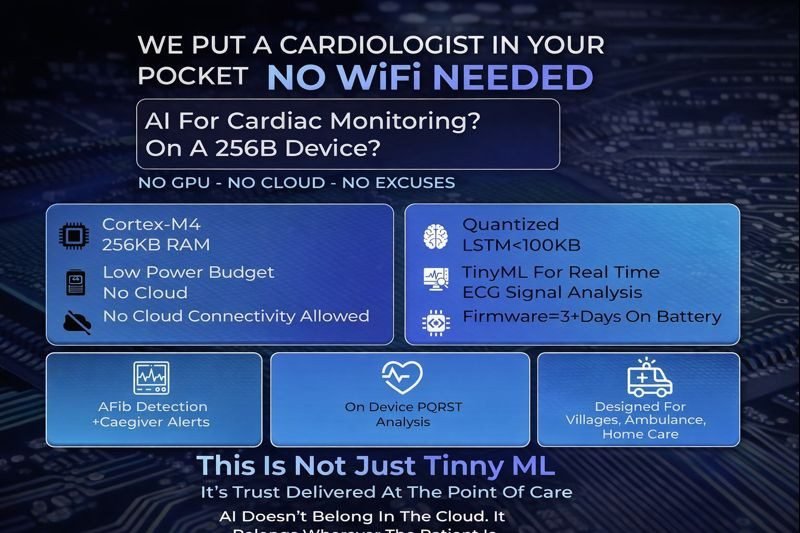
When we began building a portable cardiac monitor, the goal sounded deceptively simple: detect arrhythmias early, at the point of care, without relying on the cloud.
The challenge was far more complex. We were not designing a research prototype or a proof-of-concept demo. This device needed to work reliably in ambulances, remote clinics, home-care environments, and low-connectivity regions, places where latency, power constraints, and environmental noise are unforgiving.
The constraints were clear and uncompromising:
- No GPU, only a Cortex-M4 microcontroller
- Just 256KB of RAM
- Continuous operation for days on battery power
- Zero tolerance for cloud latency or connectivity dependence
This was not a problem we could solve by merely shrinking an AI model. It requires rethinking Medical Device Hardware Design, Firmware Development Services, and machine learning as an integrated system.
Why On-Device Intelligence Matters in Cardiac Care
Cardiac events do not wait for network availability. In many real-world scenarios, such as rural healthcare centers, emergency transport, or home monitoring, cloud connectivity is unreliable or absent. Yet this is often where early detection can make the biggest difference.
Traditional wearable monitors typically record data and upload it later for analysis. That delay is costly. Transient arrhythmias, subtle waveform anomalies, and early AFib indicators can be missed or discovered too late.
Our objective was different: analyze ECG data in real time, directly on the device, and act immediately. That requirement fundamentally shaped every decision we made.
The Hardware Constraints Were Non-Negotiable
From the start, Medical Device Hardware Design dictated the boundaries of what was possible.
We were working with:
- A low-power ARM Cortex-M4 MCU
- Limited SRAM and flash
- Strict thermal and power budgets
- Continuous sensing requirements
There was no room for excess memory usage, inefficient computation, or unpredictable power spikes. Every hardware choice had to support deterministic behavior and long-term reliability.
High-resolution ECG acquisition, clean analog front-end design, and stable power regulation were just as important as the AI model itself. Without pristine signal quality, even the most advanced algorithms would fail. Hardware was not just the foundation; it was the gatekeeper.
TinyML Was a Necessity, not a Trend
Given the constraints, running conventional machine learning pipelines was impossible. But abandoning intelligence entirely was not an option. This is where TinyML became central to the solution.
Rather than asking, “How small can we make this model?” we asked: “How do we redesign intelligence to fit the device?”
This change in perspective drove our entire solution.
Redesigning the Model, Not Just Compressing It
Our original arrhythmia detection model was an LSTM trained on ECG sequences. On a desktop system, it performed well, but it was far too heavy for an embedded environment.
Instead of forcing it onto constrained hardware, we re-engineered the entire pipeline:
- Converted the LSTM into a fully quantized version under 100KB
- Reworked feature extraction to reduce runtime complexity
- Optimized inference paths for fixed-point arithmetic
- Eliminated unnecessary intermediate buffers
Quantization wasn’t just about shrinking size; it ensured predictable execution time and low power draw, both critical for medical devices.
The result was a model that fits comfortably within memory limits while preserving clinically meaningful accuracy.
Signal Processing Was as Important as the Model
One of the most overlooked aspects of embedded AI is preprocessing. Raw ECG signals are noisy. Motion artifacts, electrode variability, and environmental interference can overwhelm naïve models, especially on constrained devices.
We implemented a real-time signal preprocessing pipeline that:
- Filtered noise and baseline wander
- Normalized waveforms dynamically
- Segmented cardiac cycles accurately
All of this ran on the device before the ML model ever saw the data.
This approach allowed the TinyML model to focus on meaningful PQRST morphology rather than waste cycles compensating for noise.
In embedded systems, effective preprocessing often outweighs the cost of model complexity.
Firmware Was the Unsung Hero
None of this would have been possible without disciplined Firmware Development Services. Running a full ML inference pipeline continuously without draining the battery required a firmware architecture designed for efficiency from the ground up.
Key firmware strategies included:
- Event-driven task scheduling instead of polling
- DMA-based data transfers to reduce CPU load
- Aggressive use of low-power sleep modes
- Precise timing control for sensor acquisition
- Memory-safe buffers to prevent fragmentation
The firmware orchestrated sensing, inference, alerts, and communication seamlessly.
In medical devices, firmware is not just glue code. It is the real-time operating backbone that determines safety, responsiveness, and longevity.
Continuous Operation Without Compromising Battery Life
One of the hardest requirements was endurance. The device needed to run continuously for days, not hours, while performing:
- High-frequency ECG sampling
- Real-time signal processing
- Repeated ML inference
Power profiling became a daily discipline. Every function was measured. Every interruption was justified. Every wake-up had a cost.
By combining:
- optimized firmware scheduling
- quantized ML inference
- efficient hardware power management
We achieved multi-day operations without sacrificing detection accuracy. This was not a trade-off; it was a design goal.
Real-Time Decisions at the Point of Care
The final system delivered what we set out to build:
- On-device arrhythmia detection
- AFib identification in real time
- Immediate alerts to caregivers
- Zero cloud dependency
The device analyzes PQRST patterns continuously and makes clinical decisions locally. It does not wait for uploads, servers, or dashboards.
This matters because care happens where patients are, not where infrastructure is convenient.
This Is Not Edge vs Cloud
It is tempting to frame this as a debate between edge and cloud computing. That misses the point. The real question is: Where does intelligence need to live to deliver clinical value?
In many cardiac use cases, the answer is clear: at the point of care.
Cloud platforms still have a role in long-term analytics, population insights, and clinician review. But first-line detection must happen instantly and reliably, even when connectivity fails. Embedded intelligence makes that possible.
What This Means for Medical Device Development
This project reinforced a fundamental lesson: Successful medical devices are not built by optimizing components in isolation. They are built by aligning Medical Device Hardware Design, Firmware Development Services, and intelligent algorithms into a single, cohesive system.
When these disciplines work together:
- Constraints become design drivers
- Efficiency becomes predictable
- Intelligence becomes trustworthy
TinyML is not about doing less; it is about doing the right things, in the right place, with absolute reliability.
Final Thoughts
Portable, intelligent cardiac monitoring represents a shift in how healthcare is delivered. It moves diagnosis closer to the patient, reduces dependency on infrastructure, and enables earlier intervention where it matters most.
At Pinetics, this philosophy guides how we build medical technology. Through deep expertise in Medical Device Hardware Design and Firmware Development Services, we help teams engineer devices that are not only innovative but also practical, efficient, and clinically reliable in real-world environments.
We believe intelligence belongs where care happens, not just where computation is easy. And building that future starts by respecting constraints, engineering deliberately, and designing systems that patients and clinicians can trust.
 Sr. Test Engineer
 Sales Marketing Manager
 Marketing & Sales – BBA : Fresher