
In modern edge computing architectures, the IoT gateway is more than a connectivity device. It acts as the operational brain of distributed systems, orchestrating communication between sensors, embedded devices, and cloud infrastructure. Selecting the right gateway architecture can determine whether an IoT deployment scales smoothly or becomes a long-term engineering bottleneck.
Through real-world implementations across industrial automation, healthcare, and connected infrastructure, one lesson becomes clear: the gateway is mission-critical. It is the control layer, the data filter, and often the first line of security in any connected system.
For organizations investing in IoT Product Development Services, understanding how to evaluate gateway options is essential to building reliable, future-ready edge computing systems.
The Role of the IoT Gateway in Edge Architectures
An IoT gateway sits between edge devices and centralized systems, managing communication, computation, and security. While sensors generate raw data and cloud platforms provide analytics and storage, the gateway determines how data moves between these layers.
In edge computing environments, gateways typically handle:
- Protocol translation (Modbus, CAN, BLE, MQTT, etc.)
- Local data aggregation and filtering
- Real-time processing and decision logic
- Device authentication and encryption
- Over-the-air (OTA) update coordination
- Edge AI inference pipelines
Without a properly designed gateway layer, IoT systems become overly dependent on cloud connectivity, leading to increased latency, higher bandwidth costs, and greater operational risk.
This is where strong Hardware Firmware Development becomes essential. The gateway must be engineered as both a hardware platform and a software-defined system that can evolve.
Off-the-Shelf IoT Gateways: Speed and Simplicity
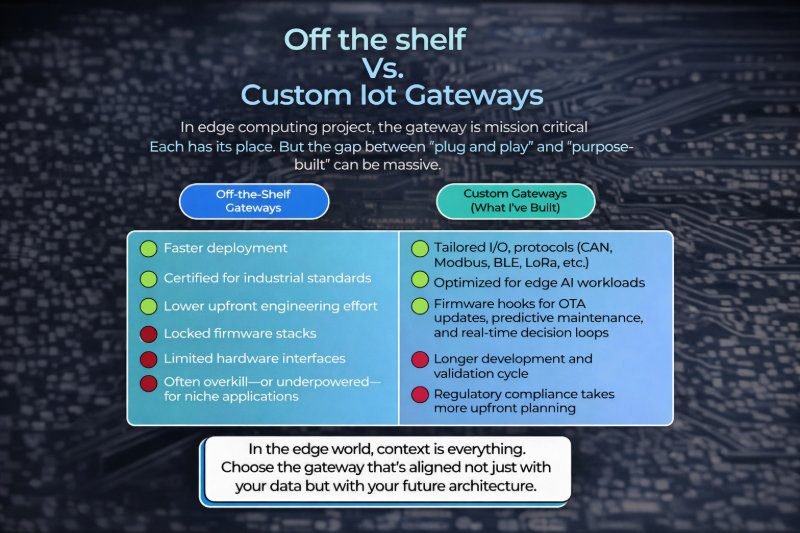
Off-the-shelf (OTS) gateways are often the fastest way to get an IoT deployment started. These pre-built platforms typically include certified wireless modules, industrial I/O interfaces, and standardized operating systems.
Their biggest advantages include:
Faster deployment cycles: OTS gateways allow teams to move from prototype to pilot quickly without designing custom hardware.
Industrial certifications: Many OTS platforms already meet safety and compliance requirements, reducing validation effort.
Lower upfront engineering investment: Hardware design, board validation, and manufacturing setup are already handled.
For early-stage deployments or standard telemetry applications, OTS gateways can be an excellent starting point.
However, they come with limitations. OTS platforms often include fixed hardware interfaces, limited expansion options, and firmware stacks that restrict customization. In some cases, they may be either underpowered for edge AI workloads or unnecessarily complex for simple deployments. Over time, these constraints can slow innovation.
Custom IoT Gateways: Built for Context
Custom gateways are designed around the specific needs of a system rather than forcing the system to adapt to a generic platform. This approach requires more engineering effort upfront but offers significant long-term advantages.
Custom gateways enable:
- Tailored I/O interfaces
- Protocol-specific optimization
- Hardware acceleration for edge workloads
- Controlled firmware architecture
- Scalable OTA infrastructure
In complex IoT deployments, customization allows engineering teams to optimize both performance and power efficiency.
For example, industrial gateways may need to support CAN, Modbus, Ethernet/IP, and BLE simultaneously. Healthcare gateways may require secure data handling and deterministic behavior. Smart infrastructure systems may require ultra-low-power operation. Generic hardware rarely fits all these requirements.
Custom gateway design ensures the architecture aligns with system goals from the beginning.
Firmware Architecture: The Gateway’s Intelligence Layer
Gateway performance is determined as much by firmware as by hardware. Strong Firmware Development Services ensure the gateway operates reliably under real-world conditions.
Gateway firmware typically handles:
- Device communication scheduling
- Buffering and prioritization of data streams
- Encryption and authentication
- OTA update pipelines
- Fault detection and recovery
- Real-time control logic
Unlike sensor firmware, gateway firmware must manage multiple concurrent tasks and communication channels.
This requires careful architecture decisions, such as:
- RTOS vs Linux-based environments
- Containerized edge applications
- Modular communication stacks
- Secure update mechanisms
A poorly designed firmware layer can create latency issues, memory bottlenecks, and security vulnerabilities. A well-designed firmware stack turns the gateway into a scalable edge platform.
Edge AI and Local Decision-Making
Edge computing increasingly involves AI inference running directly on gateways. Instead of transmitting all sensor data to the cloud, gateways can process information locally and send only actionable insights.
This reduces bandwidth consumption, improves response times, and enhances reliability in low-connectivity environments.
Custom gateways often integrate:
- AI-capable processors
- Hardware acceleration modules
- Optimized memory architectures
- Firmware pipelines for model updates
When paired with robust Hardware Firmware Development, gateways can support predictive maintenance, anomaly detection, and automated workflows without relying on the cloud. This local intelligence is becoming a defining characteristic of modern IoT systems.
Security Starts at the Gateway
In distributed IoT systems, gateways often serve as the primary security boundary between field devices and enterprise networks.
Security considerations include:
- Secure boot mechanisms
- Encrypted communication channels
- Certificate-based authentication
- Device identity management
- Intrusion detection
Because gateways aggregate data from multiple devices, they become high-value targets for attackers.
Security must therefore be embedded into both hardware and firmware design, not added later. This is another reason custom gateways often outperform generic solutions in mission-critical environments.
Power, Reliability, and Environmental Constraints
IoT gateways frequently operate in industrial or remote environments where reliability is essential.
Design considerations include:
- Thermal management
- Vibration tolerance
- Power redundancy
- EMI/EMC resilience
- Long-term component availability
Gateway reliability depends heavily on integrated engineering decisions across hardware and firmware layers.
This integration is a key focus area for teams delivering IoT Product Development Services, where scalability and lifecycle management are critical.
When to Choose OTS vs Custom Gateways
Both approaches have valid use cases.
OTS gateways are ideal when:
- Rapid prototyping is required
- Applications use standard protocols
- Workloads are predictable
- Customization needs are minimal
Custom gateways are better when:
- Deployments involve complex protocols
- Edge AI processing is required
- Hardware integration is unique
- Long-term scalability is a priority
- Security requirements are strict
The right decision depends on system architecture, not just immediate development speed. Choosing a gateway should always reflect the product’s future direction.
Designing Gateways for the Future
Edge computing continues to evolve as IoT deployments grow in scale and intelligence. Gateways are becoming distributed with computing nodes rather than simple communication bridges.
Future gateways will increasingly support:
- Autonomous edge decision-making
- AI model lifecycle management
- Secure distributed architectures
- Predictive maintenance frameworks
- Real-time industrial control integration
As this evolution continues, the importance of coordinated hardware and firmware engineering will only increase.
Gateways must be designed not just for current workloads, but for future system complexity.
Final Thoughts
Selecting the right IoT gateway is not simply a hardware decision; it is an architectural decision that affects performance, scalability, and security across the entire system’s lifecycle.
Whether choosing an off-the-shelf platform for rapid deployment or building a custom gateway for long-term innovation, success depends on aligning hardware capabilities with firmware intelligence and system requirements.
At Pinetics, we help organizations design scalable edge architectures through advanced IoT Product Development Services, Firmware Development Services, and Hardware Firmware Development. By engineering gateways that combine reliability, security, and adaptability, we enable connected systems to perform where they matter most at the edge. In edge computing, the gateway is not just a bridge. It is the foundation of intelligent, distributed systems.