
In modern healthcare technology, portability is no longer a luxury; it is an expectation. From wearable cardiac monitors to portable diagnostic equipment and home-care devices, medical innovation is moving closer to the patient than ever before. But behind every portable medical device lies a constraint that determines whether the product succeeds or fails in power.
No matter how advanced the sensing technology, connectivity stack, or clinical algorithms may be, a device that cannot maintain reliable power operation cannot fulfill its clinical mission. In medical environments, battery life is not just a convenience metric; it is directly tied to patient safety, reliability, and regulatory compliance.
This is where thoughtful Medical Device Hardware Design, intelligent firmware architecture, and disciplined Hardware Firmware Development converge to define product success.
Why Power Optimization Matters in MedTech
Unlike consumer electronics, medical devices operate under strict reliability and safety expectations. A smartwatch running out of battery is inconvenient. A portable cardiac monitor shutting down during a patient’s episode is unacceptable.
Battery-powered medical devices must balance multiple competing requirements:
- Continuous sensing and monitoring
- Wireless communication
- Real-time processing
- Safety diagnostics
- Regulatory compliance
- Long operational lifetime
Power optimization, therefore, becomes a system-level engineering discipline rather than a single hardware decision.
In portable medical systems, every milliamp matters.
Designing for Power from Day One
One of the most common mistakes in device development is treating power optimization as a late-stage firmware task. Power efficiency must be engineered into architecture from the beginning.
Effective Medical Device Hardware Design considers:
- Processor selection
- Analog front-end efficiency
- Power regulation topology
- Battery chemistry and capacity
- Component sleep characteristics
- Communication module consumption
These decisions shape the power profile long before firmware is written.
When hardware and firmware teams collaborate early through structured Hardware Firmware Development, systems achieve significantly better runtime and reliability.
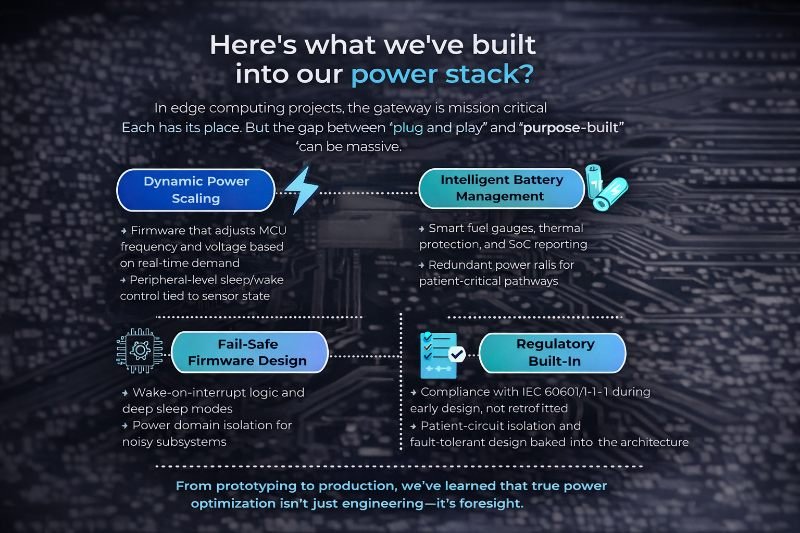
Dynamic Power Scaling in Medical Devices
Modern embedded processors support multiple power states, allowing devices to dynamically adjust performance based on workload.
Dynamic power scaling enables:
- Reduced clock frequency during idle periods
- Adaptive voltage scaling
- Selective peripheral activation
- Workload-based processing bursts
This approach ensures that the processor only consumes energy when necessary.
Through advanced Firmware Development Services, devices can monitor sensor activity and automatically adjust power states in real time. For example, a wearable device may operate in low-power monitoring mode most of the time, switching to high-performance processing only when abnormal signals are detected.
This balance between responsiveness and efficiency is essential in medical applications.
Intelligent Battery Management Systems
Battery management is another critical element of power optimization in portable medical devices.
Modern systems integrate:
- Smart fuel-gauge ICs
- Thermal monitoring circuits
- Redundant protection mechanisms
- State-of-charge estimation algorithms
- Battery health monitoring
These features allow devices to operate safely while providing accurate runtime predictions.
In patient-critical systems, redundant power pathways may be implemented to ensure that essential functions continue operating even during partial power failures. Battery management is not just about extending runtime; it is about ensuring predictable and safe operation.
Firmware’s Role in Power Efficiency
Firmware architecture has a profound impact on energy consumption.
Inefficient firmware often causes:
- Unnecessary CPU wake cycles
- Continuous polling loops
- Poorly managed communication stacks
- Excessive memory operations
- Improper sleep state transitions
These inefficiencies accumulate over time, draining batteries faster than expected.
Professional Firmware Development Services focus on designing event-driven firmware architectures that minimize processor activity while maintaining responsiveness.
Examples include:
- Interrupt-based sensor handling
- DMA-driven data transfers
- Low-power RTOS scheduling
- Deep sleep state orchestration
- Wake-on-interrupt logic
When implemented correctly, these techniques can dramatically extend battery life without sacrificing performance.
Power Domain Isolation and Noise Control
Medical devices often contain both sensitive analog circuits and high-noise digital subsystems. Without proper power domain isolation, these systems can interfere with each other.
Power-aware Medical Device Hardware Design ensures:
- Separation of analog and digital power rails
- Filtering of switching regulators
- Isolation of communication modules
- Stable reference voltages for sensing circuits
This improves both signal quality and energy efficiency.
Isolating power domains also allows certain subsystems to shut down independently when not in use.
Regulatory Considerations in Power Design
Power architecture in medical devices must comply with international safety standards such as IEC 60601-1 and IEC 60601-1-11.
These standards address:
- Electrical safety
- Patient isolation
- Leakage current limits
- Fault tolerance
- Thermal protection
Regulatory compliance influences hardware layout, component selection, and firmware behavior.
When regulatory requirements are incorporated early in Hardware Firmware Development, devices avoid costly redesign cycles later in development. Compliance and efficiency must evolve together.
Power Optimization Enables True Portability
Portable medical devices must operate reliably in diverse environments:
- Home healthcare
- Ambulances
- Rural clinics
- Remote monitoring setups
- Emergency response scenarios
In many of these environments, charging opportunities are limited, and connectivity may be unreliable.
Power optimization ensures devices remain operational when they are needed most. Longer battery life also improves patient experience, reducing the need for frequent charging and maintenance.
The Connection Between Power and Trust
In healthcare technology, reliability builds trust. Clinicians trust devices that operate consistently. Patients trust devices that remain available. Regulators trust devices that demonstrate predictable performance. Power optimization contributes directly to all three.
A well-engineered power architecture ensures:
- Predictable device runtime
- Stable sensing performance
- Reduced thermal stress
- Longer product lifespan
- Improved safety margins
This reliability transforms engineering decisions into clinical confidence.
Lessons from Real-World Development
Across global projects involving portable and patient-facing medical devices, one consistent insight emerges: true power optimization is not about reducing consumption alone; it is about designing resilience.
Effective systems combine:
- Hardware-level efficiency
- Firmware-level intelligence
- Battery-level safety
- Regulatory-level compliance
When these layers work together, portable medical devices become dependable tools rather than fragile electronics.
Power optimization becomes a design philosophy rather than a feature.
Final Thoughts
As medical technology continues moving toward portability, remote monitoring, and home-based care, power optimization will play an increasingly central role in device development.
Battery-powered medical systems must balance performance, safety, and longevity while meeting strict regulatory requirements.
At Pinetics, we help healthcare innovators build reliable, portable devices through advanced Medical Device Hardware Design, robust Firmware Development Services, and integrated Hardware-Firmware Development practices. By engineering power-aware architectures from concept to production, we enable medical devices to operate longer, safer, and with greater confidence.
In MedTech, power is not just about consumption. It is about trust, reliability, and readiness when it matters most.