
In medical device engineering, electromagnetic interference (EMI) and electromagnetic compatibility (EMC) are often misunderstood as certification requirements that appear late in development. EMI/EMC considerations are fundamental to device reliability and patient safety.
When electronic medical systems fail due to interference, the consequences are not just technical; they can be clinical. A monitoring device displaying inaccurate readings, a wearable losing signal integrity, or a therapy device experiencing communication disruption can directly impact patient outcomes.
That is why EMI/EMC readiness must be treated as a core principle of Medical Device Hardware Design, not a compliance checkbox at the end of development.
Why EMI/EMC Matters More in MedTech
Medical devices operate in electrically complex environments. Hospitals and clinical settings are filled with electronic equipment: imaging systems, infusion pumps, ventilators, wireless networks, and mobile devices. Each of these can introduce electromagnetic disturbances.
At the same time, medical devices themselves generate electromagnetic emissions through switching regulators, wireless modules, microcontrollers, and high-speed digital interfaces.
The challenge is twofold:
- Devices must not emit interference that affects other systems.
- Devices must remain immune to external interference.
This balance defines electromagnetic compatibility.
In Medical Device Hardware Design, achieving this balance is essential for regulatory approval and safe clinical operation.
The Cost of Treating EMI/EMC Too Late
Many engineering teams focus on functionality first and electromagnetic performance later. This approach often leads to expensive redesign cycles.
Late-stage EMI/EMC failures typically result in:
- PCB layout changes
- Shielding redesign
- Component replacement
- Filtering adjustments
- Enclosure modifications
- Repeated compliance testing
These changes are not only costly but also delay product timelines.
When EMI/EMC design is integrated early, most of these risks disappear. Preventive engineering is far more efficient than corrective engineering.
Grounding and Shielding Strategy
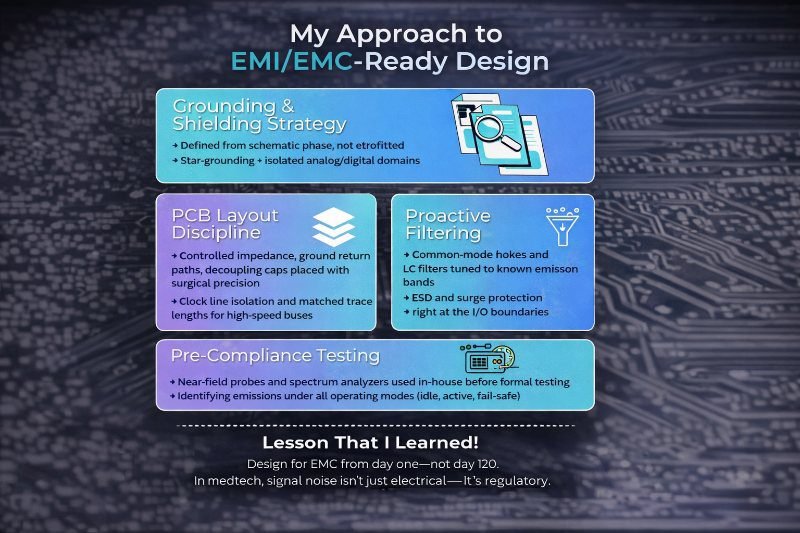
One of the most critical aspects of EMI/EMC performance is grounding architecture. Effective Medical Device Hardware Design defines grounding strategy during schematic design, not after PCB layout.
Common best practices include:
- Separating analog and digital grounds
- Implementing star-ground configurations
- Minimizing ground loops
- Ensuring consistent return current paths
- Using shielding where necessary
Sensitive analog front ends, especially those used in ECG, EEG, or bio signal acquisition systems, require careful isolation from noisy digital circuits.
Shielding strategies must also be planned early to ensure enclosure design supports electromagnetic containment.
PCB Layout Discipline
PCB layout plays a decisive role in EMI/EMC performance. Even well-designed schematics can fail compliance testing if layout discipline is ignored.
Critical layout practices include:
- Maintaining continuous ground planes
- Placing decoupling capacitors close to IC power pins
- Controlling impedance on high-speed traces
- Minimizing loop areas in power paths
- Isolating clock lines
- Managing the return current flow
In Medical Device Hardware Design, layout is not just mechanical placement; it is electromagnetic engineering.
High-speed interfaces such as USB, SPI, and display buses require controlled routing to prevent radiated emissions and signal-integrity issues.
Filtering and Protection at Interfaces
External interfaces are common entry points for electromagnetic disturbances. Proactive filtering reduces both emissions and susceptibility.
Typical techniques include:
- Common-mode chokes on communication lines
- LC filters power inputs
- Transient voltage suppression devices
- ESD protection circuits
- Ferrite beads on supply rails
Placing protection components directly at I/O boundaries ensures disturbances are contained before reaching sensitive circuitry.
This strategy improves device robustness and simplifies compliance testing.
Power Supply Noise Management
Switching power supplies are often the largest source of electromagnetic emissions in medical devices.
Effective Medical Device Hardware Design must address:
- Switching frequency selection
- Proper grounding of regulators
- Input and output filtering
- Shielding of high-current loops
- Minimizing trace inductance
Power supply layout requires careful attention to current paths and component placement.
Noise generated in the power domain can easily propagate into signal acquisition circuits if isolation is not maintained.
Pre-Compliance Testing Saves Time
Pre-compliance testing is one of the most valuable practices in EMI/EMC engineering.
Instead of waiting for formal certification testing, teams can use:
- Near-field probes
- Spectrum analyzers
- Conducted emission test setups
- Immunity testing tools
These allow engineers to identify emissions early and correct them before final validation.
Testing devices in multiple operating modes, idle, active, wireless transmission, and fault states, provides a realistic view of electromagnetic performance. This approach dramatically reduces certification risk.
EMI/EMC and Patient Safety
Electromagnetic interference can affect sensor accuracy, communication reliability, and the operation of control systems.
For example:
- Noise can distort bio signal acquisition
- Interference can disrupt wireless telemetry
- Voltage spikes can damage sensitive components
- Unstable communication can interrupt therapy delivery
In medical environments, these risks translate directly into safety concerns.
This is why EMI/EMC standards for medical devices are more stringent than those for consumer electronics. Engineering teams must design systems that remain stable even in noisy electromagnetic environments.
Regulatory Expectations
Medical device regulations require compliance with international EMC standards, including IEC 60601-1-2.
These standards evaluate:
- Radiated emissions
- Conducted emissions
- Electrostatic discharge immunity
- Radiated immunity
- Electrical fast transients
- Surge immunity
Passing these tests requires deliberate design choices, not last-minute fixes.
When EMI/EMC planning is integrated into Medical Device Hardware Design, regulatory approval becomes smoother and more predictable.
Designing for Reliability, Not Just Compliance
The ultimate goal of EMI/EMC design is not certification; it is reliability.
Devices must perform consistently across:
- Hospitals
- Ambulances
- Home-care environments
- Rural clinics
- Industrial medical settings
Each environment presents different electromagnetic challenges.
Engineering for EMC resilience ensures devices remain dependable regardless of where they are used.
Lessons Learned from Real Projects
Across multiple medical device programs, one lesson stands out clearly: EMI/EMC success begins with architecture, not testing.
The most successful designs:
- Define grounding strategy early
- Maintain strict PCB layout discipline
- Isolate analog and digital systems
- Filter external interfaces
- Perform pre-compliance testing
- Consider electromagnetic behavior during system architecture
When these practices are followed, compliance testing becomes confirmation rather than discovery.
Final Thoughts
EMI/EMC engineering is often invisible when done correctly. Devices simply work reliably, safely, and predictably. But achieving that reliability requires deliberate planning throughout development.
At Pinetics, we integrate EMI/EMC readiness into every stage of Medical Device Hardware Design, ensuring devices meet regulatory requirements while maintaining signal integrity and operational stability. By designing electromagnetic compatibility from the start, we help medical innovators avoid costly redesigns and deliver products that perform safely in real-world environments.
In MedTech, EMI/EMC design is more than an engineering discipline. It is a safety net that protects patients, clinicians, and the technology they depend on.