Author name: Alankar Dhobale

Alankar Dhobale is Co-Founder and Global CTO at Pinetics, with 21+ years in embedded firmware and medical electronics. He holds a BE in Electronics from Shivaji University. His work spans firmware architecture, RTOS and bare-metal design, low-power optimisation, OTA update systems, and IEC 62304 software lifecycle compliance for medical devices.

Cardiac Monitor with TinyML

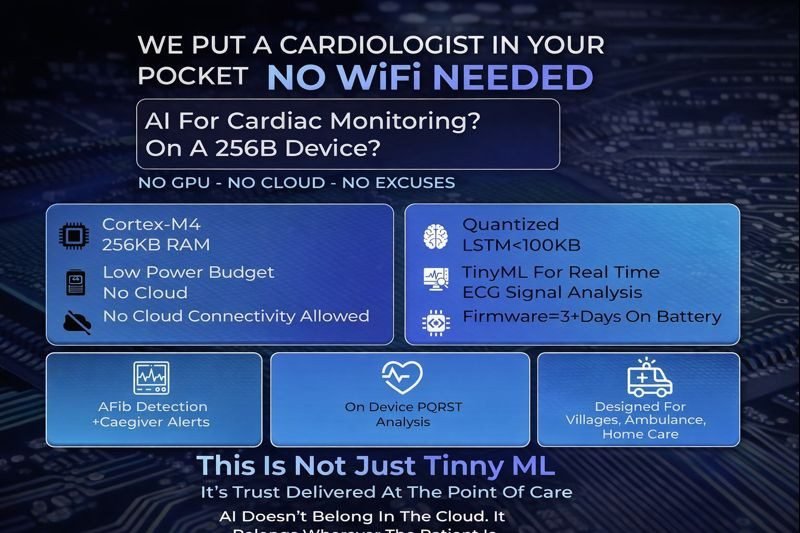
How We Built a Portable Cardiac Monitor with TinyML

When we began building a portable cardiac monitor, the goal sounded deceptively simple: detect arrhythmias early, at the point of care, without relying on the cloud. The challenge was far more complex. We were not designing a research prototype or a proof-of-concept demo. This device needed to work reliably in ambulances, remote clinics, home-care environments, and […]

How We Built a Portable Cardiac Monitor with TinyML Read More »
Medical Implants Become Intelligent Companions

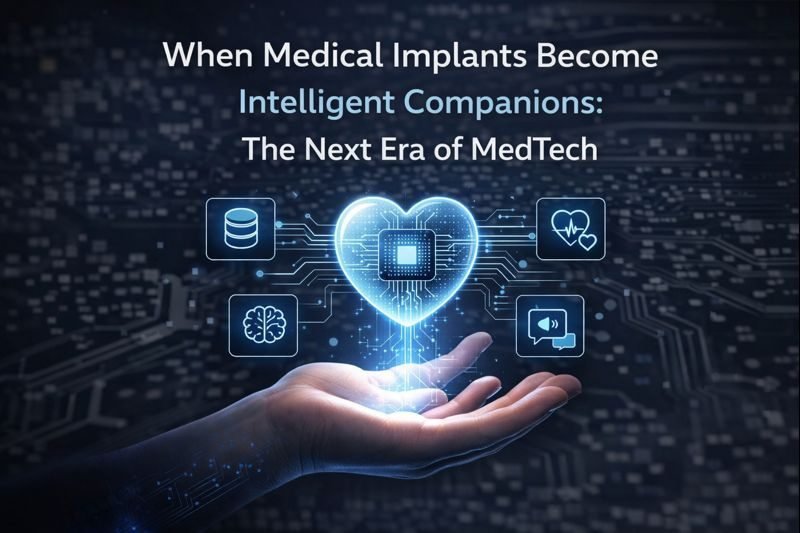
When Medical Implants Become Intelligent Companions

What if your pacemaker understood you better than your cardiologist? Not in a dystopian, surveillance-driven way but in a deeply clinical, human-centred sense. Imagine a device that recognizes subtle physiological patterns unique to you. It notices how your heart rate changes during stress, sleep, or emotional strain. It adapts to therapy in real time, not based on population

When Medical Implants Become Intelligent Companions Read More »

Firmware Optimization

Firmware Optimization Is a Critical Safety Factor in Medical Devices

We’ve reviewed and optimized firmware for dozens of medical devices over the years, devices where milliseconds matter, power efficiency determines usability, and uptime can directly affect patient outcomes. A recurring issue I encounter is firmware that functions but is dangerously inefficient. In medical technology, “working” does not mean “safe,” “reliable,” or “clinically trustworthy.” Poorly optimized firmware may pass basic validation. Yet

Firmware Optimization Is a Critical Safety Factor in Medical Devices Read More »

Medical Device

Why Does Embedded Systems Excellence Drive Medical Device Innovation?

Embedded systems excellence drives medical device innovation because every modern medical device is a tightly integrated hardware and firmware system, and the device is only as reliable, safe and approvable as that integration. Embedded systems excellence in medical device innovation means the hardware, the firmware, the safety case and the compliance evidence are designed together

Why Does Embedded Systems Excellence Drive Medical Device Innovation? Read More »

Embedded Systems

Why C++ Isn’t Always the Best Choice for Embedded Systems

C++ gives software engineers power, but in embedded systems, power without restraint is often a liability. On a recent firmware project, our team made what seemed like the obvious decision: we chose C++. The reasoning was sound. C++ offers cleaner syntax, strong modularity, object-oriented design, and modern tooling. For complex systems, it provides structure and scalability, qualities every

Why C++ Isn’t Always the Best Choice for Embedded Systems Read More »

Automotive Electronics

Why Efficiency in Automotive Electronics Is No Longer Optional

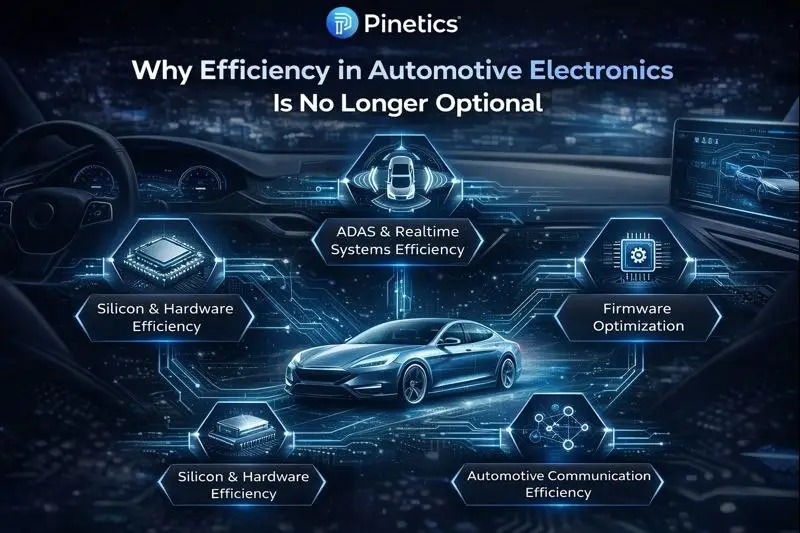
Modern vehicles are no longer defined solely by mechanical engineering. Today cars are real-time computing ecosystems on wheels, powered by millions of lines of code, dozens of electronic control units (ECUs), high-speed networks, and complex software stacks. Advanced Driver Assistance Systems (ADAS), infotainment platforms, battery management systems, vehicle-to-everything (V2X) communication, and autonomous features all operate simultaneously, often under strict real-time

Why Efficiency in Automotive Electronics Is No Longer Optional Read More »

Reducing Embedded Boot Time

How Do You Reduce Boot Time on an Embedded Linux Device?

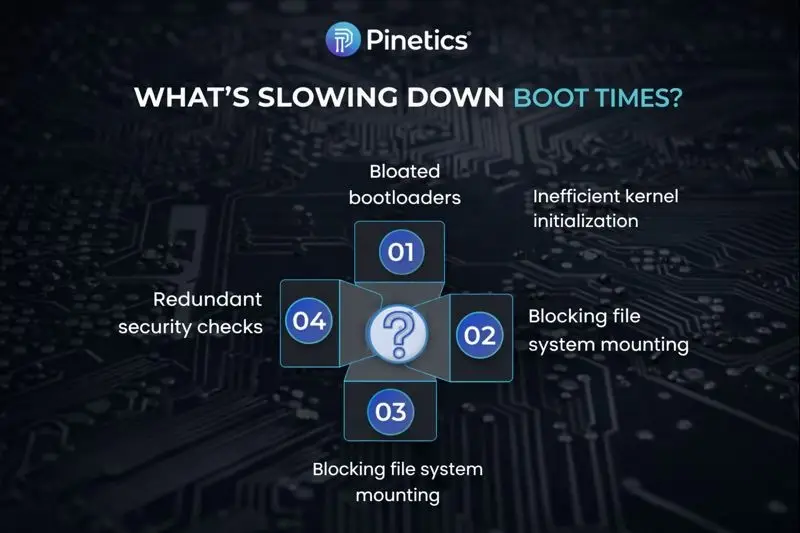
Reducing embedded boot time on a Linux device starts with timing every boot stage, then removing what the product never uses from the bootloader, kernel and startup sequence. Most hidden startup delays sit in configuration, not hardware: drivers probed for absent peripherals, services started before anything needs them, a file system mounted before the application

How Do You Reduce Boot Time on an Embedded Linux Device? Read More »

(MedTech) Medical Device Hardware Design

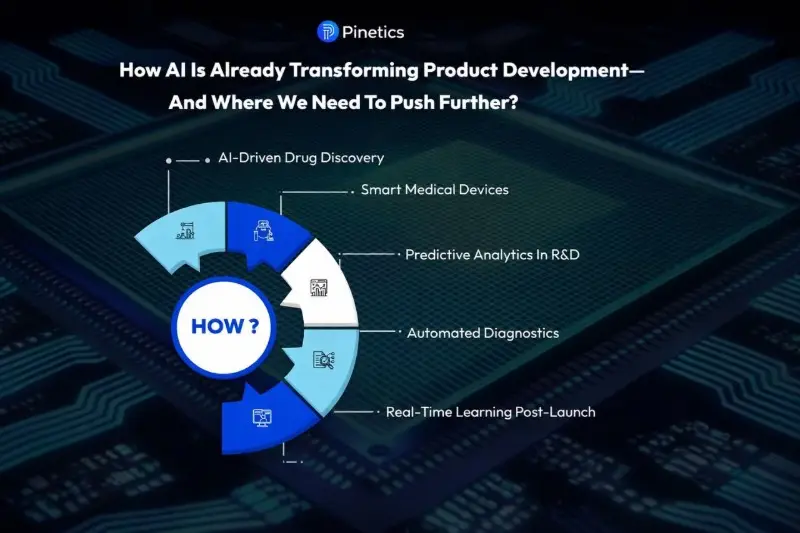
How AI is Transforming Product Development in MedTech

Artificial Intelligence is often described as a game-changer for healthcare and medical technology. Yet in practice, many organizations are still experimenting on the margins. PoCs are launched, pilot programs are explored, and innovation labs publish concept demos, but AI is rarely embedded across the entire product lifecycle.  That hesitation is a missed opportunity.  In MedTech, the stakes are uniquely high.

How AI is Transforming Product Development in MedTech Read More »

IoT Communication

Securing IoT Communication for Trustworthy Connected Products

The adoption of IoT technologies has accelerated across industries such as healthcare, industrial automation, automotive electronics, and smart infrastructure. Connected devices now play a direct role in decision-making, automation, and real-time monitoring. However, as IoT systems become more pervasive, they also become more exposed to security threats.  In many IoT deployments, communication channels remain the weakest link.

Securing IoT Communication for Trustworthy Connected Products Read More »

Firmware Rework

The Hidden Cost of Firmware Rework

Firmware is often treated like a one-time effort; code it, flash it, ship it. But in today’s fast-paced product cycles, that mindset is becoming a liability. In fact, nearly 30% of hardware project delays are now attributed to firmware issues, according to a report by Embedded Market Forecasters. As hardware evolves rapidly with new sensors, connectivity standards, and compliance

The Hidden Cost of Firmware Rework Read More »