
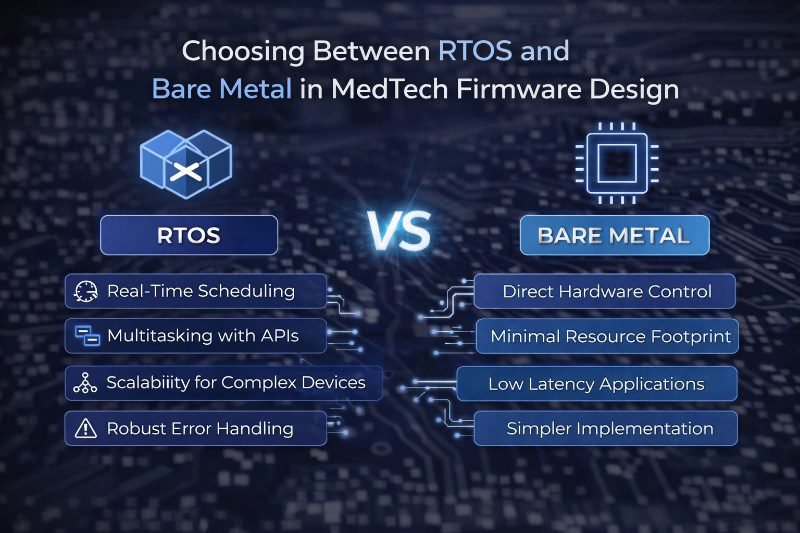
The most significant decision in medical device firmware is made before the application code: RTOS or bare metal?
RTOS or bare metal?
On the surface, this choice is often framed as a technical preference or performance trade-off. Especially for Class II and Class III medical devices, it is neither. It is a risk-alignment decision.
Your architecture shapes how firmware is judged, validated, and how you prove patient safety in worst-case scenarios. In MedTech, architecture is evidence.
Why This Decision Matters More in Medical Devices
Unlike consumer electronics, medical devices face strict regulatory scrutiny. Each design choice must be justified, documented, and traced to risk mitigation.
From a Medical Device Hardware Design perspective, firmware is not an isolated software layer. It directly governs how hardware behaves in normal operation, fault conditions, and edge cases.
Whether you use an RTOS or bare metal fundamentally impacts:
- Determinism and timing guarantees
- Fault isolation behavior
- Memory usage and stack control
- Audit complexity
- Long-term maintainability
This is why the RTOS vs. bare-metal decision cannot be based on convenience or familiarity.
Why RTOS Feels Like the “Professional” Choice
On paper, an RTOS appears to be the mature and scalable option.
It offers:
- Structured task scheduling
- Modular separation of concerns
- Cleaner code organization
- Support for growing system complexity
For many engineering teams, especially those coming from complex embedded or IoT backgrounds, an RTOS feels like a natural choice.
And in many systems, it is. But MedTech introduces constraints that fundamentally change the calculus.
The Hidden Costs of RTOS in Regulated Systems
In practice, RTOS-based designs often introduce risks that are easy to underestimate during early development.
1) Non-Deterministic Latencies
Context switching is not free. In Class II and Class III devices, even small scheduling jitter can become a problem when:
- Handling safety-critical interrupts
- Servicing time-sensitive control loops
- Reacting to fault conditions
Proving worst-case execution time (WCET) becomes significantly more complex when task preemption and priority inversion are involved.
2) Memory and Stack Overhead
RTOS systems require:
- Per-task stacks
- Scheduler data structures
- Synchronization primitives
On memory-constrained MCUs, this can lead to:
- Stack bloat
- Fragmented memory usage
- Harder-to-predict failure modes
From a Hardware Firmware Development standpoint, uncontrolled memory growth is a serious safety risk.
3) Audit and Validation Complexity
Regulators do not just review your application code; they review the entire execution environment.
When using an RTOS, you must:
- Justify scheduler behavior
- Validate OS configuration
- Document task interactions
- Prove that timing guarantees are held under all conditions.
This increases the scope of documentation and the audit surface area. RTOS can accelerate development, but it can also slow down approvals.
The Case for Bare Metal in High-Criticality Systems
Bare metal firmware offers something invaluable in MedTech:
Absolute predictability.
With bare metal:
- You control every interruption.
- You define every scheduling decision.
- You know exactly when and why code executes.
No scheduler can be blamed; only your logic is responsible.
This level of control is particularly valuable when:
- Real-time constraints are hard, not soft.
- Failure modes must be tightly bound.
- System behavior must be explained line by line.
In safety-critical firmware, simplicity is often a strength.
But Bare Metal Comes with Responsibility
Bare metal is not easier; it is more accountable.
When you choose bare metal, you own:
- Task sequencing
- Timing guarantees
- Fault isolation strategies
- Watchdog recovery logic
- CPU budgeting
There is no abstraction layer to shield design errors.
From a Firmware Development Services perspective, this demands a high level of engineering discipline and documentation rigor.
Bare metal fails loudly if misdesigned but succeeds well when crafted right.
The Questions That Should Drive the Decision
Instead of asking “RTOS or bare metal?”, MedTech teams should ask deeper questions.
Are Your Real-Time Constraints Hard or Soft?
If missing a deadline can cause harm, predictability matters more than modularity.
Can You Prove Worst-Case Execution Time?
Regulators will not accept average-case behavior.
How Does Your Watchdog Recover?
A reset is not a mitigation if it creates new hazards.
Will Your Logs Survive an Audit?
Can you trace faults, timing, and state transitions clearly?
Does Complexity Scale or Risk Scale?
More tasks do not always mean better architecture. These questions connect firmware architecture directly to safety and compliance.
RTOS Shines When Complexity Scales
RTOS-based designs excel when:
- Multiple independent subsystems must run concurrently.
- Communication stacks, UI, and networking coexist.
- Feature growth is expected over time.
- Hardware resources are sufficient.
In such cases, an RTOS can reduce development friction when carefully configured and documented.
The mistake is assuming that RTOS equals safety. It does not. Safety comes from how the RTOS is used and controlled.
Bare Metal Wins When Predictability Is King
Bare metal architectures excel when:
- Timing determinism is critical.
- The system scope is well defined.
- Hardware resources are limited.
- Regulatory simplicity is a priority.
In many Class II and III devices, the predictability and transparency of bare metal significantly simplify risk analysis and validation.
Less abstraction often means fewer unknowns, and fewer unknowns mean fewer regulatory surprises.
Architecture Is a Regulatory Artifact
One of the most important mindset shifts in MedTech firmware design is this:
Architecture is not just technical; it is regulatory evidence.
Every design decision must support:
- The safety case
- The risk management file
- The design history file (DHF)
- Verification and validation plans
Whether you choose RTOS or bare metal, regulators will ask:
- Why were this architecture chosen?
- How does it mitigate risk?
- How is behavior controlled under failure?
If you can’t answer these questions, the architecture won’t pass review.
There Is No Universal “Right” Choice
RTOS and bare metal are tools, not solutions. Choosing between them without defining the safety case first is backward.
In MedTech:
- Safety defines architecture
- Architecture defines implementation
- Implementation defines compliance
Get the order wrong, and rework is inevitable.
Final Thoughts
In medical device development, firmware architecture is not a performance optimization; it is a patient’s safety and regulatory decision.
RTOS shines when complexity must scale, and resources allow careful control.
Bare metal wins when predictability, simplicity, and auditability are paramount.
At Pinetics, we help teams make this decision deliberately. With deep expertise in Medical Device Hardware Design, Firmware Development Services, and Hardware-Firmware Development, we align firmware architecture with safety cases, regulatory expectations, and real-world clinical use.
We do not start with tools. We start with risk, evidence, and patient impact. In MedTech, the right architecture isn’t the one that feels modern; it’s the one that can be defended, validated, and trusted when it matters most.
 Sr. Test Engineer
 Sales Marketing Manager
 Marketing & Sales – BBA : Fresher